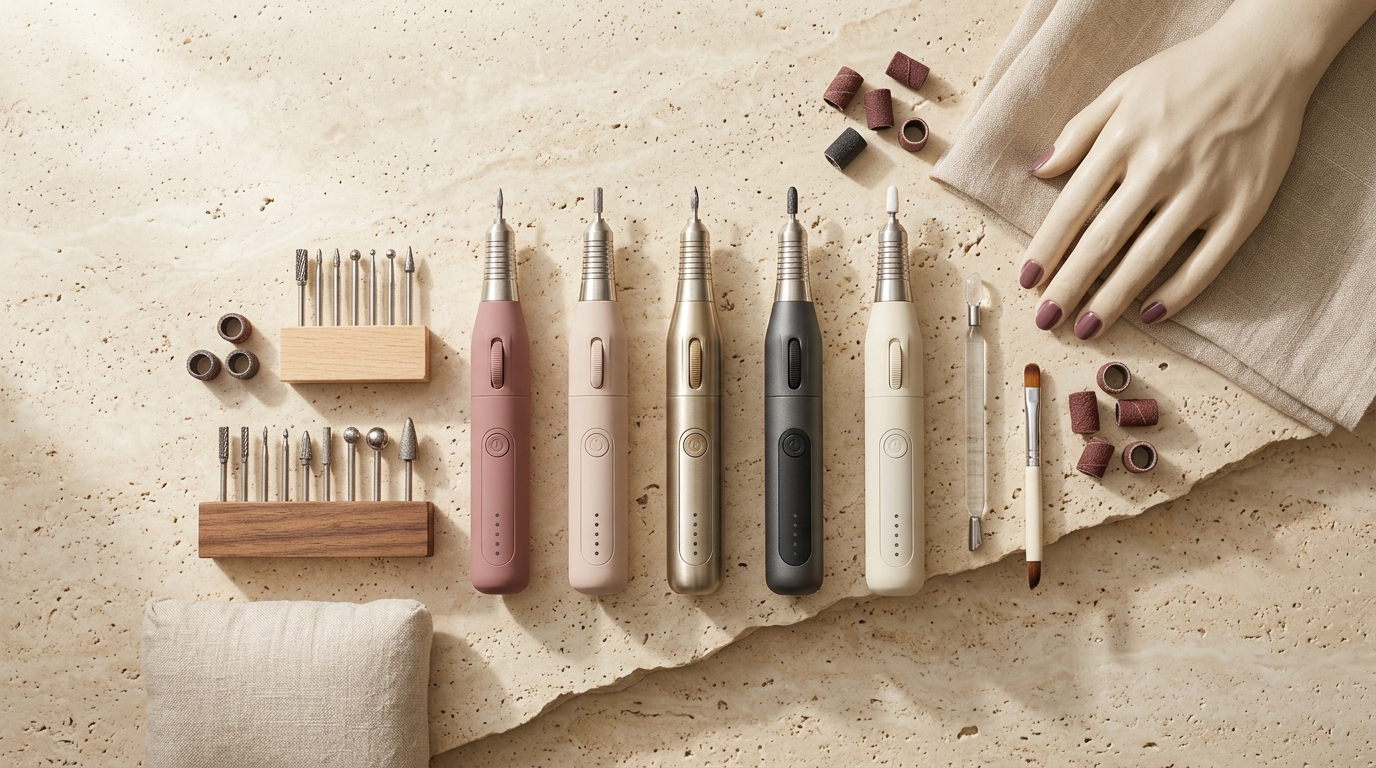
A cordless nail drill should make a manicure feel more controlled—not turn your desk into a cloud of dust and regret. We compared the most useful models in Prizm Nail Hub’s current catalog by speed control, portability, kit quality, beginner usability, value, and listing clarity. The result is a shortlist built around how people actually do nails at home.
Last checked: July 17, 2026. Prices and availability can change. This is a specification-led editorial comparison, not a hands-on lab test. Scores reflect published features, kit contents, current pricing, and our editorial judgment about fit and value.
Our cordless nail drill picks at a glance
| Pick | Best for | Published top speed | Current price | What stands out | Main trade-off | Score |
|---|---|---|---|---|---|---|
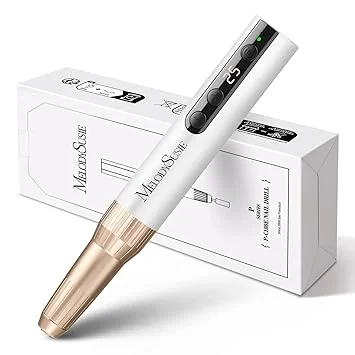
| MelodySusie PC180EBest overall | DIY gel manicures | 25,000 RPM | Check latest price | Portable pen format; approachable speed ceiling | Not our first choice for constant bulk acrylic removal | 8.7/10 |
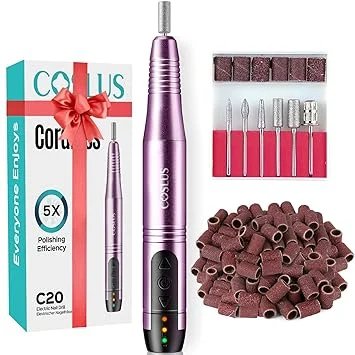
| COSLUS C20Best budget | Beginners and light upkeep | Adjustable; maximum not clearly stated | $19.99 | 3.2-ounce body; six bits; use-while-charging support | Missing top-speed detail makes power comparison harder | 8.2/10 |
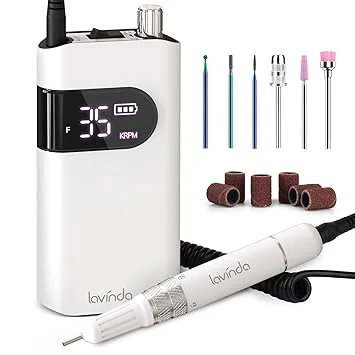
| Lavinda 35KBest step-up | Frequent gel/acrylic removal | 35,000 RPM | $71.99 | Coreless motor claim; safety monitoring; 3/32-inch bits | Costs considerably more | 8.5/10 |
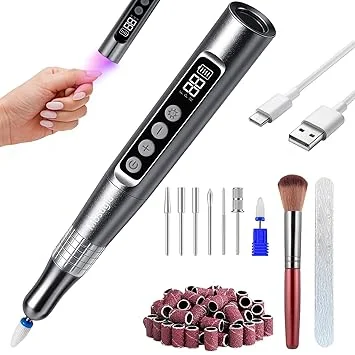
| Mosugia 2-in-1Most versatile | Travel and compact setups | 35,000 RPM | $23.99 | Built-in curing light; seven bits; stated 5-hour runtime | Combo design is less proven than separate tools | 7.8/10 |
Price and availability reflect the catalog snapshot when checked. “Check latest price” means the current Amazon response did not provide a display price.
How we scored these drills
More RPM does not automatically make a drill better. For most at-home manicures, predictable control matters more than a dramatic maximum-speed claim. A beginner removing gel close to the natural nail needs a machine that is easy to hold, easy to slow down, and easy to reverse. Someone debulking acrylic every week has a different brief: sustained power, a standard bit size, and a handpiece that does not feel like a toy.
Our score weights control and speed range at 25 percent, portability and battery design at 20 percent, included-bit utility at 15 percent, beginner usability at 15 percent, value at 15 percent, and support/listing clarity at 10 percent. We score only what can be supported by the published listing and current catalog data. We do not award phantom points for “salon quality,” and we do not treat a manufacturer’s low-noise claim as a measured decibel result.
Editorial score, out of 10
Prizm Nail Hub editorial analysis. Scores are not laboratory performance measurements.
Best overall: MelodySusie PC180E
The PC180E lands in the sweet spot that too many nail-tool roundups ignore. Its 25,000-RPM maximum is enough on paper for routine gel removal, shaping enhancements, cleaning product from the underside, and refining a manicure—without selling a first-time user on power they may never need. The pen-shaped cordless body is the point. There is no separate control box sliding around the table, and no cable tugging at your wrist while you work around a sidewall.
MelodySusie is also a recognizable name in the home e-file category, which matters less as a status symbol than as a practical buying signal. Replacement accessories and basic how-to information are easier to find than they are for a completely anonymous model. We would choose this for the person who does structured gel, Gel-X maintenance, or regular soak-off manicures and wants one compact tool that can grow with their technique.
Why we like it
- Sensible balance of speed and approachability
- Pen format reduces desk clutter
- Good fit for routine gel work
- Established consumer nail-tool brand
Know before buying
- A 25K ceiling is not aimed at nonstop salon acrylic removal
- Cordless convenience never replaces good bit control
- Beginners should still start at low speed
Our verdict: This is the model we would point most DIY users toward first. It is not trying to win a spec-sheet arms race; it is trying to be useful.
Best budget: COSLUS C20
At $19.99 when checked, the COSLUS C20 makes the strongest case for someone who wants to learn without turning the purchase into a major commitment. The published dimensions put it at 3.2 ounces, and the kit includes six bits plus sanding bands. Forward and reverse controls make it usable in either hand, while the ability to operate during charging is genuinely practical if you forget to top it up before a removal session.
The catch is listing clarity. The product copy promises adjustable speed but does not clearly publish the maximum RPM in the data available to us. That does not make the C20 a bad drill; it makes it harder to compare honestly with models that disclose 25,000 or 35,000 RPM. We would treat it as a light-maintenance and learning tool rather than assume it will chew through thick acrylic at the pace of a more substantial machine.
Who it suits: A beginner doing cuticle-area cleanup, shortening soft-gel tips, removing topcoat before soaking, or learning how pressure and bit angle interact. It is also an easy secondary drill for travel.
Who should skip it: Anyone buying specifically for repeated hard-gel or acrylic debulking. In that case, clearer power specifications are worth paying for.
Best step-up option: Lavinda Professional 35,000 RPM
Lavinda’s 35,000-RPM model is the grown-up option in this group. The listing specifies a second-generation coreless motor, a smart protection chip, warning icons, overload feedback, and compatibility with standard 3/32-inch bits. Those are the kinds of details that make a higher price easier to understand. They do not prove that it will run cooler or quieter than every competitor, but they show a design brief beyond “make the RPM number bigger.”
At $71.99 when checked, it needs to earn its place. We think it does for the person who removes product often, rotates through more specialized bits, or wants a display and safety feedback. It is harder to justify for occasional polish prep. A $20 drill can handle basic jobs; the Lavinda is for someone who already knows why a standard bit system and higher ceiling matter.
Our verdict: Buy it for frequency and control—not because “professional” appears in the title. If you are doing one gel manicure every three weeks, the extra capacity may sit unused. If you regularly reshape extensions or debulk overlays, the upgrade makes more sense.
Most versatile: Mosugia 35,000-RPM 2-in-1
The Mosugia model is the oddball, and that is exactly why it earns a spot. It combines a cordless 35,000-RPM drill with a small curing light, plus seven bits, a brush, a file, and roughly 60 sanding bands. The listing states a 1,000mAh battery, about 1.5 hours to charge, and up to five hours of use. At $23.99 when checked, the feature count is aggressive.
But a combination tool deserves a little skepticism. A built-in lamp can be useful for flash-curing or travel, yet it does not automatically replace a full-size lamp with complete, even hand coverage. We would consider the lamp a bonus rather than the reason to buy. The unusually broad kit also means you should inspect each included bit and understand its purpose instead of assuming every attachment belongs on a natural nail.
Our verdict: An appealing compact-kit choice for travel, press-on customization, and occasional home use. For a permanent manicure station, we still prefer separate dedicated drill and lamp tools.
Which cordless nail drill should you buy?
If you mostly wear gel polish or soft-gel tips: Choose the MelodySusie PC180E. Its balance is more valuable than chasing 35K or 50K.
If you are completely new and watching your budget: Start with the COSLUS C20, then spend the difference on a quality fine-grit bit and education.
If you frequently remove acrylic or structured gel: The Lavinda 35K has the clearest step-up feature set.
If you travel or want one ultra-compact kit: The Mosugia 2-in-1 is the cleverest package, as long as you treat its small lamp as a convenience feature.
The feature we care about more than maximum RPM
Control. Specifically, whether you can move slowly and deliberately without the handpiece feeling awkward. High speed can reduce the temptation to press, but speed without technique also removes product faster than a beginner expects. The safe goal is not to grind down to a perfectly bare nail. When removing gel or acrylic, leave a thin protective layer if you are uncertain, then refine conservatively or soak what is designed to soak.
Forward and reverse matter, too. The bit should rotate in a direction that throws debris away from the working edge rather than pulling itself into the nail. Left-handed users should never have to adapt to a one-direction tool. Standard 3/32-inch compatibility is another quiet advantage: it gives you access to better bits as your skill improves instead of locking you into whatever came in the box.
What we would not pay extra for
We would not pay more solely for a giant RPM claim, a rainbow display, or a huge bag of unlabelled bits. A 50,000-RPM headline looks impressive, but it says nothing about low-speed smoothness, handpiece vibration, torque under load, or the quality of the collet. Likewise, 30 accessories are not automatically better than six useful ones.
We are also cautious with “low heat” claims. Heat at the nail can come from friction, pressure, a dull or inappropriate bit, staying in one spot, and product chemistry—not only the motor. The most expensive drill cannot make an unsafe technique safe.
How to use an e-file without wrecking your natural nails
- Know the product you are removing. Soak-off gel, hard gel, dip powder, and acrylic do not behave identically.
- Start slower than you think. Learn the bit’s cutting behavior on a practice tip before working near skin.
- Keep the bit moving. Parking in one spot creates heat and grooves.
- Use light pressure. Let the bit do the work. Pushing harder is not a substitute for the correct grit.
- Stop before bare natural nail. Especially while learning, leaving a thin base is safer than chasing every translucent patch.
- Do not use sharp bits blindly around the cuticle. Fine diamond bits require angle control and an understanding of living versus nonliving tissue.
- Control dust. Work in ventilation, wipe surfaces, and consider a proper dust collector for frequent use.
Choosing a bit matters more than buying a bigger kit
The drill is only the motor. The bit determines how aggressively the tool cuts, where it can work, and how much room for error you have. That is why we would rather see six clearly identified bits than a case of 30 mystery attachments. Included kits are useful for orientation, but they should not be treated as a complete education.
A sanding band on a mandrel is common for removing shine, refining enhancement product, and shortening tips. Its behavior changes dramatically with grit. A coarse band that moves efficiently through acrylic can be far too aggressive near a natural nail. Fine diamond bits are typically used for detailed dry manicure work around nonliving cuticle tissue, while carbide and ceramic shapes are generally associated with bulk product removal. The material name alone does not tell you the safe task; shape, grit, direction, speed, and technique all matter.
| Common bit | Typical role | Beginner reality |
|---|---|---|
| Fine sanding band | Removing surface shine or refining enhancement product | Useful, but keep it moving and away from bare natural nail |
| Mandrel | Holds disposable sanding bands | Confirm the band fits securely before starting |
| Fine diamond flame | Detailed sidewall and nonliving cuticle work | Requires angle awareness; not a tool for digging into skin |
| Rounded safety bit | Product refinement with a less pointed tip | The rounded top helps, but the cutting surface can still cause damage |
| Carbide or ceramic barrel | Removing bulk enhancement product | Practice on tips first; cutting direction and grit are critical |
When a listing does not identify bit grit or intended use, assume less—not more. Replace worn sanding bands, clean reusable bits according to their material and manufacturer instructions, and never share non-disposable implements without an appropriate sanitation process. Home use is not an exemption from hygiene.
The cordless reality: batteries change the ownership experience
Cordless tools feel wonderfully uncomplicated on the first day. Six months later, battery behavior becomes part of the product. Runtime claims are useful for rough comparison, but they are usually measured under conditions that may not resemble a long removal session. Higher speed, pressure, motor load, battery age, and charging habits can all affect usable time.
We give credit for use-while-charging support because it keeps an unfinished manicure from becoming an emergency. We also favor USB-C when a listing clearly specifies it; replacing a common cable is easier than hunting for a proprietary charger. Neither feature makes a weak drill powerful, but both make a decent drill easier to live with.
Store the drill somewhere dry, keep dust away from charging ports and vents, and do not wrap a cable tightly around the handpiece. If the machine sounds different, stalls repeatedly, becomes unusually hot, or the locking mechanism stops holding a bit securely, stop using it. A manicure is not worth troubleshooting an electrical or mechanical fault against your nail.
Frequently asked questions
Is 20,000 RPM enough for a nail drill?
For many home gel tasks, yes. Maximum RPM is only one part of performance. Technique, torque, bit quality, and low-speed control matter just as much. Frequent acrylic debulking may justify a stronger 30,000–35,000-RPM class machine.
Are cordless nail drills as powerful as corded drills?
Some are powerful enough for serious home use, but “cordless” does not guarantee sustained torque. A corded or control-box model remains attractive for long salon days because it is not limited by battery state and can use a more substantial handpiece.
Can beginners use a 35,000-RPM nail drill?
They can own one, but they should not begin at maximum speed. A higher ceiling is capacity, not a recommended setting. Practice bit direction, contact angle, and pressure on a tip before working on a natural nail.
What bit size should I look for?
Standard 3/32-inch compatibility gives you the broadest access to replacement bits. Always confirm that a drill uses a secure locking mechanism and that the bit is seated correctly before turning it on.
Can a nail drill remove gel polish completely?
It can remove the topcoat and most color efficiently, but beginners should avoid drilling all the way to bare natural nail. For soak-off systems, reducing the bulk and then soaking the remainder is a more forgiving approach.
The bottom line
The best cordless nail drill is not the one with the loudest title. It is the one whose power, controls, format, and price match the manicures you actually do. For most at-home gel users, that is the MelodySusie PC180E. The COSLUS C20 makes learning affordable, while the Lavinda 35K is the more convincing investment for frequent enhancement work. The Mosugia 2-in-1 is a smart travel wildcard—but not a replacement for a full manicure station.
Whichever one you choose, budget time for technique. A good e-file can make removal cleaner and faster. It cannot tell you when to stop.