
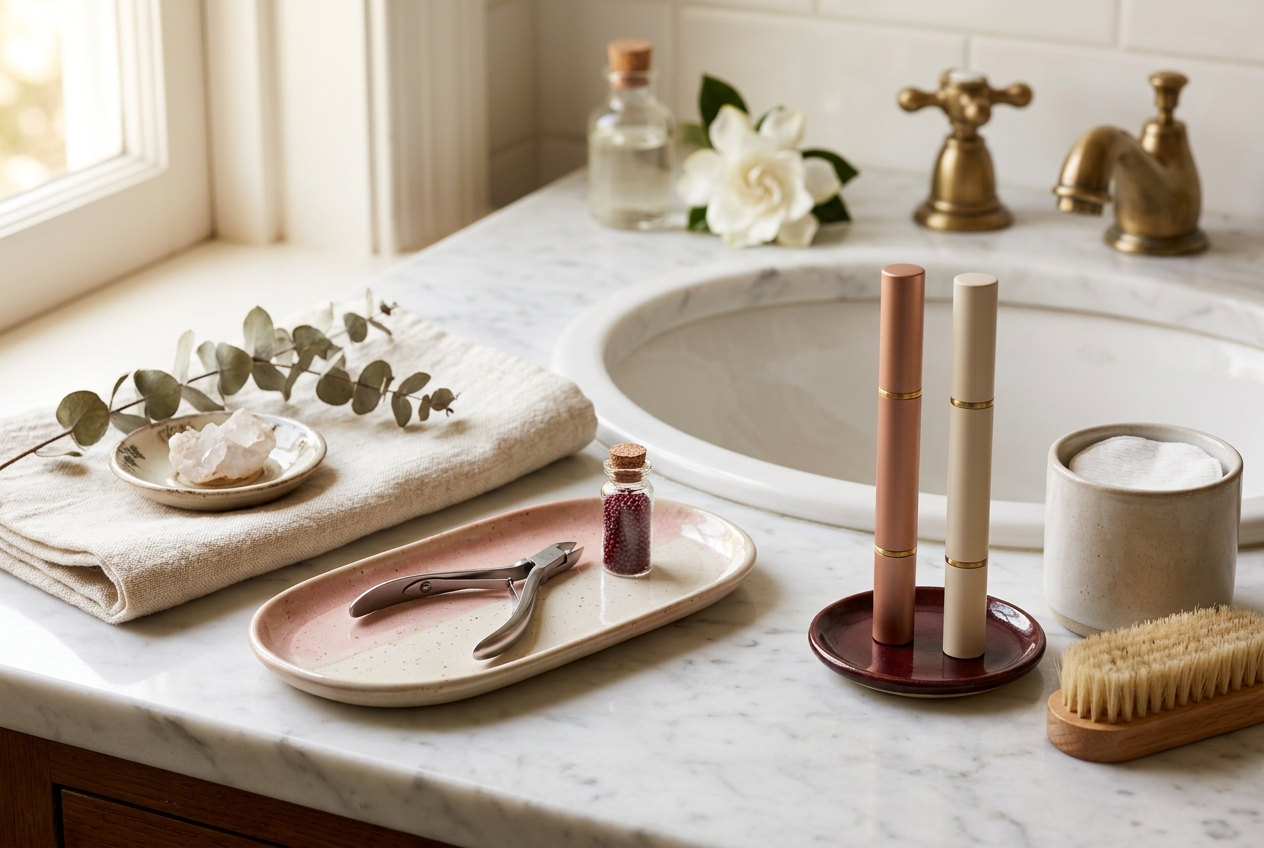
Moisturizing and cutting are not interchangeable
A cuticle oil pen is a cosmetic-care format. Cutting removes tissue. The two actions should not be treated as competing versions of the same manicure step, especially when the visible problem is ordinary roughness.
The American Academy of Dermatology advises leaving cuticles intact and moisturizing rough cuticles rather than cutting them. That guidance gives a sensible starting point for a sink-side routine: respond to dryness with moisturizing, not with an attempt to erase every uneven edge. The supplied product listings describe the two pens as conditioning, hydrating, or treatment products, but their wording does not establish that either one makes cutting necessary, safer, or interchangeable with moisturizing.
A pen can offer a portable way to apply a cosmetic product. It cannot promise nail repair, faster growth, or a particular result for every person. Persistent or concerning nail changes belong outside a routine product comparison and warrant professional assessment.
The seven-day sink-side diary
Imagine the week beginning beside a bathroom sink, where a dry-looking nail fold becomes noticeable after washing your hands. The temptation is familiar: find the smallest tool, remove the jagged bit, and make the outline look finished. A barrier-first approach takes a different path. It treats the visible roughness as a reason to moisturize rather than an automatic instruction to cut.
Day one: notice the border without naming it a defect
Bright light makes every irregularity look more urgent. A pale or lifted-looking edge, a jagged section, or skin that seems thicker than the surrounding area can be distracting. None of those appearances, by themselves, identifies tissue that needs removal.
Pause long enough to ask what is actually bothering you. Is the area simply dry-looking? Does it catch on fabric? Has the change persisted? Is it concerning? The first question can lead to cosmetic moisturizing. The latter questions may call for professional assessment rather than more manicure work.
Day two: put the tool down
On the second day, the useful experiment is not whether you can create a sharper outline. It is whether leaving the cuticle intact changes your urge to intervene. The AAD advises moisturizing rough cuticles instead of cutting them, and that distinction matters even when the cut looks small.
Cutting can make a cosmetic routine feel productive because the visible edge changes immediately. Immediate visual change is not the same as evidence that removal was needed. A less dramatic response may be the more appropriate one when the concern is routine roughness.
Day three: make the cosmetic step easy
The listings position their pens as controlled, targeted, mess-free, or portable formats. Those descriptions can explain why someone might keep one near a sink, desk, or bag. They remain seller descriptions of intended use. They do not establish a measured hydration result or a universal response across skin types.
Apply an amount that feels comfortable for your skin and use the current product label as the source for directions. A small, repeatable step is easier to fit around ordinary life than a ritual that requires a dedicated manicure session. Do not assume that a heavier layer or more frequent use creates a stronger result; the supplied records do not establish that.
Day four: separate appearance from warning signs
By the fourth day, the useful distinction is between a cosmetic appearance concern and a persistent or concerning nail change. A pen can be part of cosmetic maintenance. It cannot diagnose irritation, infection, trauma, product sensitivity, or another health concern.
If the area looks increasingly irritated or the nail change remains persistent or concerning, stop treating the issue as a question of polish-room neatness. Seek appropriate professional assessment. The purpose of a barrier-first routine is not to make every issue disappear into a cosmetic category.
Day five: resist the manicure reflex
After a manicure or enhancement, uneven-looking skin can invite extra pushing, trimming, or clipping. Oil does not make aggressive removal appropriate. Leaving cuticles intact remains consistent with the AAD guidance, and an oil pen should not be used to rationalize working through pain, bleeding, or irritation.
When a border looks less tidy than the manicure itself, the best decision may be to leave it alone. The goal is comfortable hands, not a perfectly erased line.
Day six: judge the habit, not a promised outcome
A portable pen may earn its place if its format helps you remember cosmetic moisturizing. That is a statement about routine convenience, not a guarantee that the product will improve nail strength, accelerate growth, or reverse damage after enhancements.
The listings use language about conditioning, hydration, softness, flexibility, healthy-looking nails, or quick absorption. Read those as product-copy claims about intended cosmetic use. They are not independent evidence that every person will see the same outcome.
Day seven: decide what deserves attention
At the end of the week, the decision is modest. If ordinary roughness is the issue, moisturizing rather than routine cutting is consistent with the AAD guidance. If a pen makes that choice easier to repeat, its practical role is clear. If the nail change is persistent or concerning, a cosmetic pen is not the answer to the underlying question.
The week ends with the tool still in the drawer and the pen beside the soap: one is for removing tissue, while the other is a cosmetic way to moisturize. That difference is more useful than a promise of a flawless outline.
The salon conversation changes the question
At a salon, the exchange can sound different from the private argument at the sink.
Client: “Can you cut these so the manicure looks cleaner?”
Professional: “They look rough, but cutting is not automatically required. We can keep the cuticles intact and discuss moisturizing instead.”
Client: “Would oil make cutting safer?”
Professional: “The product is described as conditioning or hydrating. That does not turn tissue removal into a necessary step or establish that cutting is safer.”
Client: “What if the change does not settle?”
Professional: “Persistent or concerning nail changes should be assessed professionally rather than covered with more cosmetic care.”
This conversation does not turn a pen into a clinical product, and it does not make a salon service an assessment. It simply keeps the categories clear. Moisturizing addresses a cosmetic maintenance goal described by the AAD guidance. Cutting is a separate act involving tissue removal. When the client is asking for a neater perimeter, the answer need not be a more invasive perimeter.
The same distinction applies at home. A pen may be convenient after handwashing or while sitting at a desk. It does not supply permission to push, clip, or cut irritated skin. If the area hurts, bleeds, or looks increasingly irritated, the routine should stop rather than escalate.
What the pen format tells you
“Pen” describes a delivery format, not a clinical category. Bliss Kiss is listed as a cuticle oil pen. Sally Hansen is listed as a nail and cuticle treatment pen. Their product copy presents controlled, portable, or mess-free application as intended uses.
That may matter to someone who wants a compact cosmetic step. It does not establish compatibility with every skin type, a medical benefit, a measured performance result, or guaranteed improvement in nail appearance. It also does not mean two pens with similar packaging have identical formulas, directions, quantities, or fragrance status.
A useful test is whether the format solves a routine problem. If a bottle is forgotten in a cabinet, a pen kept near soap may be easier to notice. If fragrance information or ingredient detail is important, the product record needs to be read separately. Convenience and product documentation are different questions.
Do not turn portability into a promise of consistency for every user. The supplied records describe the format and seller claims; they do not establish how reliably people apply the products or what result each person will see.
Reading the two listings carefully
The Bliss Kiss Simply Pure Fragrance-Free Cuticle Oil Pen is identified in the supplied listing as a 1 Count, fragrance-free cuticle oil pen. Its product copy names jojoba oil and vitamin E, states that the formula is free from parabens, phthalates, and mineral oil, and describes precise, controlled application. The listing also uses claims involving conditioning, hydration, flexibility, absorption, and nail appearance.
Those details make the Bliss Kiss record more directly informative for someone looking specifically for a stated fragrance-free product and a listed 1 Count quantity. They do not show that damaged nails will recover or grow faster, and they do not establish individual suitability for a particular allergy history, sensitivity, or health concern. Current package information remains the relevant place to check product details.
The supplied Sally Hansen Vitamin E Nail and Cuticle Treatment Pen record identifies Vitamin E, apricot kernel oil, and aloe in the seller’s formula description. The product copy claims that it hydrates and conditions dry nails and cuticles and absorbs quickly without residue. In the supplied record, it is listed at $6.49 and In Stock.
The same record does not state its net quantity, full ingredient list, fragrance status, application directions, or applicator construction. Those fields should remain unknown rather than being inferred from the Bliss Kiss listing or from a broader brand range. A shopper comparing scent, quantity, or complete ingredients has a specific reason to inspect the current package or product page.
| Detail | Bliss Kiss Simply Pure Fragrance-Free Cuticle Oil Pen | Sally Hansen Vitamin E Nail and Cuticle Treatment Pen |
|---|---|---|
| Listed format | Cuticle oil pen | Nail and cuticle treatment pen |
| Named formula details | Jojoba oil and vitamin E; listing states no parabens, phthalates, or mineral oil | Vitamin E, apricot kernel oil, and aloe |
| Fragrance status | Fragrance free | Not stated |
| Listed quantity | 1 Count | Not stated |
| Captured price and availability | $8.99; In Stock | $6.49; In Stock |
| Performance evidence in supplied record | Not stated | Not stated |
The comparison is intentionally limited to what the records say. Price and availability can change. Product-copy language is not laboratory testing, and neither listing is presented as an endorsement by the American Academy of Dermatology.
Where routine cosmetic care should stop
A rough-looking cuticle can be a simple appearance concern, but not every nail change belongs in that category. The AAD advises professional assessment for persistent or concerning nail changes. The supplied listings do not establish that either pen can diagnose, treat, or resolve such a change.
Be cautious about adding another product when a change follows a new polish, remover, gel product, adhesive, oil, or cleaning product. The timing may be useful information, but it is not a diagnosis. If the issue persists or concerns you, seek appropriate professional assessment rather than assuming more cosmetic care will settle it.
Stop a cosmetic routine if the area becomes painful, bleeds, or appears irritated. A product that is described as conditioning or hydrating does not make it appropriate to work through discomfort. The barrier-first idea is restraint: preserve intact cuticles, moisturize ordinary roughness, and avoid converting a small appearance concern into a larger maintenance project.
For nail maintenance beyond the cuticle question, our brittle nails care routine covers a broader routine. For a non-cutting approach specifically, see our cuticle care without cutting guide.
Choosing on documented facts
There is no need to force a winner between the two pens when the records describe them differently. Bliss Kiss supplies a stated fragrance-free claim and 1 Count quantity, along with the named jojoba oil, vitamin E, and stated exclusions. Sally Hansen supplies the named Vitamin E, apricot kernel oil, and aloe, plus claims about hydration, conditioning, and quick absorption without residue. The supplied Sally Hansen record leaves several comparison fields unstated.
Choose based on the information that matters to your own purchase decision, while keeping the product claims in their proper category. A fragrance-free listing does not establish that a product suits everyone. Named ingredients do not establish a result for every user. A lower captured price does not establish better value, and In Stock is a time-specific listing detail rather than a permanent condition.
For readers planning enhancements, our fitting soft gel nail tips guide explains why preparation and current manufacturer instructions matter before that service. The pen comparison should not be used to turn oil into a preparation shortcut or to justify cutting.
A minimal routine can therefore be quite plain: leave the cuticle intact, moisturize roughness, use the current label for the cosmetic product, file nails in one direction, and stop when the concern is no longer an ordinary dryness question. The image to keep is not a salon-perfect rim. It is a hand at the sink, reaching for a pen instead of a cutter, while the unresolved question—“What is this persistent change?”—is reserved for professional assessment.
Sources
American Academy of Dermatology, “Healthy nail tips.” https://www.aad.org/public/everyday-care/nail-care-secrets/basics/healthy-nail-tips. Used for guidance to leave cuticles intact, moisturize rough cuticles rather than cut them, file nails in one direction, and seek professional assessment for persistent or concerning nail changes.
Amazon product facts were captured from current listing/API data supplied for this article. They establish the listed names, formats, selected formula details, stated exclusions, captured prices, availability, and seller product-copy claims at capture. They do not provide independent performance testing, a complete suitability assessment, guaranteed outcomes, hands-on testing, or medical endorsement. The AAD source does not endorse either product.
Frequently asked questions
Should I push back cuticles after using cuticle oil?
The product listings describe cosmetic conditioning or hydration claims, not an instruction to push or remove tissue. The AAD advises leaving cuticles intact and moisturizing rough cuticles rather than cutting them.
Can I use a cuticle oil pen every time I wash my hands?
Use frequency should be comfortable for your skin and consistent with the current product label. A small amount after a dryness trigger can be a repeatable habit, but the supplied records do not establish that more frequent use creates a stronger result.
Does fragrance-free mean the Bliss Kiss pen is suitable for everyone?
No. The supplied listing identifies it as fragrance free, but that fact alone does not establish suitability for a particular allergy history, skin condition, or sensitivity.
Why are some Sally Hansen comparison fields marked “Not stated”?
The supplied record names selected components and the pen format, but does not state net quantity, fragrance status, a complete ingredient list, application directions, or applicator construction. Check current packaging or the current product page for those details.
Can cuticle oil fix nails that are lifting, painful, or changing color?
No outcome for those concerns is established by the supplied listings. For persistent or concerning nail changes, the AAD advises appropriate professional assessment.

