The best nail lamp is not automatically the one with the biggest wattage printed on the box. A useful lamp has to match the gel chemistry, deliver the right light evenly across all five nails, and make it difficult to place a thumb outside the curing zone. Everything else—battery size, countdown displays, cordless design—is convenience layered on top of compatibility.
Last checked: July 17, 2026. This is a specification-led editorial comparison, not a laboratory cure test. Scores reflect published design, controls, current price, catalog data, and our judgment about practical fit. Always follow the gel manufacturer’s lamp and cure instructions.
Our top UV/LED nail lamps at a glance
| Lamp | Best for | Published design | Current price | Standout | Trade-off | Score |
|---|---|---|---|---|---|---|
| SUNUV SUN3Best overall | Dedicated home station | Full-hand dual-source lamp | Check latest price | Established full-size format and broad controls | Plug-in setup | 8.8/10 |
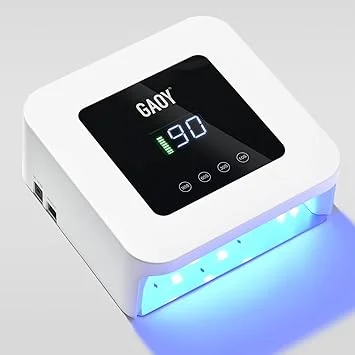
| GAOY CordlessBest cordless | Flexible desks and travel | 39 LEDs; 7,800mAh battery claim | $29.99 | Four timers, sensor, sensitive mode | Battery adds weight and long-term ownership complexity | 8.6/10 |
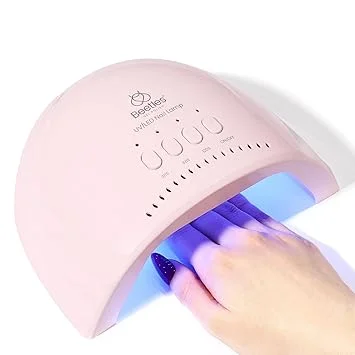
| Beetles F13Best value | Beginner gel manicures | 30 LEDs; dual-light claim | $19.99 | 30/60/120-second timers and sensor | Fewer published system details than premium brand-specific lamps | 8.3/10 |
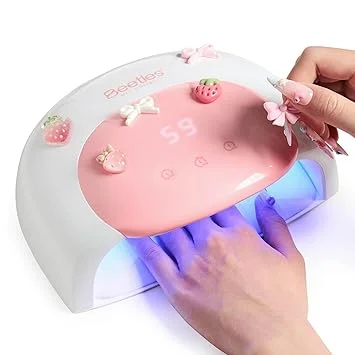
| Beetles Candy WhiteBest roomy display | Users who want visible controls | 33 LEDs; countdown display | $39.99 | Large interior, sensor, 30/60/90-second modes | Costs twice the simpler Beetles option | 8.1/10 |
| MelodySusie P-Plus30I | Brand-aware home setup | Full-size UV/LED format | Check latest price | Recognizable nail-tool brand and conventional dome | Current Amazon snapshot lacks a display price | 8.0/10 |
| MelodySusie P-Plus30FBest compact | Small manicure stations | Compact full-hand format | Check latest price | Smaller footprint and three timers | Compact space can make thumb placement less forgiving | 7.8/10 |
How we evaluated the lamps
We weighted compatibility and wavelength clarity at 25 percent, coverage and LED layout at 20 percent, timers/sensor/low-heat controls at 15 percent, portability at 15 percent, practical usability at 10 percent, current value at 10 percent, and listing/support clarity at 5 percent. These are editorial scores—not irradiance measurements.
We deliberately did not award points simply for a higher wattage claim. Wattage describes electrical consumption, not how much useful light reaches each nail at the wavelengths required by a particular formula. A lower-wattage, well-matched system can be more reliable than a high-wattage generic lamp with poor placement or unclear output.
Editorial score, out of 10
Prizm Nail Hub editorial analysis based on published specifications and current catalog data.
Best overall: SUNUV SUN3
The SUN3 gets the top spot because its conventional full-hand format makes sense for the broadest group of at-home users. A wired lamp is not exciting in the way a battery and handle are exciting, but reliability at a permanent desk is more valuable than portability you never use. The full dome gives the fingers a defined place to land, and the SUNUV line is common enough that instructions and replacement context are easier to find than they are for an anonymous lamp.
Our recommendation still comes with a compatibility condition: use the lamp only when the gel brand supports its output and follow that formula’s cure time. “Dual source†and “universal†are marketing shorthand, not proof that every photoinitiator system will cure completely.
Why it leads
- Practical full-hand shape
- Wired consistency for a fixed station
- Established lamp family
- Useful timer/control format
Who should skip it
- Mobile users who genuinely need cordless power
- Anyone whose gel brand specifies a different lamp
- Users wanting a tiny flash-cure tool
Best cordless: GAOY rechargeable lamp
GAOY publishes the clearest battery story in this shortlist: a 7,800mAh battery, 39 LEDs, four timers, an automatic sensor, and a sensitive mode. The listing claims four to six hours of use after a 1.5-hour charge. We treat those figures as manufacturer claims rather than measured runtime, but they make the intended use obvious.
This is the lamp to consider if a power cable crosses your workspace, you move between manicure and pedicure positions, or you pack a lamp away after every session. Cordless does not make curing chemistry more compatible; it makes the station easier to arrange. Batteries also age, add weight, and create one more component that can fail, so a fixed desk does not automatically benefit.
Best value: Beetles F13
At $19.99 when checked, the Beetles F13 covers the conveniences most home users notice: 30 LEDs, a full dome, 30/60/120-second settings, and a hands-free sensor. Its strongest advantage is not raw power; it is that the design is simple enough to understand and affordable enough to pair with a compatible gel system without spending salon-equipment money.
The 120-second mode should not be interpreted as permission to rescue thick or incompatible gel by doubling the time. Cure duration, layer thickness, lamp output, and formula are connected. If a system remains soft or wrinkles, stop using the combination rather than stacking more time onto it.
Best roomy display: Beetles Candy White
The Candy White model moves up to 33 LEDs, a larger interior, 30/60/90-second modes, and a countdown display. The screen is useful if you dislike guessing whether a sensor cycle restarted, while the extra room helps users place thumbs flatter. At $39.99 when checked, it needs those ergonomic advantages to matter; otherwise the F13 offers a cleaner value proposition.
MelodySusie P-Plus30I and P-Plus30F
These are sensible brand-familiar alternatives. The P-Plus30I is the more conventional full-size choice. The P-Plus30F trades some footprint for compactness. We prefer the larger format when users routinely struggle with thumb position; compactness is useful only if storage is genuinely limited.
Amazon did not provide current display prices in our latest snapshot, so we would compare the live price against the Beetles and GAOY options before deciding. “Check latest price†is not a negative score—it is an honest data boundary.
Full-cure lamp versus flash-cure lamp
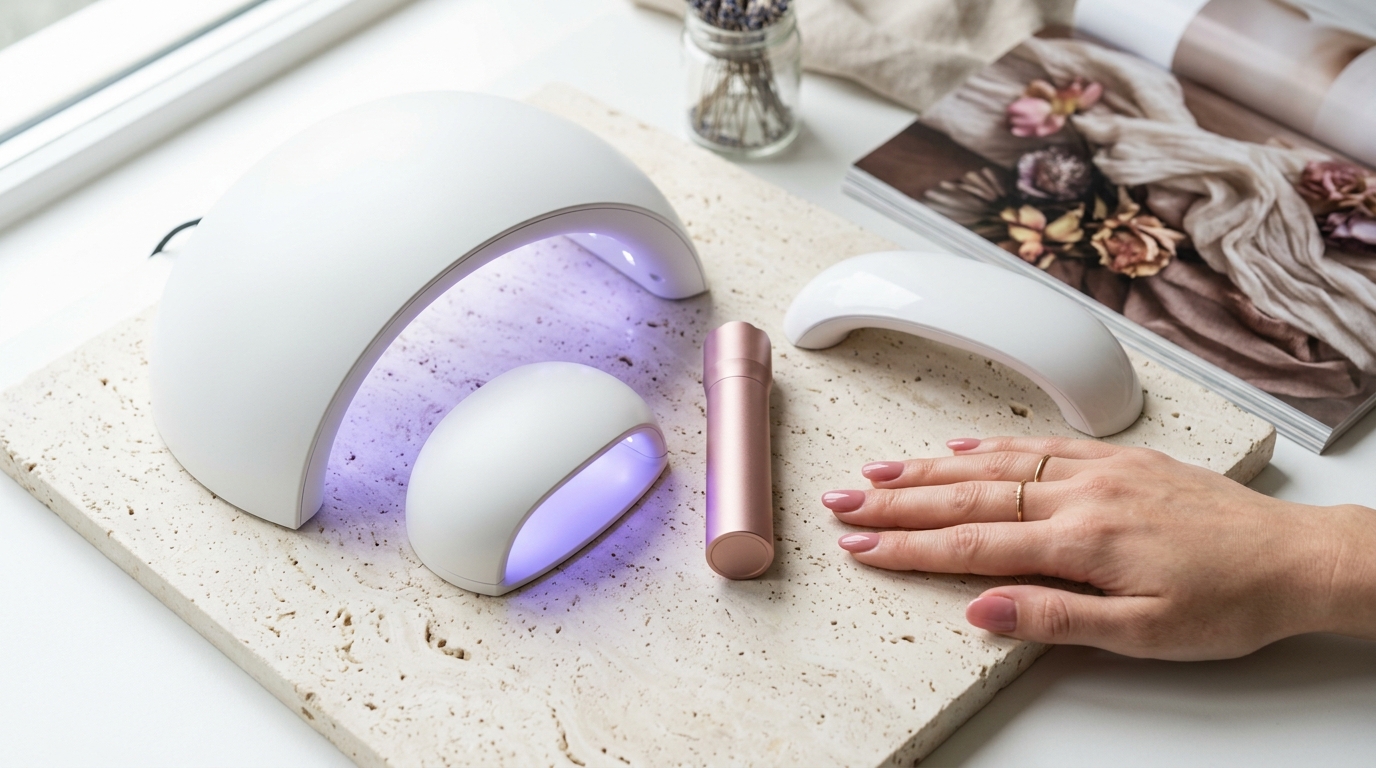
A mini handheld lamp is designed to hold a tip, charm, or small area in place while you establish enough cure to continue. It does not provide the same geometry as a full-hand dome. The thumb can sit outside the beam, and a narrow light may not reach sidewalls evenly. Use a flash lamp for the task its manufacturer describes, then complete the cure in the compatible full-size lamp when the system requires it.
| Tool | Good at | Not a substitute for |
|---|---|---|
| Full-hand dome | Even placement of four fingers or a full hand per instructions | Correct gel/lamp compatibility |
| Handheld flash lamp | Holding tips, charms, or a small design temporarily | Final full cure unless the system explicitly says so |
| Mini folding lamp | Travel and occasional small-area curing | Reliable coverage for thick structured product |
The compatibility question comes before the shopping question
Gel cures when photoinitiators absorb suitable light and trigger polymerization. The surface can feel hard while deeper material remains under-cured. That is why the safest recommendation is the lamp validated by the gel manufacturer. If you mix brands, look for explicit compatibility information rather than trusting “works with all gels.â€
Layer thickness matters too. A thick dark coat can block light from reaching the lower material. More wattage does not fix poor application. Thin coats, correct placement, clean LEDs, and the prescribed cure schedule are part of the system.
What to look for in a home nail lamp
- Compatibility information: wavelength/output guidance tied to the gel you use.
- Coverage: LEDs around the sidewalls and thumb area, not only the roof.
- Low-heat or gradual mode: useful for some structured gels, but not a cure guarantee.
- Removable base: easier cleaning and pedicure access.
- Sensor plus manual timers: convenience with a visible fallback.
- Interior size: enough room to place fingers flat without touching uncured gel.
- Clear instructions: a trust signal more valuable than inflated feature counts.
What we would not pay extra for
We would not pay more for a giant wattage number without wavelength, layout, or compatibility clarity. We would not choose a battery model for a desk sitting beside an outlet. We would not treat a countdown screen as a performance upgrade, and we would not buy a miniature lamp expecting it to handle every structured-gel job.
Wavelength and irradiance: the two words wattage cannot replace
Wavelength describes the color—or energy band—of the light. Gel formulas contain photoinitiators chosen to react within particular bands. Many modern lamps advertise dual wavelengths around 365 and 405 nanometers because those bands cover common initiator systems. That still does not prove a complete cure for every formula. The gel maker knows which initiators, pigments, and recommended layer thicknesses are in its product; that is why its lamp guidance matters.
Irradiance describes light power reaching a given area. It is affected by diode efficiency, distance, angle, reflective surfaces, voltage, and lamp design. Two 48W lamps can deliver very different exposure at the thumb because electrical draw does not describe where the light lands. Consumer listings rarely provide verified irradiance maps, so we give more editorial weight to geometry, system compatibility, and instruction quality than to a single headline number.
Hand placement is part of lamp performance
A full-hand lamp can still cure unevenly if fingers overlap, thumbs rotate outward, or the hand sits too far forward. Place four fingers flat and separated when the system permits, with nail surfaces facing the LEDs rather than tilting toward one side. Thumbs are often more reliable when cured separately and flat, especially in compact domes.
Long extensions create another geometry problem. The free edge and underside may sit beyond the strongest zone, while deep sidewalls can be shadowed. A roomy interior helps, but the correct response is not to curl the fingers to fit. Choose a lamp designed for the nail length and system, or cure in positions specified by the manufacturer.
If your thumbs wrinkle while the other nails cure: cure thumbs separately and flat; do not assume the gel formula is the only problem.
If sidewalls stay soft: inspect hand placement, LED coverage, and layer thickness.
If one side of every manicure fails: check for blocked, dirty, or failing LEDs and consistent finger positioning.
If every nail stays soft: stop using the combination and verify lamp/formula compatibility.
Dark colors and thick gels need respect, not improvised cure times
Dense pigment can absorb or scatter light before it reaches the bottom of a coat. Black, white, and highly saturated colors are common troublemakers when applied thickly. Builder gels and extension products add physical depth. The surface may become firm enough to touch while material underneath remains incompletely polymerized.
The fix starts at application: thin color coats, the correct product architecture, and a lamp validated for that system. Doubling a timer is not a universal rescue. Extra exposure cannot guarantee that the required light reaches through an overly thick or incompatible layer. When a product repeatedly wrinkles, shrinks, or remains soft, discontinue that pairing and consult the gel manufacturer.
What low-heat mode can—and cannot—do
Some structured gels release noticeable heat as polymerization accelerates. A low-heat or gradual-power mode is designed to slow the early reaction and make the sensation more manageable. It can improve comfort; it does not mean the product is safer, hypoallergenic, or fully cured independent of its instructions.
Remove the hand immediately if heat becomes painful. Do not tell someone to “push through†a spike. Nail condition, product amount, application thickness, and formula all affect sensation. Low-heat mode is a useful control, not permission to apply a larger bead than the system supports.
Cleaning and lamp aging
Dust and cured gel can block light or create uneven reflective surfaces inside a lamp. Unplug the unit and clean it only with methods approved by the manufacturer. Do not flood electronics with disinfectant, and do not scrape LEDs with metal tools. A removable base is valuable because it lets you clean product and pedicure debris without turning the whole lamp upside down.
LEDs do not remain identical forever. Heat, electronics, impacts, and repeated use can change output even if every diode still glows visibly. A visible purple-blue light is not proof of adequate cure. If a previously reliable, correctly matched system begins failing across multiple applications, inspect the lamp, adapter, cord, LEDs, placement, and product age rather than simply extending the timer.
Our buying decision tree
You use one gel brand consistently: start with that brand’s validated lamp. Compatibility confidence is worth more than an extra timer.
You use common consumer gels and need a budget full-hand setup: consider Beetles F13, but verify each formula’s instructions.
You have a fixed manicure desk: choose SUNUV SUN3 or another clear wired full-dome system. Skip battery complexity.
You pack the station away or move between rooms: GAOY’s cordless format earns its premium.
You struggle with thumb placement: favor a roomy dome and visible countdown, such as Beetles Candy White, then cure thumbs flat.
You apply tips or charms: add a handheld flash lamp for positioning, but keep a compatible full-cure lamp for final curing.
Four real-life setups—and the lamp that makes sense
The once-a-month gel manicure
You want a lamp that stores easily, has obvious timers, and does not require a charging ritual. Beetles F13 is the rational budget option if it matches your gel. SUNUV SUN3 is the upgrade when you value a more established full-dome workflow. There is little reason to pay for cordless power when the lamp comes out beside the same outlet every month.
The structured-gel regular
Your decision begins with the builder-gel system. Buy its validated lamp when available. A low-heat mode, roomy interior, flat thumb access, and clear timing matter more than a universal compatibility claim. We would rather use the brand-specific 36W lamp designed for that builder than an unrelated 120W lamp chosen from a marketplace headline.
The tiny apartment setup
Compactness has genuine value when every tool returns to a drawer. MelodySusie P-Plus30F earns its place here, but measure the interior against your hand and preferred nail length. A smaller shell that forces curved fingers is not a space-saving win. If a cable makes storage awkward, GAOY cordless becomes easier to justify.
The manicure-and-pedicure station
Look for a removable base and an interior that lets toes sit under the light without touching wet product. Cordless positioning can help when the nearest outlet is at desk height. Cleanability matters: foot-care debris should not collect around fixed electronics or inaccessible seams.
Our editorial no-buy list
- A lamp chosen only because it advertises the largest wattage. The number does not map the light reaching each nail.
- A mini flash lamp sold as a universal full-cure solution. Focused convenience and full-hand exposure are different jobs.
- A cordless model with no charging guidance. A battery is useful only when ownership is documented.
- A generic lamp for a structured gel that specifies its own system. The savings are not worth uncertain polymerization.
- A dome too small for flat placement. Curled fingers and hidden thumbs create preventable shadows.
- A listing that promises every gel, every thickness, and instant results. Chemistry does not become universal because the product page says so.
Before the first manicure
Read both manuals. Confirm the adapter, inspect every LED, clean the interior, and place an unpainted hand inside to learn where fingers and thumbs sit. Keep gel bottles away from the operating light. Apply the first manicure in thin coats, follow the complete cure schedule, and stop if the product wrinkles, stays soft, or produces painful heat.
Frequently asked questions
Is a 48W lamp better than a 24W lamp?
No. Wattage describes electrical consumption. Useful curing depends on wavelength match, irradiance, LED efficiency and placement, formula, layer thickness, and time.
Can one lamp cure every gel brand?
No universal claim is a substitute for manufacturer validation. Some dual-source lamps cover common photoinitiator ranges, but the gel brand’s instructions remain the safest reference.
Why is gel still tacky after curing?
Some gels intentionally leave an inhibition layer. If the product should cure dry but stays soft, check compatibility, layer thickness, lamp placement, LEDs, and instructions. Do not assume more time solves under-curing.
Do cordless lamps cure as well?
A cordless power source does not inherently improve or reduce curing. Output stability, design, charge state, and compatibility matter. The benefit is workspace freedom.
Do I need UV-protective gloves?
They can reduce skin exposure where covered, but they do not replace compatible products, correct timing, or manufacturer instructions. Follow professional medical guidance for individual concerns.
The bottom line
Buy the lamp for the gel system first and the lifestyle second. The SUNUV SUN3 is our broadest fixed-station choice, GAOY is the cordless convenience pick, and Beetles F13 delivers the strongest budget case. But no ranking outranks compatibility. A well-designed lamp used with the wrong formula is still the wrong lamp.