
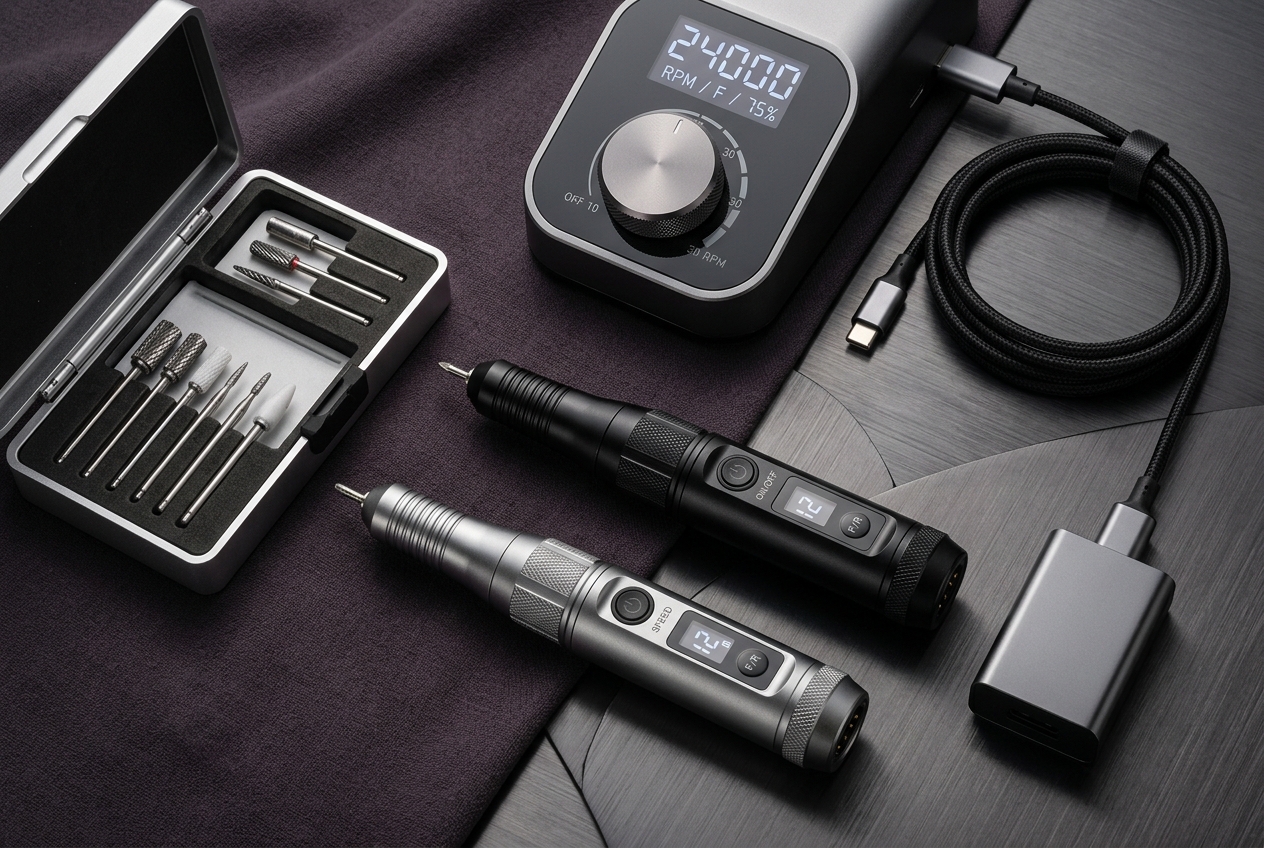
Choose the controls before the RPM number
For home use, begin with the handpiece and its controls rather than the largest number in the headline. Compare the grip, direction control, speed adjustment, battery information, and included bits with the work you intend to do. The MelodySusie SC300F listing states a waist clip, 30 adjustable gears, display information, and a 30,000 RPM maximum. JEWHITENY's SG707 listing has a lower captured price than the SC300F and states speed, direction, and battery indicators. MelodySusie describes the PC180F as pen-shaped. These are listing claims, not results from hands-on testing.
The supplied listings describe rechargeable rotary nail tools with stated bits or bands for named cosmetic nail tasks.
Imagine reaching for the tool during a session. Is the control panel where your thumb naturally lands? Can you tell which direction is selected? Can you make a small speed change without searching for a button? Does the battery information tell you enough to plan charging? Are the included accessories identified clearly enough to understand their intended role? Reading a listing in that order produces a more useful comparison than treating maximum RPM as a verdict.
At thumb reach: the handpiece decides the feel of the tool
Cordless layouts are not all alike. Some combine the motor, controls, and battery in a pen-shaped body. Others separate the handpiece from a rechargeable controller that rests on a table, clips to clothing, or hangs near the waist. Neither arrangement earns an automatic advantage. The relevant question is where the weight and controls land while the tool is being held.
The MelodySusie SC300F listing describes a compact cordless handpiece with a clip-on waist attachment. It also says that an LED display shows speed, direction, and power level. Someone working at a desk or moving around a home setup might prefer controls attached near the body instead of a base occupying the work surface. The listing calls the handpiece low heat and low vibration. Those descriptions remain seller claims; the supplied information includes no independent measurements.
MOCOWIND's listing describes a portable rechargeable unit with a speed knob, one-touch control, and LCD. Its stated dimensions are 6.3 by 2.8 by 1 inches. Those concrete details are more useful for judging the proposed layout than broad language about a “professional” motor. The listing also claims low heat, noise, and vibration, without supplying measurements for those characteristics.
Lavinda places emphasis on the handpiece. Its listing describes an aluminum-alloy, pencil-shaped, lightweight body with ventilated holes and compatibility with 3/32-inch shank bits. A pencil profile may feel familiar to a buyer who prefers a writing-tool grip, but the description does not establish comfort for every hand size or working position. Ventilation language does not establish a particular operating temperature either.
The MelodySusie PC180F is another compact option. Its listing calls it cordless and pen-shaped and gives a listed weight of 0.15 pounds. It also states a pause function, LCD, and reversible direction. This format may draw attention from someone who values a small, self-contained tool, but the body shape alone cannot answer questions about grip pressure, bit changes, dust cleanup, charging, or storage.
JEWHITENY's SG707 listing proposes a more organized control setup: a back clip for a waist pocket, an adjustable triangular bracket intended to steady the unit, and detachable embedded bit storage. These details show what the maker includes in the layout. They do not establish how stable the drill feels under load or how long the bracket will last.
Separate comfort language from comfort evidence
“Ergonomic,” “lightweight,” aluminum construction, ventilation holes, and low-vibration wording can all be relevant prompts for further checking. They are not substitutes for a stated grip diameter, measured vibration, or time in use. The supplied product information does not provide all of those details. If repetitive hand discomfort is already a concern, do not base a purchase on comfort wording alone.
Direction comes before speed
Direction is a working control, not a decorative icon. A forward/reverse function lets the bit rotate in either direction, which can help a right- or left-handed operator choose an approach that feels more controlled. It does not make every filing technique suitable.
The distinction is important with the SC300F. Its supplied listing information says that the display shows direction, but it does not explicitly confirm forward/reverse operation. A direction indicator should not be upgraded into a confirmed rotation switch. MOCOWIND explicitly states forward/reverse control through its one-touch button. Lavinda names an F/R button. PC180F states an F/R function for right- or left-handed use. JEWHITENY says a left-side button changes direction and that the screen displays forward or reverse status.
Next, inspect the speed interface. A physical knob may make gradual changes easy to understand, but a knob alone does not establish how precise the low end is, how many settings exist, or how stable the speed remains under work. A display can help a user revisit a setting, but the supplied records do not independently verify that a displayed RPM value precisely matches actual RPM while the bit is working. Numbered gears and buttons can aid repeatability; they do not replace a cautious start or an appropriate attachment.
RPM is a ceiling, not a task instruction
The maximum RPM is the stated upper limit. It is not the speed required for every job, a measure of torque, or a beginner rating. MOCOWIND, Lavinda, and JEWHITENY list ranges up to 35,000 RPM. SC300F states a 30,000 RPM maximum, stepless control, and 30 adjustable gears. PC180F states 25 adjustable speeds from 6,000 to 25,000 RPM.
Those figures can organize a comparison of the manufacturers' claimed ranges. None establishes that the fastest model removes product more effectively, runs cooler, or is easier for a new user. Pressure, bit material, grit, product thickness, bit condition, and contact area all affect how a rotary file behaves, while the supplied listings do not establish how those factors combine.
For a fuller discussion of speed settings and cosmetic tasks, read our nail drill RPM explainer. The useful shopping question is not simply which model reaches the highest number. Ask whether the control layout lets you identify direction, make restrained adjustments, see the setting, and stop before control is lost. A lower stated maximum does not by itself establish less usable control.
One table, five control panels
The comparison below keeps stated facts distinct from information that is absent. Prices and availability are captured snapshots. Runtime claims are particularly dependent on speed, load, task, and test method when those conditions are not supplied.
| Product | Handpiece or layout stated | Speed and direction stated | Battery and charge claim | Included bits or bands stated |
|---|---|---|---|---|
| MelodySusie SC300F | Compact handpiece; clip-on waist attachment | Up to 30,000 RPM; stepless control; 30 adjustable gears; display shows direction, but F/R is not explicitly confirmed | 4,000mAh; 3-hour charge; claimed 8-12 hours continuous use | 6 kinds of bits; 56 sanding bands; 3/32-inch compatibility stated |
| MOCOWIND 35,000 RPM | Portable rechargeable unit; listed size 6.3 by 2.8 by 1 inches | Up to 35,000 RPM; speed knob; LCD; forward/reverse stated | 3,600mAh; about 3-hour charge; claimed 8-10 hours use | 7 drill bits; 6 sanding bands |
| Lavinda Viva Magenta | Aluminum-alloy, pencil-shaped handpiece | 0-35,000 RPM; F/R button; LCD described as showing speed and power | 3,000mAh; claimed 2-3-hour charge; claimed 8-10 hours use | 6 drill bits; 6 sanding bands; 3/32-inch shanks stated |
| JEWHITENY SG707 | Back clip; triangular bracket; embedded bit storage | 0-35,000 RPM; top knob; direction button; screen shows speed, direction, and battery power | Rechargeable; capacity, charge time, and runtime not stated | 6 drill bits; 6 sanding bands |
| MelodySusie PC180F | Cordless pen-shaped body; listed weight 0.15 pounds | 6,000-25,000 RPM; 25 speeds; F/R and pause function stated; LCD stated | Capacity not stated; claimed 1-hour full charge; up to 6 hours use claimed | 11 kinds of 3/32-inch metal bits |
Charging evidence: capacity is not a session promise
Battery language often has an appearance of precision. Milliamp-hours describe stated capacity. Runtime describes a claim about use under conditions that may not be disclosed. A drill used at a high setting against thick artificial product is not necessarily comparable with one used briefly for light shaping. “Up to” should therefore be treated as planning information, not a guaranteed all-day result.
SC300F claims a 4,000mAh battery, a three-hour charge time, and eight to 12 hours of continuous use. MOCOWIND states 3,600mAh, approximately three hours to charge, and claimed use of up to eight to 10 hours. Lavinda states 3,000mAh, a two- to three-hour charge period, and claimed eight to 10 hours of cordless use. The figures can be placed beside one another, but the supplied records do not give the speed, load, task, or measurement method behind them.
PC180F makes a different disclosure: its listing states a one-hour full charge and up to six hours of use, but not battery capacity or charging connection. SG707 is less specific. Its screen is said to show battery power and the tool is described as rechargeable, while capacity, charge duration, connector, cable, adapter, and runtime are not stated. That omission does not prove weak battery life; it leaves charging logistics unanswered.
Ownership is easier to picture when charging habits come first. Would you charge after each use? Can you tell the remaining power before starting? Is the cable or adapter identified? Does your routine require a wired fallback? These questions are more grounded than treating a capacity figure and a runtime estimate as if they came from one standardized test.
Bits and bands: count the accessories, then identify the work
Accessory counts affect first-purchase value, but a count is not a complete bit guide. SC300F names six kinds of professional bits and 56 sanding bands, without identifying every bit profile or the complete purchase configuration. MOCOWIND states seven bits and six bands. Lavinda and JEWHITENY each state six bits and six bands. PC180F states 11 kinds of 3/32-inch metal bits.
Those numbers do not independently establish bit material, grit, finish, sanitation suitability, replacement availability, or the attachment appropriate for a particular task. Where a 3/32-inch shank is stated, that is a useful size reference. It is not permission to use any bit without checking the selected drill's instructions and the accessory maker's specifications.
A damaged, dull, contaminated, or poorly seated bit is not made suitable by a higher RPM ceiling. Check the chosen product's instructions and accessory specifications before use. If the correct attachment or technique is uncertain, consult the selected drill's instructions and accessory specifications before use.
Our guide to safely prepping nails with an electric drill discusses a cosmetic-prep mindset.
Material, curing, and dust are separate decisions
An e-file can remove or refine material only after the user understands the product system involved. It does not answer curing questions, and portability does not solve dust exposure.
OSHA identifies nail-salon exposure routes including vapors, dust, skin contact, and accidental ingestion. Its guidance emphasizes ventilation, hazard communication, safety data sheets, work practices, and PPE selected for the hazard. Those considerations belong alongside the shopping decision rather than being inferred from a drill's battery or control layout.
Ownership starts with the unglamorous questions
The captured prices make these tools tempting as quick purchases: $39.99 for SC300F, $31.98 for MOCOWIND, $29.99 for Lavinda, $19.99 for JEWHITENY, and $9.01 for PC180F. Price and In Stock status are transaction snapshots, not quality findings. A lower-priced model can suit occasional shaping if its limitations are acceptable. It can also become a poor value if unclear charger, support, bit, or return details lead to another purchase.
Check the exact selected configuration instead of relying on a generic bullet list. Which bits and bands are actually in the box? Is a cable and power adapter included? What connector is used? How are replacement bits sourced? What warranty and return terms apply? The supplied records leave several answers unstated. Where a listing offers colors or bundles, confirm that the stated screen, direction function, battery information, and accessories belong to the chosen variation.
Each listing presents a different control-panel story. SC300F combines a waist clip, 30 gears, display information, 4,000mAh claimed capacity, and 56 sanding bands; its display shows direction, but F/R control is not explicitly confirmed. MOCOWIND and Lavinda list 35,000 RPM maximums, displays, stated forward/reverse controls, and battery figures. JEWHITENY lists a clip, bracket, display, and direction controls, while battery and charging specifics are not stated. PC180F lists a 0.15-pound pen-shaped body, a 6,000-25,000 RPM range, and 11 kinds of 3/32-inch metal bits.
For a wider market view, read our guide to the best electric nail drills. Then return to the physical question: when your thumb reaches for the control, will the setting be clear enough to make a careful decision? A cordless drill earns space in a home setup when its interface, charging evidence, accessories, and safety boundaries all make sense together. The unresolved buyer question is not who wins the RPM race; it is whether the small panel you can see beside your thumb tells you enough to work with restraint.
Sources
OSHA Nail Salons. Used for exposure routes including vapors, dust, skin contact, and accidental ingestion, plus ventilation, hazard communication, safety data sheets, work practices, and hazard-appropriate PPE.
Amazon product facts, including captured price, availability, stated controls, speed ranges, battery claims, dimensions, and listed accessories, come from current listing/API data supplied for the named products. They remain listing or manufacturer claims unless identified otherwise. No hands-on testing, independent performance measurement, review analysis, warranty verification, or long-term durability assessment was performed.
Frequently asked questions
Is 35,000 RPM automatically better than 25,000 or 30,000 RPM?
No. It is a stated maximum, not a quality score or a recommended setting. Compare the speed interface, clearly stated direction function, suitable bits, and the ability to work with control.
Which listed model has the clearest battery information?
SC300F states 4,000mAh, a three-hour charge, and claimed eight-to-12-hour use. MOCOWIND and Lavinda also state capacity, charge time, and claimed runtime. Their conditions are not specified, so the figures are not direct real-world guarantees.
Does a direction indicator mean the bit can be reversed?
Not necessarily. SC300F information says the display shows direction but does not explicitly confirm an F/R control. MOCOWIND, Lavinda, JEWHITENY, and PC180F each have listing text that specifically states a direction-changing function.
Are included sanding bands enough to start removing gel or acrylic?
A count only identifies what the listing says is bundled. Verify the individual bit and band types, check the relevant instructions, and do not substitute force or heat for an appropriate attachment and technique.
Can a portable dust collector replace ventilation for nail filing?
The supplied evidence does not evaluate whether a portable dust collector provides adequate ventilation or exposure control. Use dust-control and ventilation practices appropriate to the products and amount of filing involved, alongside workplace and product safety guidance.


