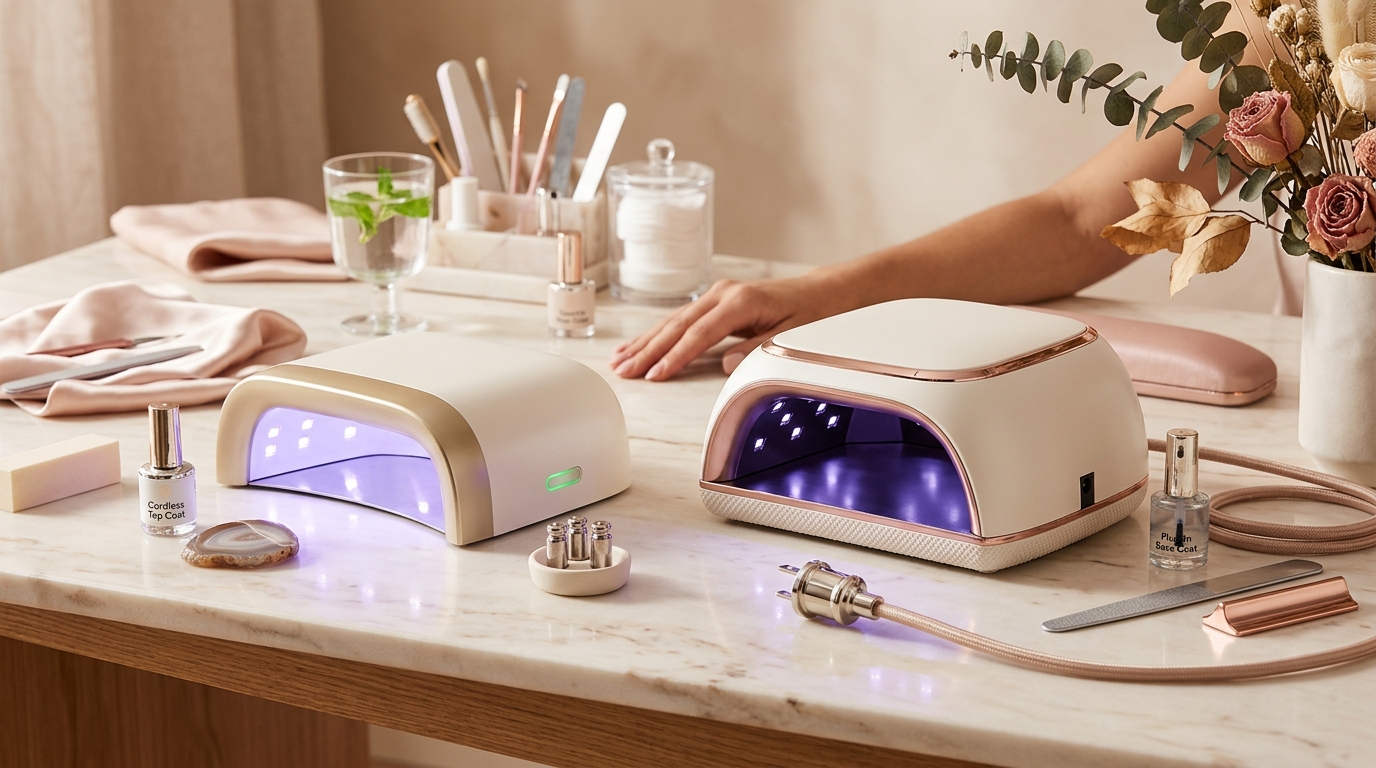
A cordless nail lamp solves a furniture problem, not a chemistry problem. It removes the cable from your desk and lets the lamp move between manicure, pedicure, and storage positions. A plug-in lamp does the opposite trade: less freedom, fewer battery questions.
Cordless versus plug-in at a glance
| Factor | Cordless | Plug-in |
|---|---|---|
| Workspace | Flexible placement; cleaner cable-free desk | Best at a fixed station |
| Runtime | Limited by charge and battery age | Continuous while power is available |
| Weight | Usually heavier from battery | Often lighter for comparable shell |
| Long-term ownership | Battery can degrade or become a failure point | Adapter and cord remain replaceable concerns |
| Pedicure/mobile use | Easier to reposition | Depends on outlet and cable routing |
| Cure quality | Depends on output/design/compatibility | Depends on output/design/compatibility |
What a battery changes
A rechargeable lamp can advertise several hours of runtime, but battery claims reflect manufacturer conditions. Charge level, age, temperature, cycle length, and electronics affect real use. A lamp that supports operation while charging provides a useful fallback, although the manual should confirm that mode.
Battery capacity does not tell you curing performance. A 7,800mAh battery describes stored electrical charge, not wavelength or irradiance. The lamp still needs stable electronics and a compatible light system.
When cordless is worth it
- You store the manicure setup after every use.
- Your outlet is behind furniture or creates a trip path.
- You move between hand and foot positions.
- You provide legitimate mobile services and can maintain sanitation.
- You need a temporary event or backstage station.
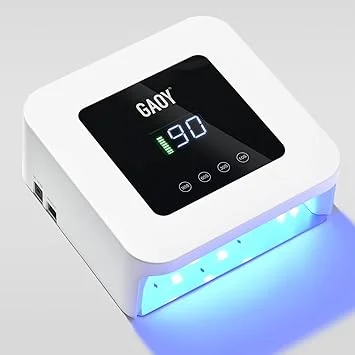
The GAOY cordless lamp is a current catalog example with a published 7,800mAh battery, four timers, and a sensor. Treat its four-to-six-hour runtime as a manufacturer claim, not our measurement.
When plug-in is the smarter buy
If the lamp lives in one spot, a cable is a small inconvenience. You avoid charging routines and battery aging, and you can focus spending on the gel system, interior geometry, and controls. A wired lamp is not inherently more powerful; it is simply more straightforward.
The SUNUV SUN3 is our fixed-station pick in the best nail lamps guide. Its advantage is the conventional full-dome workflow, not a promise that wires cure gel better.
Questions to ask before paying for cordless
- How often will the lamp move?
- Can it operate safely while charging?
- Is the charger proprietary or replaceable?
- Does the display show battery state clearly?
- Is the added weight acceptable?
- Does the gel maker support the lamp output?
- What happens when the battery eventually degrades?
Mobile does not mean mini
A small flash lamp is portable, but it may be intended only to hold a tip or charm. A cordless full-hand dome is a different tool. Do not choose by size alone; choose by the procedure the manufacturer validates.
Frequently asked questions
Do cordless nail lamps get weaker as the battery drains?
A well-designed lamp should regulate output, but consumer listings rarely provide complete discharge performance. Follow charge guidance and stop using a lamp that behaves inconsistently.
Can I use a cordless lamp while plugged in?
Only if the manual explicitly supports it. Do not infer safe pass-through operation from the charging port.
Are cordless lamps professional?
Power format does not determine professional suitability. Compatibility, output stability, sanitation design, durability, and workflow matter.
The real question is how often the lamp moves
Many home users buy cordless because it sounds premium, then leave the lamp beside an outlet forever. If that is your routine, the battery is mostly extra weight. If you pack your supplies into a drawer, move between a desk and a pedicure chair, or do mobile appointments, the benefit becomes tangible.
Battery ownership is not free convenience
Rechargeable cells age. Runtime can shrink, charging ports can loosen, and a lamp may eventually become difficult to use if its battery is not serviceable. Look for clear charge indicators, a common connector where supported, and documented use-while-charging behavior. Treat runtime as a claim, not a guaranteed session count.
Workflow and sanitation
Mobility does not reduce the need for a clean station. A cordless lamp still needs an interior and base that can be cleaned between users. A corded lamp can be easier to keep in one controlled area. For professional or mobile work, add transport protection and a repeatable disinfection routine.
Decision matrix
One home station: plug-in is simpler.
Shared room or limited outlets: cordless earns its place.
Frequent travel: choose a full-hand cordless dome, not a tiny flash lamp.
Occasional travel: a compact wired lamp may cost less and avoid battery aging.
FAQ
Does cordless mean weaker?
Not automatically. Evaluate output and compatibility separately from the power source.
Is a cordless lamp worth it for pedicures?
It can be, if you need to position it away from a desk. Confirm the interior fits the foot/nail task.
Can I leave it charging overnight?
Follow the manufacturer’s charging guidance; do not assume every battery system supports overnight charging.
Bottom line
Cordless is a workflow feature. Choose it when movement solves a real problem, not because a battery icon looks more professional.
Output stability and charge state
A well-regulated cordless lamp should maintain intended output through its usable charge range, but listings rarely publish detailed discharge curves. If timers, brightness, or behavior change as the battery drops, recharge and consult the manufacturer. Do not compensate for uncertain output by guessing a longer cure.
Charging connectors and adapters
A familiar connector does not mean any charger is appropriate. Voltage and current requirements matter. Use the supplied or manufacturer-approved adapter. A proprietary adapter can be inconvenient to replace; a common connector is useful only when specifications remain correct.
Weight and ergonomics
A battery makes a lamp easier to move without a cable and usually heavier to carry. A handle helps between rooms but adds little at a fixed desk. For mobile work, evaluate the complete kit: lamp, charger, gels, sanitation supplies, and protective case—not the lamp alone.
Cost over time
Cordless models often cost more upfront. If the battery is not replaceable, degradation may shorten the practical life of an otherwise functional lamp. Plug-in models still have failure points—cords and adapters—but those components may be easier to replace. Warranty clarity matters more than the battery-capacity headline.
Home-user examples
The dining-table manicure
You unpack supplies once every few weeks and clear them after. Cordless reduces cable clutter and makes storage easier.
The dedicated beauty desk
The lamp never moves and an outlet sits nearby. Plug-in is the rational default.
The manicure-and-pedicure setup
You shift the lamp from tabletop to floor-level positioning. Cordless can solve a real routing problem, provided the lamp is designed for that placement.
Professional workflow questions
Mobile professionals need predictable runtime, a backup power plan, secure transport, compatible systems, and sanitation—not merely a cordless label. A busy fixed salon may prefer continuous wired power. Neither format is universally more professional.
What to do when the battery ages
Follow manufacturer service guidance. Do not open a sealed battery appliance or continue using a swollen, damaged, or unusually hot unit. Dispose of batteries through appropriate local channels.
Battery capacity is not runtime by itself
Milliamp-hours describe stored charge under specified conditions. Lamp power draw, electronics, timer use, low-heat modes, age, and temperature determine how that capacity translates to sessions. Compare manufacturer runtime claims cautiously and keep a charging plan.
What happens during an interrupted cure
If a cordless lamp shuts down mid-cycle, do not guess how much useful exposure occurred. Follow the gel maker’s guidance for interrupted curing. A display that counts down and a clear low-battery indicator reduce uncertainty but do not repair the interruption.
Cable management for plug-in lamps
A wired lamp can still create a clean station. Route the cable away from hands, liquids, and walking paths. Do not stretch the adapter, pinch the cord under furniture, or use an unapproved extension setup. Replace damaged cables immediately.
Travel and airline questions
Rechargeable devices may be subject to carrier battery rules. Check current airline and destination requirements before packing. Protect the power button and lamp shell so the unit cannot switch on or crack in transit.
Backup planning
A mobile service should not depend on an untested battery estimate. Carry the approved charger and have a procedure for a failed lamp. Do not switch to an incompatible backup simply to finish a service.
Comparison beyond power source
| Question | Why it matters |
|---|---|
| Compatible with your gel? | Determines whether either format belongs on the shortlist |
| Room for flat thumbs? | Reduces shadow and placement failures |
| Removable base? | Improves cleaning and pedicure access |
| Clear battery/adapter support? | Shapes long-term ownership |
| Warranty? | Matters when electronics or battery fail |
Who should not buy cordless
Skip it when the lamp will never move, when the battery is not supported, when the charger is unclear, or when the cordless model distracts from a better-matched wired system. Convenience is not worth uncertain curing.
Final decision
Format is a lifestyle choice after compatibility is established. A plug-in lamp is the dependable default for a desk. A cordless lamp is justified by movement, storage, or mobile work. Make the choice deliberately and the lamp becomes a quiet tool instead of another feature to troubleshoot.
Questions to answer before checkout
Where will the lamp sit? How often will it move? Which gel system must it cure? Is the approved charger included? Can the battery be serviced? Does the interior fit your hand and extensions? Can the base be cleaned? Is the warranty long enough to matter?
If movement is the only unanswered question, buy plug-in. If movement repeatedly disrupts your setup, cordless becomes a practical tool rather than a novelty.
Environmental ownership note
A rechargeable unit contains a battery that requires appropriate end-of-life handling. Keep electronics out of household trash where local rules require battery recycling. A simpler wired lamp may have a longer practical life when replacement adapters remain available.
Editorial standard: Specifications describe intended design, not laboratory verification. When a listing and a gel manufacturer disagree, follow the gel system or stop using the pairing. Keep product off skin and seek qualified help for persistent irritation.
Before choosing either format, confirm the exact gel system, lamp instructions, timer, interior coverage, cleaning method, and support policy. Power delivery comes after those fundamentals. A lamp that fits the room but not the chemistry is still the wrong purchase.
The bottom line
Buy cordless for movement. Buy plug-in for simplicity. Neither choice can compensate for an incompatible gel-and-lamp system, and neither should be ranked by wattage alone.