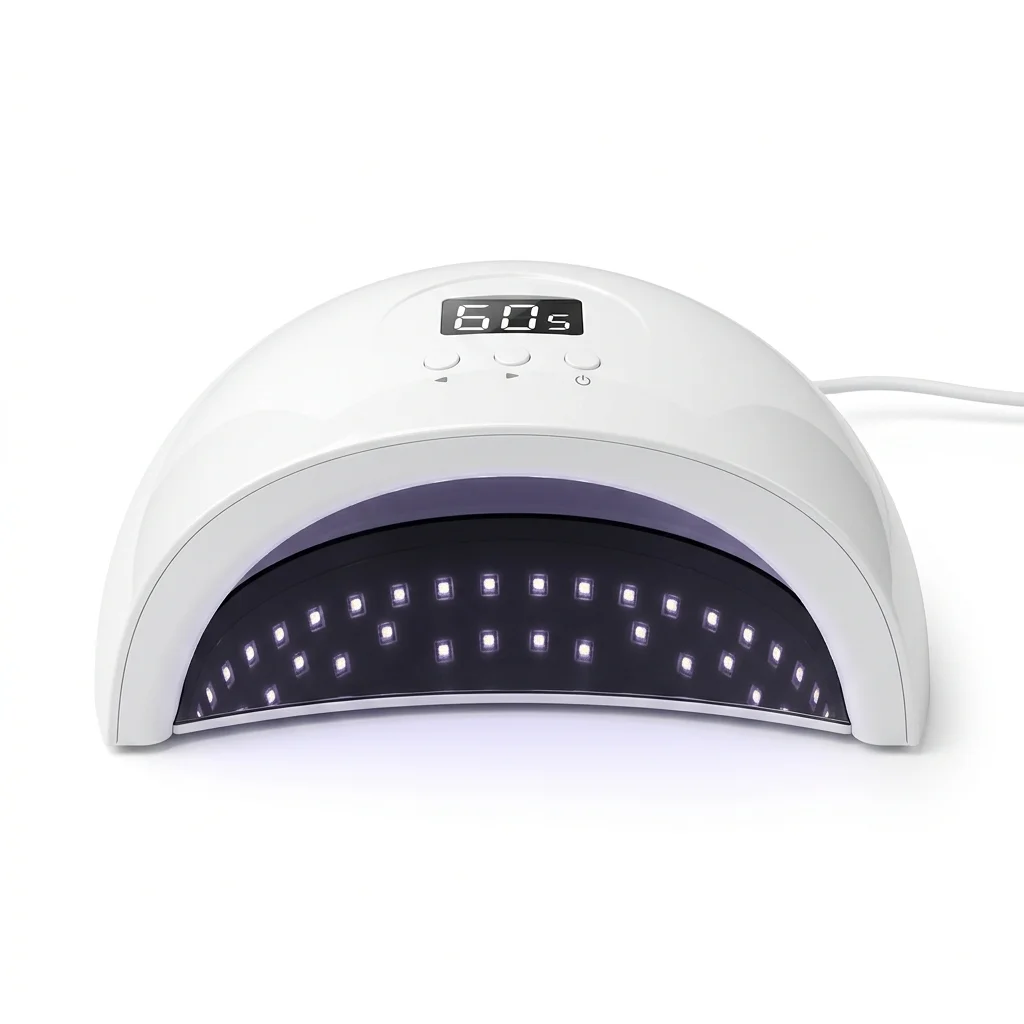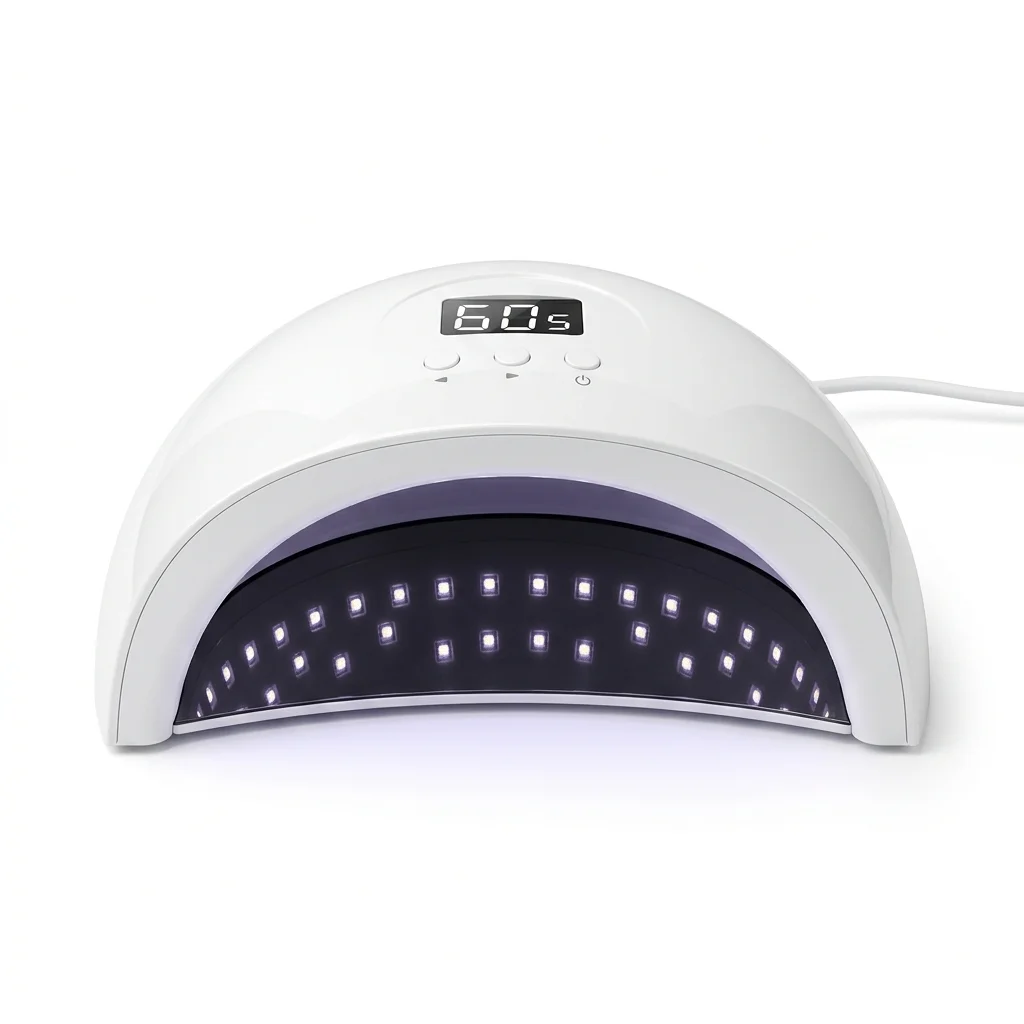
The SUNUV Sun1 is listed as a compact corded UV LED nail lamp with 24W and 48W mode labels, 30 dual-light LED beads, 365nm and 405nm wavelengths, five-, 30-, and 60-second timer presets, an automatic sensor, and a removable magnetic base. Those controls and the detachable tray are the meaningful reasons to compare it with other home gel lamps. Its appeal is less about a generic wattage number than about whether its timer layout, desk-ready corded format, and open-base design fit the way you already use a compatible gel system.
Editorial dek: The Sun1 is a feature-specific buy for shoppers who want a short directed flash-step button, standard timed presets, and easier access beneath the lamp. It is not the right shortcut for anyone whose gel maker requires a different lamp, a different timing sequence, or documented output data.
Evidence note
This is a listing-led buyer assessment, not an independent laboratory or wear test. We did not independently verify the Sun1's power settings, irradiance, wavelengths, LED placement, sensor response, timer accuracy, interior coverage, cable length, dimensions, magnetic retention, or compatibility with particular gel formulas. References to 24W, 48W, 30 dual-light LEDs, 365nm and 405nm wavelengths, listed dimensions, and use with gel polish, builder gel, or hard gel are manufacturer or retailer listing claims. Gel makers' instructions for their exact formula remain the decision-making authority.
The three standout features
Adjustable 24W and 48W labels
The listing identifies two labeled settings: 24W and 48W. That gives the Sun1 a more flexible-looking control layout than a lamp with one stated power level, but it does not create a universal timing chart. Wattage labels do not, by themselves, confirm emitted output at the nail, coverage at the thumb, formula compatibility, or whether one setting is intended for a particular gel category. The supplied information also does not explain how the two modes relate to individual timer presets.
In practical terms, treat the mode control as an available option to use only when the gel system's directions support it. Do not assume that the higher-numbered label is automatically better, faster, or appropriate for thicker applications. A gel polish, builder product, or hard-gel system may specify its own lamp, wavelength range, layer thickness, and timing sequence. Those instructions matter more than a lamp's front-panel number.
The five-second preset is for a directed flash step
The five-second button is the Sun1's most distinctive timer feature, but it needs a narrow interpretation. A brief preset can be convenient when a compatible product's directions call for a short flash or set stage before the next part of an application. Depending on the system, that may mean temporarily holding a small nail-art placement in place, following a directed extension-tip positioning step, or setting an initial detail before a subsequent manufacturer-specified timed exposure.
It should not be treated as a completed cure for a full manicure, a builder layer, a hard-gel overlay, an extension, or every piece of nail art. Five seconds is not a substitute for the complete process and timer specified by the formula maker. If a product's directions do not call for a brief step, the presence of the button is not a reason to add one. The practical value here is convenience for an existing documented workflow, not permission to invent a shorter one.
A removable magnetic base changes access more than performance
The removable magnetic tray is the clearest format feature in this category. A base that lifts away may make it easier to reach the bottom interior for routine cleaning and to approach the lamp from below when considering toe placement. It also gives the Sun1 a more adaptable shape than a fully enclosed lamp where the floor is fixed in place.
That said, an open base is not confirmation of pedicure fit. The supplied listing information does not establish foot opening clearance, toe coverage, whether all toes fit comfortably at once, or whether a particular foot position receives appropriate exposure for a compatible system. Think of the magnetic base as an access and maintenance benefit, then check current dimensions and product images against the space and use case you have in mind.
What the listing says
The table below separates the listed specifications from the questions they do and do not answer for a buyer.
| Feature | Manufacturer or retailer listing claim | What it helps you decide |
|---|---|---|
| Modes | Adjustable 24W and 48W settings | Useful only when the selected gel system supports the setting and timing. |
| LED array | 30 dual-light LED beads at 365nm and 405nm | Compare the stated wavelengths with the exact gel maker's requirements. |
| Timers | Five, 30, and 60 seconds | A focused preset selection, including a short directed flash-step option. |
| Base | Removable magnetic tray | Potentially helpful for interior access, cleaning, and evaluating toe placement. |
| Sensor | Automatic hand sensor with on/off function | A convenience feature, not a substitute for correct hand placement. |
| Cable | Approximately four feet | Measure outlet-to-desk distance before buying. |
| Size and weight | Approximately 9.1 by 7.9 by 4.3 inches and 1.2 pounds | Relevant for drawer storage, desktop footprint, and travel expectations. |
| Listed gel categories | Gel polish, builder gel, and hard gel | A broad category claim that still requires formula-by-formula confirmation. |
How the mode and preset workflow should work
The most sensible Sun1 workflow begins before any button is pressed: identify the instructions for the exact base, color, builder, hard gel, extension product, or top coat being used. Confirm the recommended lamp if one is specified, then follow the stated application thickness and timed exposure steps. The lamp's buttons should support that routine, not rewrite it.
- Set the lamp on a stable, dry desk surface and connect it with the supplied or manufacturer-approved power setup.
- Choose a 30- or 60-second preset only when that corresponds with the formula's directions. Do not choose a preset based solely on the lamp's 24W or 48W label.
- Use the five-second preset only for a clearly directed brief flash or positioning stage. Return to the manufacturer-specified timed step afterward where required.
- Place the hand fully inside without stacking fingers or hiding one nail behind another. Keep the hand in position for the directed time rather than treating sensor activation as confirmation of adequate exposure.
- Repeat only as the product instructions direct. More button presses do not resolve a compatibility question or replace an incorrect application method.
The listing says the Sun1 has an automatic sensor with an on/off function. That can reduce the friction of starting a routine, particularly when both hands are occupied, but the sensor is an activation convenience. It does not assess whether every nail is oriented well, whether the selected mode fits the product, or whether the application has followed the gel maker's instructions.
Hand and thumb placement deserve more attention than the sensor
For any lamp with a compact enclosure, placement is a buyer issue rather than an afterthought. Keep fingers comfortably separated, with nail surfaces facing upward and the hand resting flat enough that nails are not angled away from the LEDs. Avoid curling fingers tightly, layering one finger over another, or tucking the thumb beneath the fingers. Those positions can make it harder to judge whether all nail surfaces are presented consistently.
The thumb deserves a separate check because its natural angle differs from the four fingers. Depending on hand shape, the opening, and the product's instructions, processing the thumb separately may allow a more direct position. That is not a claim that the Sun1 requires separate-thumb use or that it solves coverage; it is a practical placement consideration. The listing does not provide independent coverage mapping or thumb-specific performance information.
Magnetic base: cleaning access and pedicure reality
For routine upkeep, the removable base may be more useful than it first appears. Nail dust, lint, and accidental product residue are easier to see when the floor of a lamp can be accessed. Before removing or cleaning the tray, disconnect power and follow the current manufacturer cleaning instructions. Use only the cleaning method the brand permits, avoid allowing liquid into the housing or around electrical components, and make sure the base is dry and free of debris before reseating it.
Check that the tray sits flush and that the magnetic contact area is clear. A removable floor that is not seated correctly can make the lamp less stable on the desk, even if it still appears to attach. Do not force the base, use a damaged tray, or continue with a housing, cord, adapter, or sensor area that shows damage.
For pedicure shoppers, the base may make the lamp easier to bring toward toes or easier to clean between cosmetic uses. It does not establish that the Sun1 is a dedicated pedicure lamp. Foot size, toe spacing, chair height, cable reach, and the ability to place all intended nails under the lamp matter. If pedicure access is the main reason for purchase, verify the current opening and dimensions rather than relying on the removable-base description alone.
What corded desk use looks like
The listing describes an approximately four-foot cable, which is enough for some vanity, kitchen-table, or desk setups but not every outlet arrangement. Measure from the outlet to the intended station, allowing for the adapter and a little slack. The Sun1 makes the most sense as a settled workstation lamp: one that can remain on a flat surface near power rather than being moved room to room without planning.
Keep the cable out of a footpath, avoid pulling it tight around desk edges, and do not use a substitute adapter unless the manufacturer specifically allows it. A corded model eliminates recharge planning, but it also makes outlet location part of the purchase decision. For a broader comparison of stationary and portable formats, see our cordless versus plug-in nail lamp guide.
How to decide before checkout
The Sun1 is worth considering when its specific controls solve an actual need: you use a compatible system, want five-, 30-, and 60-second presets, prefer the option of two labeled modes, and value a removable floor for access and cleaning. It is less compelling if the decision is based only on the 48W label or the general promise of broad gel compatibility.
A quick decision checklist
- Does your exact gel maker permit this lamp type, wavelength range, and timing approach?
- Do your instructions actually call for a five-second flash or positioning step?
- Will an approximately four-foot cord reach your intended desk without creating a cluttered setup?
- Do the listed dimensions fit your storage space and working surface?
- Is removable-base access useful for your cleaning routine or toe-placement needs?
- Can you accept that irradiance, coverage, and formula-specific validation are not established by the supplied listing details?
The buyer it makes sense for—and the one who should move on
The Sun1 has a clear audience: the at-home gel user with a compatible product routine who wants a compact corded lamp, straightforward timed buttons, and an accessible removable base. It is particularly logical for someone who already follows brand-directed timing and wants the five-second button available for occasional, documented flash-step work rather than as their default setting. The sensor may also appeal to shoppers who want a less fussy desk experience.
Leave it in the cart if your preferred gel brand mandates another lamp, if you need a 90- or 120-second built-in preset, or if you require published irradiance and verified coverage details before choosing a lamp. It is also not the best match for someone who needs cordless portability, guaranteed full-foot pedicure clearance, or a lamp selected solely to make unknown formulas work faster. Those are different purchase priorities than the ones this listing directly addresses.
Compatibility and practical limitations
The listing's statement that the Sun1 works with gel polish, builder gel, and hard gel is a product-category manufacturer or retailer claim, not independent confirmation that every formula in those categories is compatible. Categories are broad. Formula chemistry, pigmentation, opacity, layer thickness, extension systems, and brand-specific lamp requirements can differ substantially. Check the exact product label or manufacturer guidance for the recommended lamp, wavelength, application method, and time.
The practical limitation is simple: the supplied details do not tell a buyer the lamp's irradiance, exposure distribution, actual output at each mode, or validated timing for a named formula. Thirty LEDs and a 48W label may be useful comparison points, but neither replaces those details. Buyers who need that level of documentation should select a system that publishes it or use the lamp specified by their gel maker.
Use boundaries
- Use the lamp only for cosmetic nail products and steps that its manufacturer and the gel maker support.
- Keep uncured gel off skin and follow the product's preparation, application, and removal directions.
- Use the five-second setting for a directed brief step, not as a universal finished process.
- Do not use damaged electrical parts, housing components, or a damaged magnetic tray.
- Clean the base and interior only according to current manufacturer guidance.
FAQ
Does the 48W setting mean the Sun1 will work faster?
Not necessarily. The 48W label is a listing claim, and the supplied information does not connect it to verified output, coverage, or a formula-specific time reduction. Follow the gel maker's stated directions.
Can the five-second button replace a regular timer?
No. Its sensible role is a brief manufacturer-directed flash or positioning stage. It should not replace the full timed process required for gel polish, builder gel, hard gel, extensions, or top coats.
Is the removable base enough reason to buy it for pedicures?
It can make toe-level access and cleaning easier to consider, but it does not confirm foot clearance or all-toe coverage. Verify dimensions, opening space, and your product system's requirements first.
Does the automatic sensor ensure correct placement?
No. A sensor may start the lamp when a hand enters, but it does not confirm finger spacing, thumb orientation, formula compatibility, or the appropriate timer selection.
Final call
The Sun1's strongest case is its combination of listed 24W and 48W controls, five-second preset, 30- and 60-second timers, compact corded format, sensor, and removable magnetic base. Buy it when those specific features fit a gel routine whose instructions support the lamp and timing. Pass when you need mandated-brand compatibility, documented output and coverage, longer built-in timers, cordless freedom, or confirmed pedicure clearance. The five-second button and magnetic tray are useful differentiators; they are not substitutes for a compatible, carefully followed cosmetic gel system.