
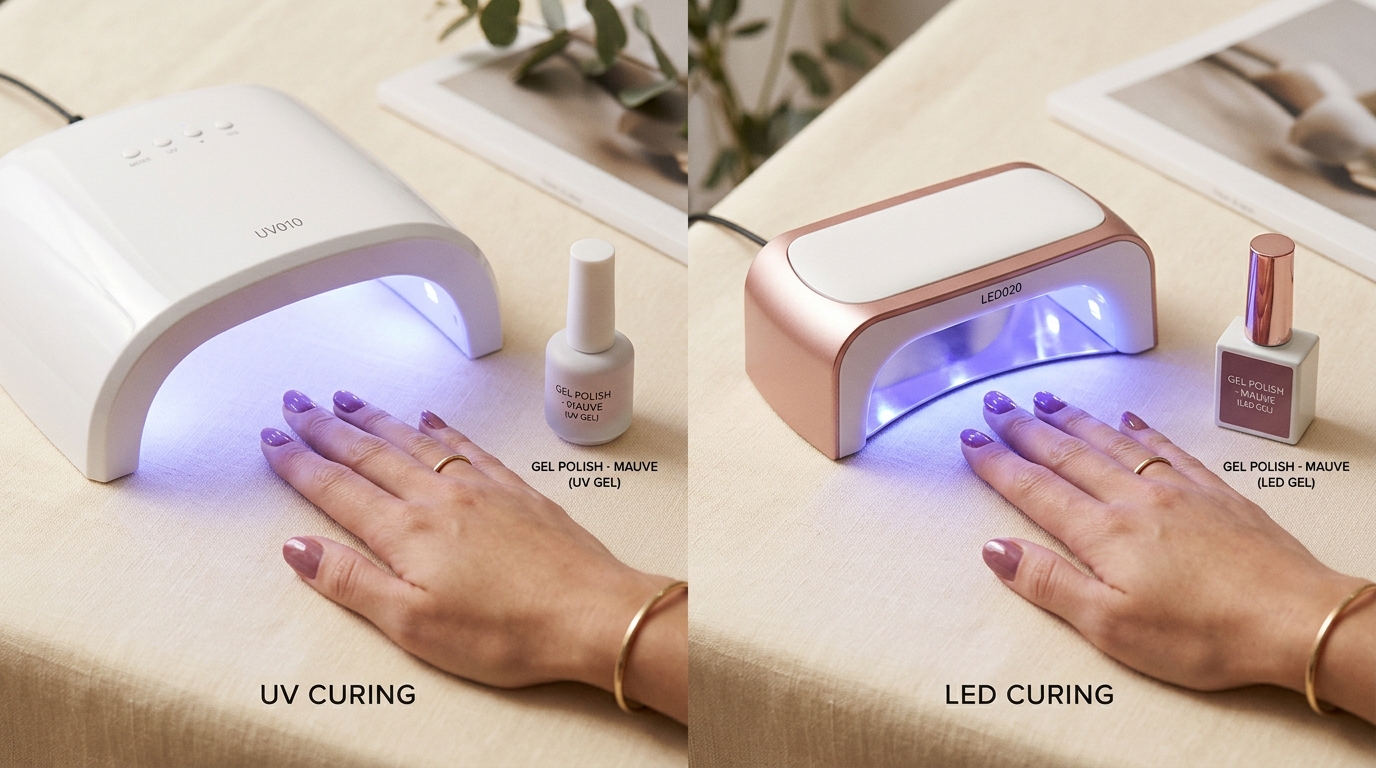
“UV lamp†and “LED lamp†sound like opposite choices. In modern gel manicures, they usually describe different ways of producing ultraviolet light—not a simple safe-versus-unsafe or slow-versus-fast split. The decision that matters is whether the lamp’s output matches the photoinitiators in the gel system you are using.
Updated: July 2026. This guide explains compatibility concepts; it cannot verify an untested lamp-and-gel pairing.
UV and LED are not opposites
Ultraviolet describes a region of light. LED describes the technology producing light. An LED nail lamp still emits UV-range energy chosen to activate gel photoinitiators. Older “UV lamps†commonly used fluorescent-style bulbs across a broader band, while modern LED lamps use diodes concentrated in narrower bands and can switch on instantly.
That is why the store shelf now includes labels such as UV/LED, dual LED, dual wavelength, and smart UV. The words are often marketing shorthand. The useful specification is the output band and whether the gel brand has validated it.
| Label | Usually means | Practical implication |
|---|---|---|
| Traditional UV bulb lamp | Replaceable fluorescent-style UV bulbs with broader output | Can work with compatible legacy systems; bulbs age and require replacement |
| LED lamp | Diodes emitting selected UV bands | Instant operation and long diode life; compatibility still formula-specific |
| UV/LED or dual-source | Diodes targeting two common bands, often around 365/405nm | Broader common compatibility, not proof of universality |
| Flash-cure lamp | Small focused LED tool | Useful for holding tips/designs; not automatically a final full-hand cure |
The lock-and-key relationship
Gel contains photoinitiators that absorb suitable light and begin polymerization. Think of the initiator as a lock and the lamp output as a key. A light can be bright, high-wattage, and visually purple yet fail to activate a particular formula efficiently. The surface may become firm while deeper material remains incompletely cured.
This is why touching the top is not a cure test. Many gels intentionally leave an inhibition layer, while an under-cured product can feel deceptively hard at the surface. The manufacturer’s validated lamp, layer instructions, and cure schedule provide a stronger safety basis than a thumbnail press or wipe experiment.
What 365nm and 405nm mean
Nanometers describe wavelength. Many consumer dual-source lamps advertise output near 365nm and 405nm because common gel photoinitiators absorb in or around those regions. The numbers do not tell you irradiance, beam uniformity, or whether enough energy reaches a thumb tucked near the edge of the dome.
A dual-band claim is useful context. It is not a passport for mixing every base, color, builder, glue, and topcoat in one lamp. Ask the product brand which lamp and time it supports, especially for structured gels and extension adhesives that create thicker layers.
Why LED earned a “faster†reputation
LED systems can concentrate efficient output in the band a matched formula uses, so validated LED gels often specify shorter cure cycles than older bulb systems. That does not mean any LED lamp cures any gel faster. A 30-second instruction belongs to a product-and-lamp combination, not to the word LED.
Do not shorten a manufacturer cure schedule because another brand cures in less time, and do not assume doubling time repairs an incompatible pairing. If light does not penetrate a thick pigmented coat or does not match the initiator, extra seconds cannot guarantee the correct reaction.
Wattage is not the compatibility answer
Wattage describes electrical power consumption. It does not directly state wavelength, irradiance at the nail, or uniformity. Two 48W lamps can position different diodes at different distances and deliver different exposure to the thumb. A well-designed lower-wattage system validated for its gel can be the better choice.
Use wattage only as one manufacturer-provided descriptor. Prioritize explicit compatibility, full-hand geometry, LED layout, clear timing, and system instructions. Our best UV/LED nail lamps guide follows that order rather than ranking by the largest number.
Should you stay inside one brand system?
For the clearest compatibility path, yes. A brand that sells and validates both gel and lamp can specify the combination it has evaluated. That does not make every closed system perfect, and it does not mean cross-brand use always fails. It means the burden of proof is lower.
If you mix brands, obtain wavelength and lamp guidance from the gel manufacturer. Keep records of the products and lamp used. Do not treat a successful-looking manicure as proof that the underside of every layer reached an adequate cure.
How hand placement changes the result
The lamp can only expose what its light reaches. Fingers should lie flat and separated according to instructions. Thumbs frequently rotate away from side LEDs, so curing them separately and flat is often more reliable. Long extensions and deep sidewalls can create shadows. A roomy dome and thoughtful diode layout help, but positioning remains part of the procedure.
Four fingers cure, thumbs wrinkle: placement is the first suspect; cure thumbs flat according to the system.
Dark color stays soft: check coat thickness, pigment, compatibility, and instructions—not only time.
One side repeatedly fails: inspect placement and LEDs for blockage or failure.
Every product fails: stop using the lamp until output and compatibility are assessed.
Traditional bulb lamps still have a use—but maintenance matters
Some legacy gel systems were designed around traditional UV bulb lamps. Bulbs lose useful output over time even while they continue to glow, and replacement schedules matter. Reflective interiors, clean surfaces, and correct bulb type also affect performance.
Do not replace a specified bulb with a random visually similar bulb. If a legacy system is no longer supported, contact the brand before improvising a modern lamp substitution.
What about UV exposure?
Both traditional bulb and LED gel lamps use ultraviolet-range light. Exposure is intermittent, but individual risk questions belong with a qualified medical professional. Follow product instructions, avoid unnecessary cycles, and consider properly designed fingerless UV-protective gloves if appropriate. Gloves do not solve under-cured gel or skin contact.
Remove uncured gel from skin before curing. Repeated skin contact with uncured acrylates is a preventable sensitization risk. Correct application and complete curing are central safety practices—not optional polish technique.
A compatibility checklist before you cure
- Identify the exact gel product and type.
- Read the brand’s lamp, wavelength, layer, and time instructions.
- Confirm your lamp model fits those requirements.
- Inspect the lamp, cord/adapter, interior, and LEDs.
- Apply the product at the stated thickness without touching skin.
- Position fingers as instructed; treat thumbs separately if needed.
- Run the complete prescribed cycle.
- Stop using combinations that wrinkle, stay soft, or behave inconsistently.
Frequently asked questions
Is LED safer than UV for gel nails?
Both can emit ultraviolet-range light. “LED†describes the source technology, not zero UV exposure. Compatibility, correct use, and exposure decisions matter.
Will a UV/LED lamp cure regular nail polish?
No. Regular lacquer dries by solvent evaporation and does not become dry because of a gel curing lamp.
Can a 365/405nm lamp cure every gel?
It covers common bands but is not a universal guarantee. Follow the gel manufacturer’s validated pairing.
Why does my topcoat stay sticky?
It may have an intentional inhibition layer. Check product instructions before assuming under-curing. If the layer is soft rather than simply tacky, stop and verify the system.
Can I use a mini lamp for a full manicure?
Only if the product manufacturer explicitly validates that lamp and procedure. Many mini lamps are intended for flash positioning, not final full-hand curing.
How to read a product listing without getting distracted
Start with the gel system, then look at the lamp. A listing that names wavelengths, compatible product types, timer modes, and hand placement gives you more useful information than one that only says “professional†and “fast.†If the page says “all gels†but gives no output or compatibility detail, treat that as a marketing claim.
Look for a full-hand shape, LEDs around the sidewalls, a thumb-friendly interior, and a removable base if you also do pedicures. A countdown display helps with workflow; it does not prove a cure. Sensors are convenient, but a manual timer should remain available.
When a mixed-brand setup makes sense
People mix brands because a favorite color comes from one company and a lamp from another. That is not automatically wrong, but the gel maker’s instructions become more important. Keep coats thin, do not cure product on skin, and do not use a hard surface as proof that a layer is fully polymerized.
For builder gel, extension gel, and adhesive products, be especially conservative. These products may be thicker, more pigmented, or designed around a proprietary lamp. A general consumer lamp can be convenient while still being the wrong tool for that specific system.
Signs a lamp is not a good match
- Repeated wrinkling despite thin, correct application.
- Soft material under a firm surface.
- One side or the thumbs fail across multiple sessions.
- The product brand specifically names a different lamp.
- You keep adding time without a consistent cure.
A simple buying decision
Use one brand system: buy the validated lamp first.
Use several consumer gels: choose a reputable full-hand dual-source model with clear instructions, then verify each formula.
Mostly do nail art: add a flash lamp for holding details, but keep a full-cure lamp.
Have long extensions: prioritize interior depth and thumb/sidewall placement over compactness.
FAQ: compatibility in real life
Do LED lamps damage gel?
The label LED does not answer that. Incorrect formula pairing, under-cured product, skin contact, and poor application create more meaningful concerns than the category name.
Can I cure builder gel in a small LED lamp?
Only when the builder-gel manufacturer validates that lamp and method. Thick product needs correct exposure through its full depth.
Does a dual-source lamp cure faster?
It may cure a matched formula efficiently, but follow the formula’s complete cure time. Faster is not automatically more complete.
Bottom line
UV versus LED is the wrong final question. Ask whether the output matches the gel, whether the geometry reaches the whole nail, and whether you can follow the complete system instructions consistently.
Editorial standard: Specifications describe intended design, not laboratory verification. When a listing and a gel manufacturer disagree, follow the gel system or stop using the pairing. Keep product off skin and seek qualified help for persistent irritation.
The safest shortcut remains simple: match the lamp to the formula, not the label to the trend.
The bottom line
Choose compatibility before category labels. A modern dual-source LED lamp is convenient and broadly useful, but the gel formula still gets the final word. The correct question is not “UV or LED?†It is “Which lamp has this gel system been designed to use?â€
