Editorial dek: A cordless nail lamp can make a manicure setup feel less tethered to one outlet, but portability comes with its own maintenance routine. This listing-led review looks at the rechargeable battery, USB-C connection, timer selection, transport considerations, and fixed-station tradeoffs behind this listed 72W UV LED nail lamp.
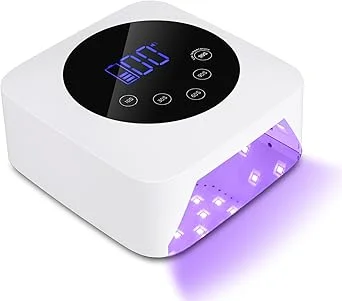
This model is listed with a 5200mAh rechargeable lithium battery, USB-C charging, dual 365nm and 405nm LEDs, touch controls, an automatic hand-and-foot sensor, five timer settings, and a reflective base plate. The combination is easy to understand: it is positioned as a lamp that can move from a vanity to a kitchen table, storage shelf, or occasional pedicure area without requiring a permanently available wall outlet.
That does not automatically make it the better choice for every gel user. A cordless lamp is primarily a workflow purchase. The central question is not simply whether a battery is convenient; it is whether charging, monitoring charge availability, carrying the unit, and occasionally operating around a cable are easier than keeping a conventional lamp plugged into a dedicated spot.
Evidence note: The specifications discussed here come from the product listing and are not independently tested findings. The listing does not provide irradiance measurements at the nail surface, light-distribution mapping, third-party battery-cycle data, confirmed pass-through operation, or brand-by-brand gel validation. Dimensions, weight, output, charging time, runtime, LED lifespan, and included accessories should be confirmed on the current retailer or manufacturer page before purchase.
Start with the cordless question
A cordless lamp makes the most sense when an outlet is genuinely inconvenient. Perhaps your usual manicure surface is shared, your outlet is behind furniture, you prefer to store nail supplies away between uses, or you want to set up in more than one room. In those cases, eliminating a power cord during the service can simplify the visual clutter and make the station easier to reset.
The listing gives approximate dimensions of 9.5 by 8.5 by 4.5 inches and an approximate weight of 1.8 pounds. If current, those figures suggest a portable countertop appliance rather than a tiny travel light. It may be easy to relocate around a home, but it still needs protective storage and a level surface. For buyers who expect to carry it frequently, the shape, base construction, and room required in a tote or case matter as much as the published weight.
By contrast, a fixed plug-in lamp can be the more frictionless option when it will live at one desk. There is no battery to top up before a session, no uncertainty about whether the unit was put away partly charged, and no need to reserve time for recharging. If your lamp is used in the same place every time and a nearby outlet is available, cordless freedom may add more routine than value.
Portability is not the same as travel readiness
“Cordless” can mean convenient room-to-room movement, but it should not be read as a promise that the lamp is ideal for every travel scenario. A lamp with an internal lithium battery needs to be protected from crushing, excessive heat, spills, and loose objects that could press against the controls or damage the USB-C port. If airline travel is part of the plan, check the airline and transportation authority’s current rules for devices with installed lithium batteries before packing. Policies can differ by carrier, route, and battery rating.
For local transport, a padded compartment or fitted case is more useful than dropping the lamp loose into a bag with bottles, metal tools, and cables. Keep the charging cable separate enough that its connector cannot scrape the lamp interior or bend under the lamp’s weight. The listing does not establish that a travel case is included.
Battery aging and charge-state uncertainty
The listed 5200mAh battery is the feature that separates this lamp from a standard corded model, but capacity alone does not answer how the lamp will fit a real routine. Milliamp-hours describe battery capacity in a limited way; they do not reveal the lamp’s actual power draw during a given timer cycle, battery-management behavior, or how much capacity will remain after months or years of use.
The listing states an approximate three-to-four-hour charge time and approximately 2.5 to three hours of continuous runtime. Those are useful planning estimates, not guarantees. Runtime can vary with battery age, starting charge level, ambient conditions, whether the lamp has been sitting unused, and how the lamp manages its LEDs and display. Timer-based use is also different from uninterrupted operation. A shopper may reasonably translate the published runtime into several at-home sessions, but the listing does not say how many full manicures, pedicures, or timer cycles that represents.
Rechargeable lithium batteries gradually lose usable capacity over time. That is normal ownership behavior, not necessarily a defect, and it matters more in a lamp that is bought specifically to avoid an outlet. A unit that initially suits occasional use may eventually require more frequent charging. For that reason, a cordless purchase is easier to justify when occasional recharging is acceptable rather than when uninterrupted availability is essential.
Charge-state uncertainty is the practical downside. Unless the current instructions specifically describe a battery-level indicator, do not assume that the timer display doubles as a precise battery gauge. A display may show selected timing or operating status without telling you exactly how much charge remains. It is worth checking the manual or product Q&A for answers to three basic questions: how low charge is indicated, whether the lamp gives any warning before it stops, and whether it remembers the last timer selection after charging or power interruption.
A better charging routine than last-minute charging
For occasional home use, charging after a session rather than immediately before the next one is often the simplest habit. It lets you begin with a predictable charge state and avoids discovering that the lamp needs several hours on a cable just as you are ready to use it. For a multi-location setup, return the lamp to one known charging spot after it has been cleaned and cooled.
Avoid treating every USB-C cable as automatically interchangeable. USB-C identifies the connector shape, not the exact charging specification, adapter output, charging speed, or supported power-delivery behavior. The current listing or manual should identify the required input and whether a wall adapter is included. A USB-C cable in the box does not necessarily mean an adapter is included, and an adapter from another device is not automatically the recommended choice.
Battery and charger questions to answer before buying
| Listing detail | Decision value | What to verify |
|---|---|---|
| 5200mAh rechargeable battery | Supports cord-free placement during use. | Whether occasional recharging works for your expected frequency of use. |
| USB-C charging | May reduce the number of proprietary cables in a beauty drawer. | The specified charging input, included cable, included adapter, and replacement-cable guidance. |
| Approximate 3-to-4-hour charge time | Sets the likely recharge window. | Whether the estimate applies with the included charging arrangement. |
| Approximate 2.5-to-3-hour continuous runtime | Provides a rough starting point for portable planning. | Whether the manual explains low-battery behavior and battery-status indication. |
| Touch controls and display | Can create a cleaner exterior than a button-heavy lamp. | Whether the controls are easy for you to use and clean around. |
| Internal battery | Makes the unit movable without an active outlet. | Warranty terms, battery-service policy, and whether replacement is offered or addressed. |
Can it be used while charging?
This is one of the most important unanswered questions for a cordless lamp. The supplied listing describes USB-C charging but does not, on its own, establish whether the lamp supports use while charging, sometimes called pass-through operation. Buyers should not assume that connecting a cable turns the lamp into a continuously powered fixed-station unit.
Some rechargeable devices are designed to operate only after being disconnected from their charger; others may work when plugged in but have particular adapter requirements; still others may charge more slowly or behave differently while operating. Only the manufacturer’s instructions for the current model can answer that question. Ask before buying if uninterrupted use matters to you.
Even if a lamp is documented to run while connected, that does not erase the cordless tradeoff. You will still want a stable outlet location, enough slack to prevent pulling on the port, and a cable path that does not cross a work area. If the lamp will spend most of its life plugged in, a conventional corded lamp may be a simpler comparison.
Timers and the mobile workflow
The lamp is listed with 10-, 30-, 60-, 90-, and 120-second settings, along with an automatic hand-and-foot sensor. A wider timer range can be useful when product directions call for different intervals across a manicure routine. The short setting may be convenient where a product system directs a brief interval, while longer settings can reduce the need to restart the lamp manually. Touch controls and a sensor can also keep a mobile station less fussy when your hands are occupied.
Still, convenience features do not eliminate setup discipline. A portable station needs a flat, dry surface with enough clearance for the lamp and hand placement. Plan where bottles, wipes, tools, and the charging cable will sit before opening product containers. A crowded surface raises the odds of spilling uncured product or bumping the lamp during a timer cycle.
The listed reflective base plate may appeal to shoppers who prefer a brighter-looking interior and a removable-looking cleanup zone, but the listing should be checked for whether the plate is actually detachable. The presence of a reflective surface is not, by itself, documentation of output uniformity or a particular result across every nail position.
Output uncertainty in plain terms
The listing identifies 72W output and dual 365nm and 405nm LEDs. Those are relevant comparison specifications: the wavelengths may be useful when reviewing the directions supplied with a gel product, and the 72W label can help distinguish one retail listing from another. But wattage is not a direct substitute for irradiance at the nail surface, interior coverage, LED placement, output consistency, or testing with a particular gel formula.
Cure compatibility caveat: Use the lamp only when your gel manufacturer’s wavelength, timing, nail-placement, and lamp guidance support it; a listed 72W rating alone does not establish that a gel has cured as directed.
The absence of published irradiance and coverage data will matter most to shoppers who want detailed technical documentation, use products with highly specific lamp instructions, or rely on a system that names its own lamp. In that situation, the documentation attached to the gel system should carry more weight than the appeal of a cordless lamp body.
What is published for this model
- Output: listed as 72W.
- Light range: listed dual 365nm and 405nm LEDs.
- Battery: listed 5200mAh rechargeable lithium battery.
- Charging: listed USB-C connection.
- Timers: listed 10, 30, 60, 90, and 120 seconds.
- Sensor: listed infrared hand-and-foot detection.
- Base: listed mirror-reflection plate.
- Size and weight: approximately 9.5 by 8.5 by 4.5 inches and 1.8 pounds, according to the listing.
- LED lifespan: listed as 50,000 hours; this is a manufacturer rating rather than a publication longevity finding.
Who this cordless lamp may suit
This format may appeal to a home user whose manicure space changes from week to week and who does not want a cable permanently visible on a vanity or desk. It can also make sense for someone who stores supplies in a closet and wants to bring out one self-contained lamp instead of planning a station around an outlet. The listed USB-C charging arrangement may be especially appealing to shoppers trying to reduce proprietary cords in a small beauty setup.
It is also a sensible category to consider for occasional pedicure use when there is no convenient outlet near a stable, comfortable footrest. The relevant benefit is placement flexibility, not a promise of a larger interior or superior coverage. Check the opening dimensions and current product photographs if foot placement is a deciding factor.
Who should probably skip it
A continuously used fixed station is the clearest reason to look elsewhere. If the lamp will remain at the same desk, needs to be ready without advance planning, or is part of a routine where a mid-session battery issue would be especially frustrating, a plug-in model avoids the battery-management layer entirely.
This is also not the strongest fit for buyers who need extensive technical documentation, confirmed testing with a preferred gel line, a specified pass-through charging function, or a replaceable-battery plan. The current listing does not provide enough detail to settle those points. Buyers who dislike touch controls, do not want to monitor battery charge, or often forget to recharge small appliances may find a corded design more practical despite its cable.
Cleaning, storage, and cosmetic foot-care boundaries
Clean the lamp according to its manual, and disconnect it from charging before cleaning. Let the unit cool if it has been in use. A soft cloth used as directed by the manufacturer is the cautious starting point for the exterior; avoid flooding seams, LEDs, the sensor area, vents if present, or the USB-C port with liquid. Do not use solvents, abrasive tools, or sprays unless the manufacturer specifically permits them for the lamp materials.
Keep uncured gel from collecting on the base, controls, and interior surfaces. If a spill occurs, follow the product and lamp instructions for cleanup rather than scraping aggressively near LEDs or sensor components. Store the lamp dry, protected from direct heat, and away from places where it could be knocked to the floor. Do not charge or use it with a damaged cable, damaged port, cracked housing, or a battery-related odor, swelling, or unusual heat concern.
For pedicure use, keep the setup within ordinary cosmetic nail care: use a clean, stable surface and avoid placing the lamp over broken, irritated, or otherwise compromised skin. The lamp is for curing nail products, not for treating foot concerns. If you are building a safer home routine, our gel label and skin-contact guide covers product handling and skin-contact habits in more detail.
Cordless decision checklist
- Do you regularly use your lamp somewhere without a convenient outlet?
- Will you realistically recharge the lamp after use or before a planned manicure?
- Does the current listing identify the charging cable, adapter requirements, and warranty terms?
- Have you confirmed whether the model can operate while charging, if that matters to your routine?
- Can you store it in a protected place rather than loose in a crowded drawer or tote?
- Does your preferred gel system provide directions that support using this lamp?
- Would a plugged-in lamp actually be easier if your setup never moves?
- Are the listed dimensions appropriate for both your hand use and any intended foot use?
If your answers lean toward one dedicated station and always-on availability, compare this category with our cordless versus plug-in nail lamp guide. If they lean toward flexible placement and occasional use, the battery routine may be an acceptable exchange for a cleaner, more movable setup.
FAQ
Does USB-C mean this lamp can use any phone charger?
No. USB-C describes the connector, not the required charging specifications. Confirm the recommended cable, adapter input, and charging instructions in the current manual or listing.
How long will the battery last in normal use?
The listing claims approximately 2.5 to three hours of continuous runtime, but it does not translate that estimate into a set number of sessions. Battery age, charge state, operating conditions, and timer usage can affect real-world planning.
Can this cordless lamp replace a plug-in lamp?
It can be a practical alternative when mobility is the priority and you are comfortable maintaining the charge. It is less compelling for a lamp that will stay in one location and needs to be ready at all times.
Is the reflective base plate easy to clean?
The listing identifies a mirror-reflection plate, but cleaning method and removability should be verified in the manual. Do not assume it is detachable or suitable for strong cleaning products.
Final verdict
This listed 72W cordless UV LED nail lamp has a straightforward appeal: a rechargeable 5200mAh battery, USB-C charging, five timer options, touch controls, a sensor, dual listed wavelengths, and a portable countertop size. Its strongest argument is flexible placement, not independently documented universal performance. Buy it if cord-free movement solves a real setup problem and you are willing to manage charging, storage, and charger verification. Choose a plug-in alternative if your priority is a permanently ready fixed station or more complete technical documentation.