A home foot spa can add ritual to an at-home pedicure, but feature count is a poor proxy for a good purchase. Start with the basin, your setup space, and the care it requires after use; then decide whether heat, bubbles, rollers, or a digital display will earn their place in your routine.
Quick answer
Choose a foot spa that fits near a stable seat and outlet, can be emptied without an awkward carry, and has an interior you can rinse, wipe, dry, and store easily. Heat, bubbles, rollers, and folding designs can be worthwhile, but only when they suit the way you plan to use and maintain the appliance.
Foot spa features: what they add and what to verify
| Feature | What it can add | What it does not establish | Shopping question |
|---|---|---|---|
| Heat or heat-maintenance setting | May help water stay warmer during a longer soak. | Whether cold water heats quickly, whether warmth is even throughout the basin, or how the setting feels for you. | Does the listing distinguish between heating water and maintaining pre-warmed water? |
| Bubbles | Adds water movement, sound, and a more animated soak. | Strong massage or a quiet operation. Depending on fill level and movement, bubbles may also call for more attention to splashing and the rim. | Will you enjoy the sound and water movement where you plan to use it? |
| Rollers | Provides a textured area for moving your feet across. | Comfort, adjustability, or simple cleanup. Roller tracks and recessed sections are design details worth checking for access during cleaning. | Are the rollers fixed or powered, and can you reach around them easily? |
| Temperature display | Offers a reference point while filling or using the basin. | That water will feel the same in every area of the tub or align with your personal comfort preference. | Can you read the display from your chair and operate the controls comfortably? |
| Splash guard | May help contain movement near the basin rim. | A spill-proof setup, particularly when the filled unit must be moved or tipped. | Is the opening comfortable for your feet, and can you wipe around the guard afterward? |
| Drain | Can reduce the need to lift a filled basin over a sink or tub. | That emptying will be easy in every room; drain location and the route to a tub, shower, or sink still matter. | Where is the drain, and can you use it without a difficult lift or tip? |
| Foldable design | May lower storage height for a closet, cabinet, or under-bed space. | A smaller operating footprint, lower weight, or simpler post-use care. | Will the folded dimensions fit your storage space after the unit is fully dry? |
| Cord and footprint | Determines where the spa can sit and how much room the session requires. | That a compact product photo will work beside your chair, outlet, towel, and path to empty the basin. | Can it rest on a level, dry surface without placing the cord across a walkway? |
Shop from the listing outward
Start with the manual, dimensions, care directions, and return policy rather than the product’s headline features. Product photography often emphasizes the front panel and decorative details while leaving out the underside, drain placement, handle shape, cord exit, and interior texture. Those less-photographed areas often determine whether a model works in a particular home.
Measure the full setup, not only the unit. You need room for a chair, your knees and feet, a towel, and a path to the place where water will be emptied. Check the distance to the outlet as well. A foot spa should sit naturally on a firm, level, dry surface; it should not depend on a stretched cord, unstable furniture, soft bedding, or a narrow route through a busy room.
Read feature language literally. “Heated” can describe active heating, warmth maintenance, or a broader warming function. “Massage” may refer to fixed rollers that you move your feet over, powered components, bubbles, or several of those elements. “Foldable” describes storage form, not necessarily capacity or in-use size. When wording is broad, a manual or manufacturer support page may provide more useful clarification than the retail title.
How to interpret common listing claims
Specific claims can be useful comparison points when they remain attached to their source. They describe what the seller or manufacturer says is included; they do not answer every question about fit, noise, cleanup, or personal preference.
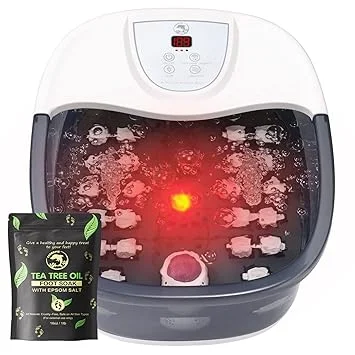
- ECARBME: A listing that mentions heat and 22 massage rollers indicates a warming feature and a high roller count. It leaves open how the heat function works with different starting water temperatures, whether the roller placement suits you, and how accessible the roller area is for cleaning.
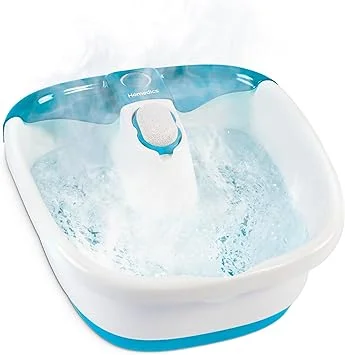
- Homedics Bubble Mate: The listing claims toe-touch control and bubble action. Toe-touch operation may appeal to shoppers who prefer not to bend to change a setting. Bubble action signals water movement, while the listing alone cannot settle expectations around sound, rim cleanup, or water movement in a given room.
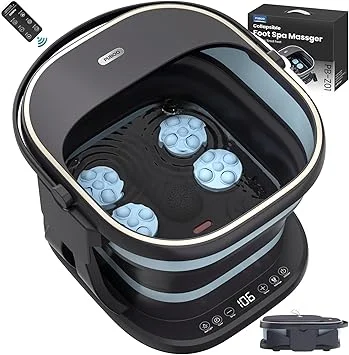
- Puboo: Its published specifications cite a 95–115°F range, stated ±1°F accuracy, motorized rollers, and a 5.5-inch folded profile. Treat these as manufacturer-stated specifications. The range and accuracy are not a personal-comfort or safety assurance, motorized rollers do not predict how they will feel, and folded height does not reveal the full operating footprint.
Use each claim to guide a concrete follow-up. A roller count invites a look at the basin interior. A folded profile calls for cabinet measurements. A control feature raises questions about where buttons sit and whether they are legible from your chair. This approach keeps marketing language in proportion to the rest of the purchase decision.
The ownership routine: setup, cleaning, drying, cord, drain, and storage
A foot spa is easiest to enjoy when the entire sequence is manageable: fill it, place it, use it, empty it, clean it, dry it, and put it away. Before buying, picture that sequence in the actual room where you expect to soak. A model that looks compact online can become cumbersome if the closest outlet is across a walkway or the nearest place to empty water is through another room.
Plan the placement before the soak
Choose a spot with a stable surface and comfortable seating. Hard flooring can simplify routine drips, though a towel nearby is practical for drying feet and catching minor water movement. Keep plugs, controls, and electrical connections away from water, and follow the manufacturer’s directions for filling and operation. A drain can reduce lifting, but it is useful only when its position aligns with a tub, shower, sink, or other appropriate emptying point.
Noise also belongs in the placement decision. Motors and bubble functions may be perfectly acceptable for a daytime pedicure but less appealing in a shared apartment, near a sleeping child, or during a quiet movie. Retail listings may use terms such as “quiet” or “low noise,” but those descriptions are best treated as preference cues rather than a promise about your particular room.
Choose an interior you can maintain
After use, empty the basin promptly according to the product instructions. Rinse away visible residue, wipe the basin walls and rim with a soft cloth, and inspect areas around roller channels, removable pieces, drain openings, and covers. The manual should govern cleaning products and methods. Harsh chemicals, abrasive tools, or water exposure beyond the manufacturer’s instructions can damage materials or electrical components.
Interior geometry matters more than it may seem in product photos. Smooth walls and open basin floors are generally easier to inspect visually. Textured platforms, narrow channels, attachments, and deep recesses can add interest to the soaking experience, but they may require more deliberate rinsing and wiping. That is a design consideration, not a reason to avoid every feature-rich model; it simply makes care instructions and part access more important.
Dry before you store
Let the unit dry fully before covering, folding, closing, or storing it. Dry removable attachments separately, then return them only when they are dry as well. For a foldable design, inspect folds and seams before putting it away, since moisture can be harder to notice in enclosed sections. Store the spa where it will not be knocked over, used as a catchall, or crowded beneath heavier items.
If this routine sounds more involved than your typical pedicure night, choose a simpler basin or skip the appliance. The right level of complexity is the one you will comfortably repeat.
Match the model to the ritual you actually want
A basic foot bath basin can make sense for someone who wants an occasional soak before polish and prefers fewer components. A heated model may suit a person who values a longer seated ritual and has a convenient place to set up and clean the unit. Bubbles, lights, and motorized features are more personal: some shoppers will use them regularly, while others may prefer a quieter, less complicated basin.
Consider foot size and basin shape alongside the feature list. Product dimensions can help, but interior photos and manuals may better show where rollers, guards, controls, and raised platforms sit. A deep basin is not automatically more comfortable if its interior layout leaves little room to settle your feet naturally. Similarly, a large unit may be easier to use while being harder to carry or store.
For a polished at-home pedicure, the spa itself does not need to do every job. A clean towel, moisturizer, toe separators if you polish, and a modest set of grooming tools may be enough. Our guide to best at-home pedicure tools can help round out a routine without turning a soak into an oversized project.
When a foot spa may be the wrong buy
A dedicated appliance is optional. If you lack convenient storage, dislike cleaning small parts, have no comfortable route for emptying water, or want a nearly silent tool, a simple basin or basin-free routine may suit you better. For basic prep before polish, showering, gently smoothing only where needed, and moisturizing can be a lower-maintenance alternative. See our guide to a safe at-home pedicure routine for the broader process.
No-buy flags
- No accessible manual or care guidance. Cleaning requirements should be clear before purchase.
- Missing dimensions. You need operating size, storage size when applicable, and enough information to judge the basin layout.
- Vague heat terminology. Look for language that explains whether the unit heats water, maintains warmth, or both.
- Hidden drain, cord, or underside views. These details affect placement and emptying.
- Complex interior with little cleaning access. Check whether attachments, channels, and textured areas can be reached and dried.
- Feature overload. If your plan is an occasional pre-polish soak, a multi-mode appliance may create more maintenance than value.
- Unclear return-policy details. Fit, control placement, footprint, and operating noise can be difficult to judge from a listing.
Frequently asked questions
Is a heated foot spa better than a basic foot bath?
It depends on your routine. Heat may add convenience for a longer soak, while a basic basin has fewer parts to store and clean.
Do I need a drain?
A drain can help when lifting water would be inconvenient, but only if you can position the spa so the drain is easy to use.
Are more rollers better?
No. Roller count does not define comfort. Look at roller type, placement, interior space, and cleaning access.
Can I run all features at once?
Follow the product manual. Permitted feature combinations, fill levels, and care requirements vary by model.
Choose the model that fits after the soak
The strongest foot spa choice is one that works with your seating, outlet, emptying route, cleaning tolerance, and storage space. Once those basics are covered, choose the heat, bubble, roller, and display features that will make the ritual feel worth repeating.