
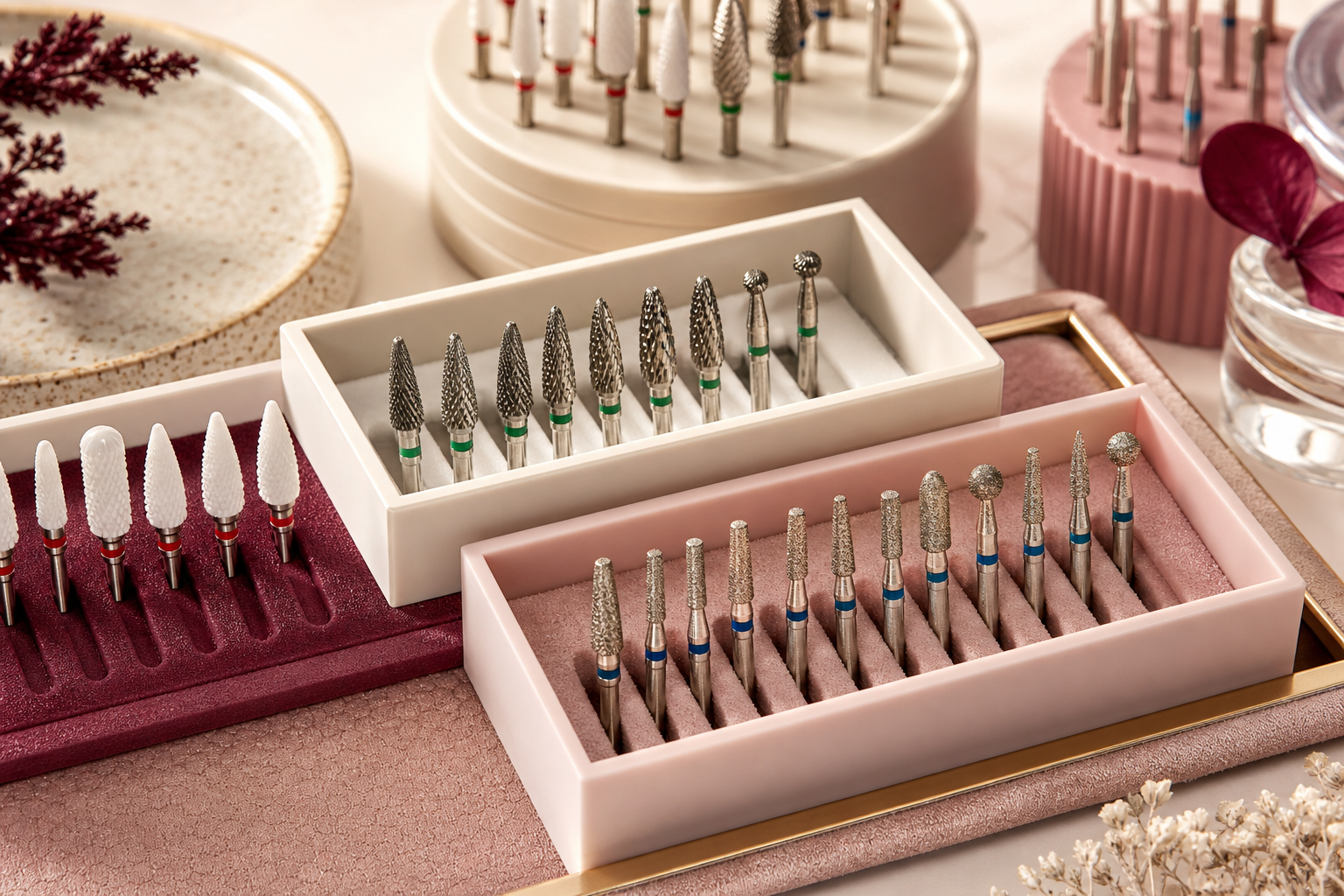
An electric-file bit is a purpose-built accessory, not a universal point that becomes appropriate simply because it fits a handpiece. The useful buying question is not which bit is best. It is which cured product is present, what job the manufacturer assigns to that head, and whether the bit matches the drill’s published specifications. A smart collection is usually small, clearly labeled, and tied to specific work rather than built around a random assortment of mystery shapes.
This guide keeps the DIY scope deliberately narrow: cured enhancement material and practice tips only. It does not teach electric filing on the natural nail plate, living skin, or cuticle area. Those surfaces and detail tasks require training, judgment, and a different level of risk assessment. If a bit catches or grabs, produces painful heat or pain, or you lose control, stop rather than trying to correct the issue while the tool is moving.
Start with the spec sheet, not the color ring
A complete bit listing should identify the shank size, working material, head shape, grit or abrasive classification, and intended rotation where relevant. Shape describes the geometry of the working end. Material describes the cutting or abrasive surface. Grit describes relative coarseness within that manufacturer’s system. Direction applies most clearly to fluted carbide bits. If a listing leaves several of those fields vague, it does not give a buyer much to verify.
Why 3/32-inch compatibility needs to be verified
In U.S. nail-drill listings, 3/32 inch usually refers to the shank: the narrow section that goes into the handpiece chuck. It does not describe the width of a barrel, cone, or sanding band. A 3/32-inch shank is approximately 2.38 mm, although some product listings use near-equivalent metric shorthand such as 2.35 mm. Treat that as a published specification to compare, not as a reason to assume every bit will fit every drill.
Check the drill manufacturer’s manual for its accepted bit size and chuck requirements, then compare that information with the bit manufacturer’s listing. Verify mandrels as carefully as solid bits. A common shank size can make shopping easier, but common is not the same as confirmed compatible. For a broader look at handpieces, chucks, and product categories, see our nail drill guide.
Materials: what is at the working end
Carbide, ceramic, diamond, and sanding bands are not a safety ranking. Each material is sold for different kinds of surface contact, product removal, and detail work. The better choice depends on the cured enhancement material, the manufacturer’s stated use, the shape, the grit, the bit’s condition, and the user’s control. No material is universally safer in every situation.
Carbide bits
Carbide bits are commonly sold with fluted working heads. Manufacturer listings often position barrel-shaped carbide bits for reducing bulk or removing cured acrylic and hard-gel product. The flutes, direction label, and head shape all matter; a carbide barrel is not interchangeable with every other carbide barrel just because the material name matches. Carbide bits are generally a purchase for a clearly identified cured-product task, not a reason to improvise with specialty shapes.
Ceramic bits
Ceramic bits are often listed with a tooth-like cutting pattern and are commonly marketed for cured-product removal or refinement. Their product descriptions may emphasize a particular pattern, coating color, or claimed use with certain enhancement systems. Read the maker’s intended-material statement instead of treating ceramic as automatically gentler or automatically more aggressive than carbide. A ceramic bit that is chipped, cracked, or damaged from a drop should be retired rather than used.
Diamond bits
Diamond bits use an abrasive-coated working area rather than carbide-style flutes. Manufacturer catalogs may include diamond barrels for surface work and diamond flame, cone, ball, or needle shapes for professional detail and prep tasks. That catalog language is not an at-home invitation to work on natural nails, skin, or cuticle tissue. Within this guide’s limited scope, a diamond bit still needs a stated grit, a known manufacturer, and a use that remains confined to practice tips or cured enhancement material.
Sanding bands and mandrels
A sanding band is a disposable abrasive sleeve that fits over a mandrel. Listings may describe bands by grit and intended shaping or finishing jobs, while the mandrel listing should state its shank size and the band size it accepts. Treat every sanding band as single-use: use a fresh band for the session, then discard it. Do not try to clean, sanitize, and reuse a worn sleeve. The mandrel itself is a separate reusable accessory that should be inspected and maintained according to its manufacturer’s directions.
Shape names tell you what a listing expects the bit to reach
Material alone does not explain a bit. A barrel or cylinder has a broad working surface. A tapered barrel narrows toward one end. A cone comes to a smaller point, while flame, needle, and ball shapes are detail-oriented profiles. Product photos can make these differences look minor, but shape changes the area a manufacturer expects the bit to contact and the precision required to control it.
Terms such as safety barrel or safety top describe a rounded-end design feature, not a blanket safety promise. Likewise, a fine-looking flame bit is still a detail bit. In home shopping, the most cautious choice is often to skip shapes marketed for cuticle prep, sidewall work, skin detail, or other professional finishing tasks. The table below keeps the decision column centered on cured enhancements and practice tips.
| Material or accessory | Common shape names | Manufacturer-intended job commonly shown on listings | Buyer decision |
|---|---|---|---|
| Carbide | Barrel, cylinder | Reducing bulk or removing cured acrylic or hard-gel product. | Consider only when the enhancement system and bit listing identify a compatible cured-product use. |
| Carbide | Tapered barrel, safety barrel | Refining cured product around contours or reducing product thickness. | Confirm the flute direction and grit. A rounded top does not make it a universal beginner bit. |
| Ceramic | Barrel, tapered barrel | Cured-product removal or refinement, depending on the product line and grit. | Buy only with a stated grit and material use; reject any chipped or cracked bit. |
| Diamond | Barrel | Surface detail or refinement in some manufacturer lines. | Do not extend a surface-work claim to natural nail or skin work. Keep the scope to practice tips or cured product. |
| Diamond | Flame, cone, ball, needle | Professional detail, prep, and close-area work in many catalogs. | Skip these shapes for DIY use around living skin, cuticles, or the natural nail plate. |
| Sanding band | Coarse, medium, fine sleeves | Shaping or finishing work on a compatible mandrel. | Match the sleeve to the mandrel and treat the band as a single-use consumable. |
| Mandrel | Standard or tapered holder styles | Holding a properly sized sanding band. | Verify the shank specification and band fit separately; replace a damaged or bent mandrel. |
A short decision path for a first purchase
Begin with the enhancement material, not the bit material. A bit listing may name acrylic, hard gel, builder gel, soft gel, gel polish, or another cured system, but those terms are not interchangeable. Read the enhancement brand’s removal guidance and the bit maker’s intended-use information. If the product maker does not support electric-file removal, a bit purchase does not change that limitation.
- Identify the job. Is the purchase for practice tips, reducing known cured enhancement bulk, surface refinement, or a disposable sanding-band task? If the job involves the natural nail or living skin, it is outside this guide’s DIY scope.
- Choose the least specialized shape that matches the published job. A broad barrel or a sanding-band system may be easier to shop by specification than a kit full of sharp-looking detail heads. This is a buying principle, not a promise that one shape works for every product.
- Verify the complete label. Confirm shank size, material, grit, intended use, manufacturer identity, and direction for fluted bits before checkout.
Practice tips are useful for understanding how a particular bit is labeled and how it behaves on cured artificial material. They are not a substitute for training on living tissue, and they do not justify moving a bit onto an exposed natural nail plate or cuticle area.
Color bands and rotation are easy to overread
Color-band labels are not a universal grit chart. One manufacturer’s color may represent fine, medium, coarse, an internal product family, or a visual design choice; another company may use the same color differently. The same caution applies to words such as fine, medium, and coarse. Those labels are useful only within the manufacturer’s own system. Check the actual packaging, product specifications, or brand grit chart before buying a replacement. Do not select a bit based on a color seen in a marketplace photo.
Direction and handedness matter most with fluted carbides
A handpiece’s rotation setting and a carbide bit’s flute direction are related but not identical. A reversible handpiece means the machine may be capable of rotating in more than one direction. It does not mean every carbide bit is designed to be used in both directions. Product listings may identify a bit as right-hand, left-hand, forward-cutting, reverse-cutting, or reversible. Verify the maker’s intended rotation rather than guessing from a product image or from which hand holds the handpiece.
Using a directional bit contrary to its stated orientation can feel unpredictable and may contribute to grabbing or loss of control. Stop if that happens. A higher listed RPM is not a quality grade or an exact safety setting, either. For context on how published speed ranges fit into overall tool control, read the nail drill RPM guide.
Bit condition, replacement, and storage belong in the budget
Bits are wear items, even when the shank and head still look presentable from a distance. There is no universal replacement calendar because material, grit, product type, usage, and the manufacturer’s construction all vary. Use the manufacturer’s care guidance, inspect each accessory before use, and replace a bit when its condition is no longer dependable.
- Retire solid bits with visible cracks, chips, bent shanks, corrosion, damaged flutes, patchy abrasive coating, or rough defects.
- Replace a mandrel that is bent, damaged, or no longer holds a sanding band securely.
- Do not compensate for a worn or loaded bit by pressing harder. Remove it from service instead.
- Keep solid bits clean and completely dry according to the maker’s instructions before placing them in storage.
- Store bits in a labeled case, tray, or holder that protects working edges from collisions and keeps grit categories identifiable.
- Discard sanding bands after one use; do not return a used band to a storage container.
Cleaning instructions can differ by material, coating, and accessory type. Our nail drill bit cleaning guide explains how to approach cleaning and storage without treating disposable abrasives as reusable tools. A dry, organized storage system also makes it easier to see when a bit is damaged, missing its label, or ready to replace.
No-buy red flags
A low price is not a value if the listing leaves you unable to identify what you are purchasing. Skip or pause on these common warning signs:
- No stated shank diameter, or a vague claim that the bit is universal.
- No material identification, grit information, or clear product photo of the working head.
- Color-only grit descriptions with no manufacturer chart or written classification.
- Fluted carbide bits with no stated direction, handedness, or reversible-use claim.
- Bundles that present cuticle or skin-detail bits as beginner shortcuts.
- Used, opened, visibly damaged, corroded, or poorly packaged bits marketed as new.
- Sanding bands described as washable, reusable, or suitable for repeated sessions.
- Promises that one bit can safely handle every product, every shape, and every user.
Frequently asked questions
Will every 3/32-inch bit fit my nail drill?
No. A 3/32-inch shank is a common published specification, but compatibility still depends on the drill’s chuck and the manufacturer’s stated requirements. Check both the drill manual and the individual bit listing, including the mandrel if you use sanding bands.
Is carbide or ceramic safer?
Neither material is universally safer. The appropriate choice depends on the specific cured enhancement material, the head shape, grit, bit condition, intended direction, and the user’s ability to maintain control. For DIY use, keep the work limited to cured enhancement material and practice tips.
Do color bands tell me the grit?
Not reliably across brands. Color-band systems vary, and some colors are not grit indicators at all. Use the written product specification or the manufacturer’s own grit chart instead of relying on a color seen in a photo.
Can I buy a flame, ball, or needle bit for cuticle work?
This guide does not recommend DIY electric filing on cuticles, living skin, or the natural nail plate. Those detail shapes may be marketed for professional prep or finishing work, but a listing is not training or a substitute for scope-appropriate instruction.
Can a carbide bit run in reverse?
Only if the bit manufacturer states that it is intended for that direction or is designed for reversible use, and only if the handpiece supports that rotation setting. A reversible drill does not automatically make every directional carbide bit reversible.
When should I replace a solid bit?
Replace it when inspection shows damage, worn abrasive coating, damaged flutes, a bent shank, corrosion, or another condition that makes the bit unreliable. Follow the manufacturer’s care guidance rather than relying on a fixed calendar.
Can sanding bands be reused?
No. Treat sanding bands as single-use consumables. Use a fresh band, discard it after the session, and inspect the reusable mandrel before fitting the next one.