
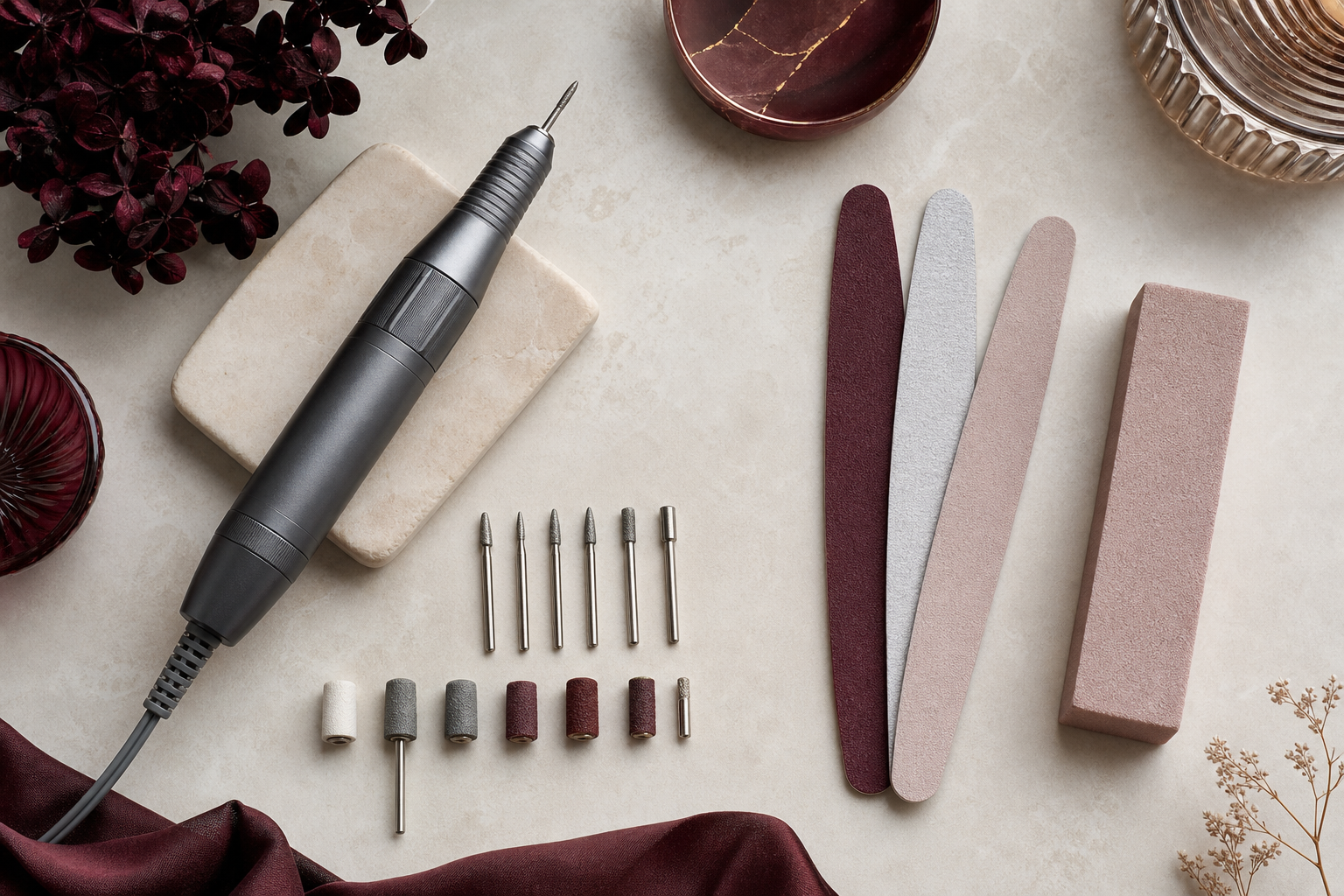
A hand file and a nail drill, often called an e-file, are not interchangeable versions of the same manicure tool. They solve different problems, ask for different levels of attention, and create different ownership commitments. The better choice is not automatically the powered one or the manual one; it depends on the material in front of you, the amount of product you need to adjust, your tolerance for equipment upkeep, and how close the work is to your natural nail or skin.
For most at-home routines, a hand file remains the essential tool. It is portable, inexpensive to replace, and gives direct tactile feedback for everyday shaping and edge refinement. An e-file can offer more speed potential when reducing cured enhancement bulk, but it is not always faster once setup, cleanup, uncertainty, and careful control are part of the job. Start with the task, then choose the tool that leaves the smallest margin for error.
Start with the boundary: cured product versus your natural nail
The most important distinction is what the tool will touch. A hand file is the beginner-friendly default for natural-nail shortening, shaping, and smoothing the free edge. Its resistance is felt directly through your hand, which can make small adjustments easier to judge. It also remains the better recommendation for beginners working anywhere near the natural nail, sidewalls, cuticle area, or living skin.
An e-file has a possible at-home role only when the target is cured enhancement product, such as acrylic, hard gel, or an overlay, and the user understands the specific tool and its manufacturer directions. This comparison does not recommend using an e-file on the bare natural nail plate, living skin, sidewalls, or cuticle area. If the boundary between enhancement product and natural nail is not clear, the right move is to stop rather than keep filing toward it.
For broader context on what an e-file is designed to do, begin with this nail drill guide. It can help separate useful product-maintenance information from the idea that every manicure needs a powered tool.
At-a-glance comparison
| Decision factor | Nail drill or e-file | Hand file |
|---|---|---|
| Speed potential | Can reduce a larger amount of cured enhancement product in an appropriate application, though setup and cautious control affect the overall pace. | Lower potential for broad bulk reduction, but often efficient for one edge, one corner, or a small shaping adjustment. |
| Tactile feedback | Powered motion offers less direct resistance feedback and requires closer attention to control. | Direct hand resistance can make small changes easier to feel and assess. |
| Noise category | Produces audible handpiece or motor sound; the character and level vary by model and use. | Usually limited to quiet abrasive filing sound. |
| Dust category | May create fine product dust when reducing cured enhancement material. | Can create filing debris, generally in smaller amounts during routine edge work. |
| Natural-nail work | Not recommended for at-home use on the natural nail plate, skin, or cuticle area. | The preferred choice for beginner natural-nail shaping and free-edge refinement. |
| Portability | Requires a handpiece, power arrangement or charging plan, bits, and protected storage. | Lightweight, simple to pack, and ready without charging. |
| Ownership | Involves the tool, compatible bits, cleaning and storage practices, and replacement planning. | Requires replacement files and basic clean, dry storage. |
| Learning curve | Higher, because tool handling, bit choices, product boundaries, and maintenance all matter. | Lower for routine shaping, although deliberate filing still takes practice. |
Choose by task, not by tool status
A drill can look like the more capable purchase because it is powered, while a hand file can look too basic for enhancement wearers. In practice, the useful choice changes from one manicure task to the next.
Reducing cured enhancement bulk
If the goal is to reduce cured acrylic, hard gel, or another enhancement product—not to work on the natural nail beneath it—an e-file can have meaningful speed potential. That potential matters most when there is a substantial amount of product to reduce repeatedly. It does not mean every removal or refresh is quicker with a drill. A small overlay adjustment may involve more setup and cleanup than the task warrants, and unfamiliar equipment can make a straightforward job feel less manageable.
A hand file is the more deliberate option for occasional reduction and minor product adjustments. It may require more effort when enhancement bulk is substantial, but it gives a cautious at-home user more time to evaluate what is happening. Do not treat removal as a race to bare nail. If the product is lifting, the material layers are hard to distinguish, or you cannot tell where enhancement ends, pause the project instead of continuing with either tool.
Shaping natural nails
For routine natural-nail length and shape, choose a hand file. This is especially true for a beginner, anyone rebuilding confidence after overfiling, and anyone who prefers to make gradual changes. Keep the work focused on the free edge, assess the shape frequently, and keep the file clear of skin. A hand file is not less legitimate because it is slower; for small shape changes, its control is often the point.
An e-file is not necessary for a neat natural-nail manicure. A powered tool does not improve a shape merely by being available, and it is not an at-home substitute for manual edge work near the nail plate or skin.
Refining an edge or smoothing a snag
Edge refinement is hand-file territory in most home routines. Whether the nail is natural or enhanced, a manual file lets you address a tiny rough point without introducing a powered tool for a very small job. This is also the practical travel choice: one file can handle an unexpected snag without a charger, bits, or a dedicated cleanup area.
For an intact enhancement, a hand file can also be the sensible first choice for a small free-edge adjustment. If the issue is more than a rough edge, reassess before trying to turn a repair into a shaping session.
Preparing for polish or an enhancement service
Prep should not be the reason to graduate to an e-file. At home, keep prep around the natural nail, cuticle area, and skin non-electric. A careful manual approach is easier to pause and reassess, especially for newer manicure enthusiasts. This safe nail-prep guide covers a conservative preparation mindset without treating aggressive filing as a requirement for polish wear.
There is no benefit in using a powered tool simply because one is in your kit. Good prep is about condition, cleanliness, and appropriate product directions—not chasing a more dramatic-looking surface change.
Handling a chip, crack, or lifting enhancement
Not every damaged-looking manicure is a filing task. A minor free-edge snag on an otherwise intact nail may be smoothed manually. Lifting, a crack that changes the structure of an enhancement, an unclear product boundary, or visible damage close to the natural nail calls for a pause rather than more abrasion. An e-file's speed potential does not make a repair automatically appropriate.
If you are unsure whether you are looking at a surface flaw, a product issue, or a natural-nail concern, avoid filing further. A qualified nail professional can help assess an enhancement issue; seek medical advice when the concern involves an injury or ongoing pain.
Match the tool to your risk tolerance
Risk tolerance here is not about being brave enough to use a machine. It is about deciding how much equipment complexity, cleanup, and opportunity for an unwanted mistake you want in a home manicure. A lower tolerance is a completely valid reason to stay manual.
- Lower tolerance: Choose a hand file if you are new to filing, work mainly on natural nails, make occasional shape changes, or want the clearest tactile feedback. This is the right lane for work near natural nail and skin.
- Moderate tolerance: You may own both tools, using the hand file for shaping and edge work while reserving any e-file consideration for cured enhancement product only. This approach still requires a clear product boundary and comfort maintaining the equipment.
- High ownership tolerance: If you wear enhancements often and are prepared to manage bits, storage, dust, and model-specific instructions, an e-file may be worth considering for repeated bulk-reduction needs. More comfort with equipment does not make powered filing appropriate on the natural nail or skin.
Painful heat, grabbing, pain, or loss of control means stop. Do not try to finish the task by changing pressure, chasing a setting, or pushing through discomfort. Set the tool aside and reassess the product condition and the manicure plan.
What you are really buying and maintaining
A hand file is a small, low-commitment purchase, but it is still a consumable tool. Shape, abrasive surface, condition, and cleanliness affect whether it remains useful. Keep replacement files on hand, discard worn or damaged ones, and follow the product maker's care directions where applicable. Its simplicity is part of its value: there is little to charge, assemble, or troubleshoot.
An e-file purchase is better viewed as a system purchase. Beyond the handpiece, consider the power arrangement, storage, compatible bits, cleaning guidance, and how you will manage product dust. A manufacturer listing may state that a model includes particular bits, supports a certain speed range, or has charging features. Those are manufacturer claims for that specific listing, not universal indicators of quality, suitability, or safety. Check the current listing and manual before assuming an included accessory fits your intended use.
Bits are an ongoing ownership category, not a one-time add-on. Materials, labels, intended uses, and compatibility can differ between brands and product lines. Read the manufacturer's directions for the tool and accessory, then use a nail drill bits guide to understand the terminology before making a purchase. Avoid buying a collection of bits simply because a set has more pieces; a larger assortment does not solve an unclear task or a lack of control.
Likewise, a prominently advertised maximum RPM is not a quality ranking, a performance promise, or an exact safety number. It cannot tell you whether a tool is appropriate for a specific product or person. This nail drill RPM guide explains how to read speed claims without treating a number as a target.
Buyer profiles: who benefits from which approach?
The natural-nail beginner
Buy a small selection of hand files first. Your most common jobs are likely shaping, shortening, and smoothing the free edge, all of which are well suited to manual control. An e-file adds cost and complexity without being necessary for a polished basic manicure.
The occasional enhancement wearer
Keep a hand file as the default tool, even if you eventually add an e-file for recurring cured-product bulk reduction. You will still use the manual file for quick edge adjustments, travel, and careful finishing. If removals are infrequent or product boundaries feel uncertain, a salon removal can be the less stressful choice.
The frequent enhancement wearer with a dedicated setup
An e-file may be a reasonable consideration when cured bulk reduction is a recurring need and you are willing to learn the model-specific system, maintain bits, and manage dust. It should complement, not replace, manual filing. A hand file remains important for controlled edge work and natural-nail shaping.
The minimalist or travel-focused manicure person
Choose hand files. They take little space, make little sound, need no power, and address the most common between-manicure annoyance: a rough edge. A compact kit that you will actually use is more valuable than a more elaborate tool that stays stored away.
Learning curve and maintenance reality
Manual filing has a learning curve too. Filing too aggressively, ignoring symmetry, or continuing after a shape no longer looks balanced can create frustration. Still, the pace is easy to slow down, and the tool is intuitive for most beginners.
An e-file adds a second layer of learning: handling a powered device, identifying its parts, understanding the maker's instructions, selecting compatible accessories, and recognizing when a task is outside your comfort zone. It also needs routine inspection, cleaning, dry protected storage, and attention to manufacturer maintenance directions. If the tool behaves unexpectedly or you lose confidence in control, stop using it rather than improvising a fix during a manicure.
Task decision matrix
| Task | Best starting choice | Risk tolerance | Reason or limit |
|---|---|---|---|
| Shortening or shaping natural nails | Hand file | Lower | Direct feedback and controlled free-edge work make this the beginner default. |
| Smoothing a small free-edge snag | Hand file | Lower | A powered tool adds little value for a small localized adjustment. |
| Reducing cured enhancement bulk | Hand file or carefully considered e-file | Moderate to higher | An e-file has speed potential only for product reduction, with a clear product boundary and model-specific knowledge. |
| Prep near the nail plate, skin, or cuticle area | Non-electric manual prep | Lower | Do not use an at-home e-file on natural nail, living skin, sidewalls, or cuticle area. |
| Lifting, an unclear crack, or an unknown product boundary | Pause and assess | Any | Neither tool is the automatic answer when the condition is uncertain. |
Frequently asked questions
Is a nail drill always faster than a hand file?
No. An e-file can have more speed potential for reducing substantial cured enhancement bulk, but it is not automatically faster for small jobs. Setup, cleanup, unfamiliarity, and the need to work carefully can make a hand file the more efficient choice for a rough edge, shape adjustment, or minor refinement.
Can a hand file handle enhancement maintenance?
Yes, for many small adjustments. A hand file can refine an enhanced free edge, smooth a minor snag, and make modest shape changes. It may be less practical for repeated reduction of substantial cured product bulk, but less potential speed does not make it the wrong choice for an occasional wearer.
Should I buy an e-file for routine natural-nail manicures?
Usually, no. A hand file is the better starting tool for routine natural-nail shaping and edge work. An e-file is not necessary to create a tidy at-home manicure, and this guide does not recommend powered filing on the natural nail plate, skin, sidewalls, or cuticle area.
What does a maximum RPM number tell me?
It tells you part of a model's listed operating range, not whether the tool is better, easier to control, suitable for every bit, or exactly safe for a given task. Compare the full ownership picture: manufacturer instructions, bit compatibility, intended use, storage, upkeep, and your actual manicure needs.
What should I do if filing becomes uncomfortable or unpredictable?
Stop rather than trying to finish the manicure. Do not work through discomfort, heat, grabbing, or a loss of control. Reassess whether the task is appropriate for home maintenance, and seek qualified help when the product condition or your nail condition is unclear.
The practical verdict
A hand file fits nearly every at-home manicure kit and should be the first choice for beginners, natural-nail care, shaping, and work near skin. An e-file can be a useful specialized tool for some frequent enhancement wearers who need to reduce cured product bulk and are prepared for the learning and maintenance involved. Choose the simplest tool that fits the material and task—and let uncertainty be a reason to pause, not a reason to file harder.