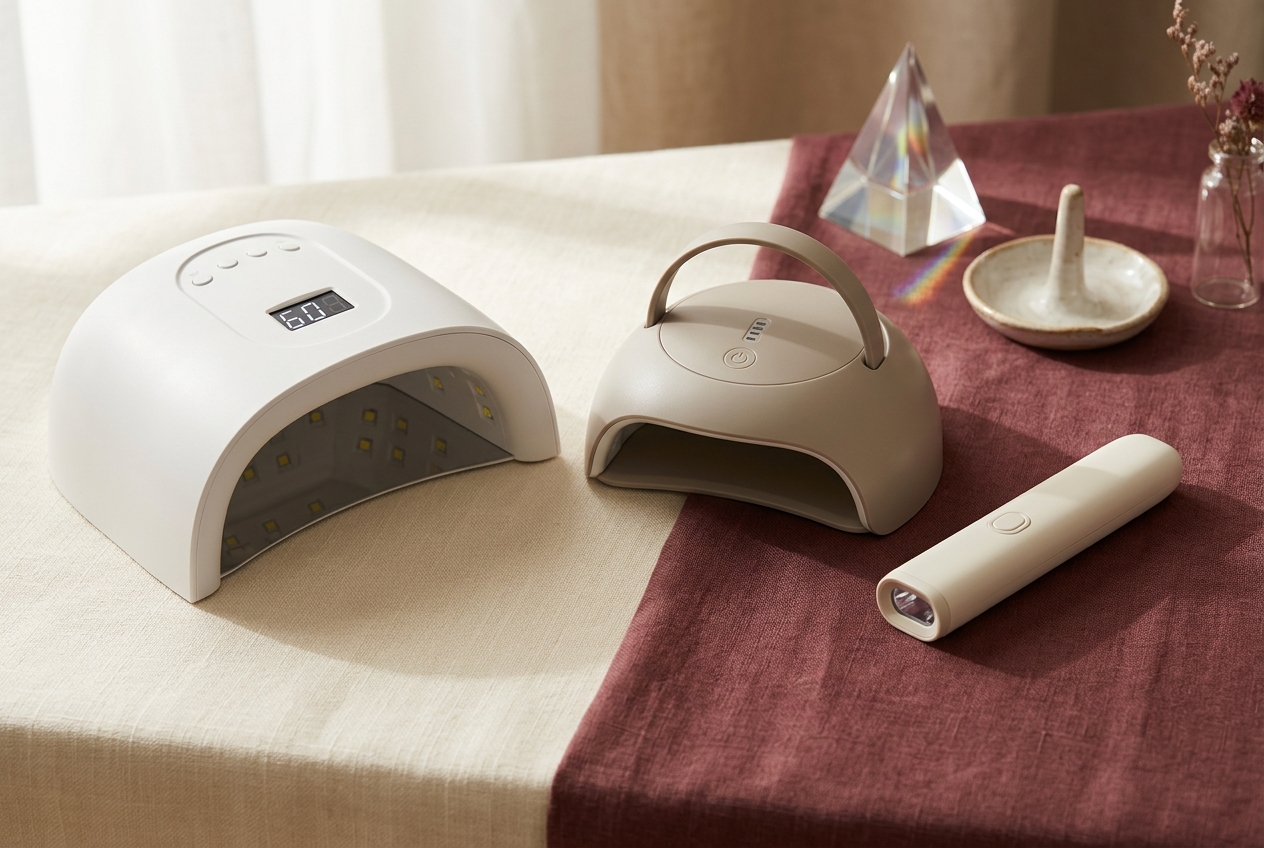
Picture a retail floor with three lamp footprints marked out: a fixed housing large enough for a hand or foot, a rechargeable unit that can leave the outlet, and a compact light intended for one nail at a time. That is the useful starting map for choosing a home gel nail lamp. Walk backward from the place where you work, the number of nails you handle at once, and the gel maker's instructions. Only then compare the product names and headline wattage.
The Lavinda listing gives the clearest full-hand-and-foot description, with space intended for five fingernails or toenails and a detachable base. Ayshone is the clearest rechargeable cordless UV/LED option in the supplied selection. GAOY's listing is oriented toward one-nail curing and detail nail art. LKE and modelones occupy the fixed-lamp territory with timer and sensor wording. None becomes the automatic winner merely because its title contains a larger wattage number.
The supplied product information does not provide enough measurement context to treat wattage alone as proof of compatibility or cure performance. The gel maker's instructions remain the controlling source for the formula's exposure schedule.
The floor-map answer
Start with Lavinda if the job is a conventional manicure or pedicure and the listing's explicit five-fingernail or five-toenail space matters. Choose Ayshone when the lamp needs to move away from a fixed outlet and rechargeable cordless operation is the deciding feature. Choose GAOY when the work is one nail at a time or centered on detail nail art. LKE and modelones are lower-cost fixed-lamp alternatives whose listings name useful controls but leave more questions about interior fit and performance evidence.
Mark the first footprint: the full-hand station
On a retail floor, the broadest footprint is also the easiest one to imagine in a normal home manicure routine. A fixed full-hand lamp is designed around placing several nails inside one housing, then moving through the layers required by the chosen product. That can make sense for someone who regularly applies base, color, and top coat across a complete set. A user may prefer a fixed housing to positioning a small handheld light over every nail, but an exterior dimension, a product title, or a bead count cannot by itself prove that every nail receives equivalent exposure.
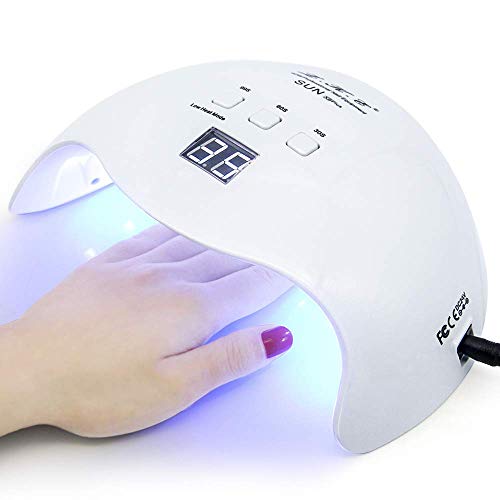
Lavinda 48W UV LED Nail Lamp has the most direct full-hand and foot description in this group. Its listing describes a detachable magnetic base and room intended for five fingernails or toenails. For a buyer deciding whether one lamp can serve manicure and pedicure sessions, those are more relevant facts than the 48W label alone. The listing also names 10-, 30-, 60-, and 90-second settings, infrared hand detection, 33 LED beads, and advertised 365nm and 405nm light sources. A long press on the 90-second control is described as activating low-heat mode.
Those are operating details, not a universal cure promise. The supplied product notes say that cure time can depend on gel chemistry, shade, layer thickness, and the formula maker's specified schedule. The Lavinda listing does not publish irradiance, wavelength tolerance, interior measurements, electrical details, or independently measured curing performance. Its timer is therefore best read as a control that can be used with a compatible gel's instructions, rather than as four interchangeable guarantees.
The product's removable base gives the full-hand footprint a second use case: access around the foot. Lavinda's wording supports a comparison of cosmetic pedicure setup, but it does not establish interior measurements, treatment capability, or a result for every foot position. A nail lamp is a cosmetic tool and is not intended to diagnose or treat medical conditions.
LKE 40W UV LED Nail Lamp with 3 Timers is the least expensive captured option. Its seller listing names 21 LED lights, 30-, 60-, and 99-second timers, an LCD display, and automatic activation when a hand is inserted. The published exterior size is 8.54 by 5.24 by 2.95 inches. That helps a buyer estimate countertop footprint. It is not an interior-opening measurement, so it cannot establish fit for every hand, foot, nail length, or pedicure position.
modelones 48W UV Nail Lamp with Gloves and 3 Timers follows the same fixed-lamp route. Its listing states 30-, 60-, and 90-second settings, automatic sensor wording, and 21 UV and LED light sources. The package is sold as a lamp-and-fingerless-gloves kit. That combination may appeal to someone who specifically wants both items together. The supplied product information does not state glove sizing, quantity, coverage around the nails, lamp dimensions, plug details, or voltage.
What the broad footprint can and cannot tell you
A lamp that looks roomy on a retail page is not necessarily roomy for every use. Product photos and exterior measurements do not replace an interior-opening measurement. They also do not show whether a particular hand or foot position places each nail where the maker intended. Lavinda's explicit five-nail wording is useful because it describes the seller's intended access. It still is not an independent fit test or a cure-performance measurement.
The same separation applies to the labels “UV/LED” and “48W.” They identify listing language, not a complete compatibility standard. The formula, shade, layer thickness, and instructions remain part of the decision. Read what nail-lamp wattage actually explains if the wattage printed in a title is becoming the main reason for your choice.
Mark the second footprint: the cordless station
The cordless footprint changes the room more than it changes the curing question. A rechargeable lamp can move from a desk to a dining table, a shared bathroom counter, or a temporary nail-art station without tying the session to one outlet. That is a genuine placement advantage for a buyer who works in different locations. It does not establish output stability, coverage, or battery longevity over months of use.
Ayshone 48W Rechargeable UV LED Nail Lamp is listed as a rechargeable cordless UV/LED lamp. Ayshone describes a white rechargeable lamp with a built-in 7800mAh battery, automatic infrared sensing, and advertised 365nm and 405nm wavelengths. The seller claims that a two-hour charge can support up to three hours of continuous cordless operation. The listing names UV nail gel, LED nail gel, builder gel, sculpture gel, rhinestone glue, base coat, and top coat among intended product categories.
That category list is a starting screen, not a demonstration that every formula in those groups reaches a complete cure under this lamp. The supplied listing does not state timer presets, dimensions, weight, interior clearance, charging-port design, charging hardware, irradiance, or output behavior as battery charge declines. Its feature copy also refers to both 33 LED bulbs and 30 durable LED beads, so the light count is not presented consistently.
For a buyer who always works beside a powered station, a corded lamp may be simpler because charging is not part of the routine. For someone who needs to move the lamp, Ayshone's cordless architecture is the decisive listing fact. The remaining questions should be taken to the gel maker: which lamp type is named, how long is the exposure, how thick can each coat be, and are there restrictions for a particular color or builder product?
The battery belongs to the ownership decision
A stated battery capacity and runtime describe the seller's battery claim. They are not measurements of gel compatibility. The same boundary applies to the 48W title. A battery can make a station more convenient without making a formula more suitable. It can also add a charging task that does not exist with a corded model.
That distinction is especially useful when comparing Ayshone with Lavinda. Lavinda's listing offers a detachable base and explicit hand-or-foot space. Ayshone's listing offers rechargeable cordless placement. Neither set of facts answers every formula-specific curing question. The format decision comes first; the gel maker's schedule comes after it.
Mark the third footprint: one nail and detail work
The smallest footprint has the narrowest stated job. A handheld one-nail lamp can be useful when the work is an individual nail, a small detail, or an initial exposure specified by a gel or adhesive maker. It is not automatically a substitute for a fixed full-hand lamp. Preference for handheld positioning does not establish coverage or curing performance.
GAOY Handheld UV Gel Nail Lamp with Stand is the focused choice in this selection. Its listing describes a silver cordless UV light with a stand, an LCD display, and a 400mAh battery. The product copy highlights one-nail curing and detail nail art. That stated use is more reliable for format selection than trying to infer broad coverage from the lamp's appearance. The seller also claims up to 60 minutes of continuous use after one charge and uses the phrase “2 Weeks Battery Life.”
GAOY's listing separately claims an 8-second cure for gel nail polish and a 12-second cure for gel top coat. Those are seller claims for the named categories, not a transferable schedule for every brand, shade, layer, adhesive, or enhancement. Wavelength, wattage, LED details, dimensions, charging method, stand adjustment, and broader compatibility are not stated in the supplied information.
If a gel or adhesive maker specifies a flash-cure workflow, use that maker's directions rather than assuming a handheld lamp replaces the full cure specified for the product. If the maker specifies an initial exposure followed by a longer cure in another lamp, use that sequence. GAOY's listing supports one-nail curing and detail nail art as its stated focus; it does not establish an initial-exposure process for every gel, adhesive, or enhancement.
If you do not know whether a product has a multi-step cure process, ask its maker or select a product with explicit instructions. Ayshone's supplied safety note says not to leave under-cured gel on the nail and to stop if irritation occurs.
Put the footprints side by side
The table below keeps the comparison tied to the supplied listing material. “Not stated” means the information was not provided here; it does not mean the feature is absent. Prices and stock status are captured snapshots rather than promises of a current offer.
| Product | Best-defined format | Named controls or access | Listed light information | Captured offer |
|---|---|---|---|---|
| LKE 40W UV LED Nail Lamp | UV/LED nail lamp | 30s, 60s, 99s; LCD; automatic sensor wording | 40W title; 21 LED lights | $9.49; In Stock |
| Lavinda 48W UV LED Nail Lamp | Full-hand/foot-oriented listing | 10s, 30s, 60s, 90s; sensor; detachable magnetic base | 48W; 33 LED beads; advertised 365nm and 405nm | $27.83; In Stock |
| Ayshone 48W Rechargeable UV LED Nail Lamp | Rechargeable cordless UV/LED nail lamp | Automatic infrared sensor; timer presets Not stated | 48W title; advertised 365nm and 405nm; bead count stated inconsistently | $39.99; In Stock |
| GAOY Handheld UV Gel Nail Lamp with Stand | Handheld, one-nail/detail-oriented lamp | Cordless; stand; LCD display | UV Light title; wavelength and LED details Not stated | $15.99; In Stock |
| modelones 48W UV Nail Lamp with Gloves | UV/LED nail curing lamp kit | 30s, 60s, 90s; automatic sensor wording; fingerless gloves included | 48W title; 21 UV and LED light sources | $20.99; In Stock |
Walk backward from the desk to the formula
Once the physical station is clear, move backward to compatibility. First, use the cure instructions printed by the gel maker. That instruction is more useful than assuming that “UV/LED,” “dual wavelength,” a short timer, or a high wattage title makes a lamp appropriate. The UV versus LED compatibility guide provides more context; the supplied information does not establish one universal compatibility standard.
Next, keep formula categories separate. A sheer color layer, a black or highly pigmented shade, a thick builder application, a rhinestone adhesive, and a top coat can have different exposure requirements. When a lamp listing names several categories, it is reporting intended product categories. It is not supplying a verified cure protocol for every product in each category.
Finally, distinguish a timer from a result. A 30-second button tells you what control is available. It does not tell you whether a particular formula, shade, or layer is ready after that interval. The maker's directions should determine the exposure schedule, including any additional cure that follows a flash cure.
Exposure choices are part of the station
The U.S. Food and Drug Administration describes UV nail curing lamps as low risk when used as directed and advises users to follow labeled exposure times. For people concerned about exposure, FDA notes that broad-spectrum sunscreen or UV-absorbing gloves are optional considerations. The American Academy of Dermatology similarly advises broad-spectrum, water-resistant SPF 30+ on the hands or dark opaque fingerless gloves before a gel manicure.
Those public-health sources do not endorse any lamp in this guide. If you use gloves, remember that fingerless gloves do not cover the entire hand and that fit matters around the nail area. The modelones product copy makes UV-blocking and heat-protection claims for its included gloves, but those remain seller claims. Gloves do not answer compatibility questions and should not encourage longer-than-directed exposure.
Build the station around the chosen shape
For a full-hand lamp, leave enough counter space to insert and remove the hand without scraping wet product against the housing. A detachable base can matter when the same lamp is used for feet, but the listing's access description remains different from an independent fit check.
For Ayshone, add charging to preparation. A cordless lamp is most useful when it is charged before the session and placed where the hand can enter without awkward repositioning. The supplied information claims a two-hour charge and up to three hours of continuous cordless operation; it does not state whether the lamp can operate while charging.
For GAOY, stabilize the hand and decide where the lamp and stand will sit before beginning detail work. The listed one-nail focus can suit an individual nail, but the lamp should not be assumed to provide simultaneous full-hand coverage. Any additional or final cure belongs to the gel or adhesive maker's specified process.
Make the product choice last
Choose Lavinda when the clearest priority is a conventional home lamp with explicitly described five-nail hand or foot capacity, four timers, sensor operation, and a detachable base. Choose Ayshone when rechargeable cordless placement outweighs the missing details on timers, physical dimensions, interior clearance, and charging hardware. Choose GAOY when one-nail curing and detail nail art are the job, while using the gel maker's specified cure process.
Choose LKE if its $9.49 captured price, three named timers, LCD wording, and published exterior dimensions match your requirements, while recognizing that the 40W label lacks measurement context and interior clearance is not stated. Choose modelones when the included fingerless gloves, three timers, sensor wording, and lamp bundle are specifically useful, not because the listing's 48W label or relative speed language proves a better cure.
The map now has three marked places: Lavinda's listing-described hand-and-foot access, Ayshone's movable cordless station, and GAOY's small one-nail work zone. The unresolved buyer question is not which footprint looks most powerful on a product page, but which one will sit under your hand while the formula's own instructions are still visible.
Sources and evidence boundaries
FDA: UV-emitting nail dryer lamps informed the statements that these lamps are low risk when used as directed, labeled exposure times should be followed, optional sunscreen or UV-absorbing gloves can be considered, and photosensitivity from medicines or cosmetics can matter.
American Academy of Dermatology: gel manicure guidance informed the advice on SPF 30+ or dark opaque fingerless gloves, avoiding cuticle trimming, not picking gel polish, and taking breaks when appropriate.
Amazon product facts, prices, availability, feature language, and specifications in this guide were captured from current listing/API data supplied for the five named products. No hands-on testing, cure-speed testing, electrical inspection, fit test, durability assessment, medical evaluation, or independent validation of seller claims was performed. FDA and AAD guidance does not endorse these products.
Frequently asked questions
Is a 48W lamp always better than a 40W lamp for gel nails?
No. The supplied listings do not explain how their wattage labels were measured or connect them to independent irradiance or formula-specific results. Use wattage as a listing descriptor, then prioritize the gel maker's cure instructions and the lamp format you need.
Can I use a handheld one-nail lamp as my only nail lamp?
Only if the gel or adhesive maker explicitly says that lamp and exposure process are appropriate. GAOY's listing emphasizes one-nail curing and detail-art use, so it should not be assumed to provide simultaneous full-hand coverage or to replace a required final cure.
Which supplied lamp has the most explicit foot-access wording?
Lavinda. Its listing describes a detachable magnetic base and space intended for five toenails. That wording supports a cosmetic pedicure setup comparison, but does not establish interior dimensions or treatment use.
Does a cordless lamp work while it is charging?
Not stated for Ayshone in the supplied product information. Its listing claims a two-hour full charge and up to three hours of continuous operation, but does not explain charging-while-in-use behavior.
Are the modelones gloves full-hand UV protection?
Not stated. The listing identifies them as fingerless gloves and makes seller UV-blocking claims, but does not provide glove measurements, detailed coverage boundaries, or fit guidance.