The short answer
A handheld flash-cure lamp makes sense when one nail, extension tip, gem, or raised detail must stay exactly where it was placed before the next step. A full-size nail lamp makes sense when the product maker calls for a complete cure and you want a fixed, timer-equipped format for a hand-in workflow. These are different workstations rather than interchangeable versions of one tool. Compact listings emphasize one-nail or detail work, while the larger listed formats provide hand-in timer workflows. Either format belongs in a complete-curing process only when the gel maker specifies compatibility and exposure.
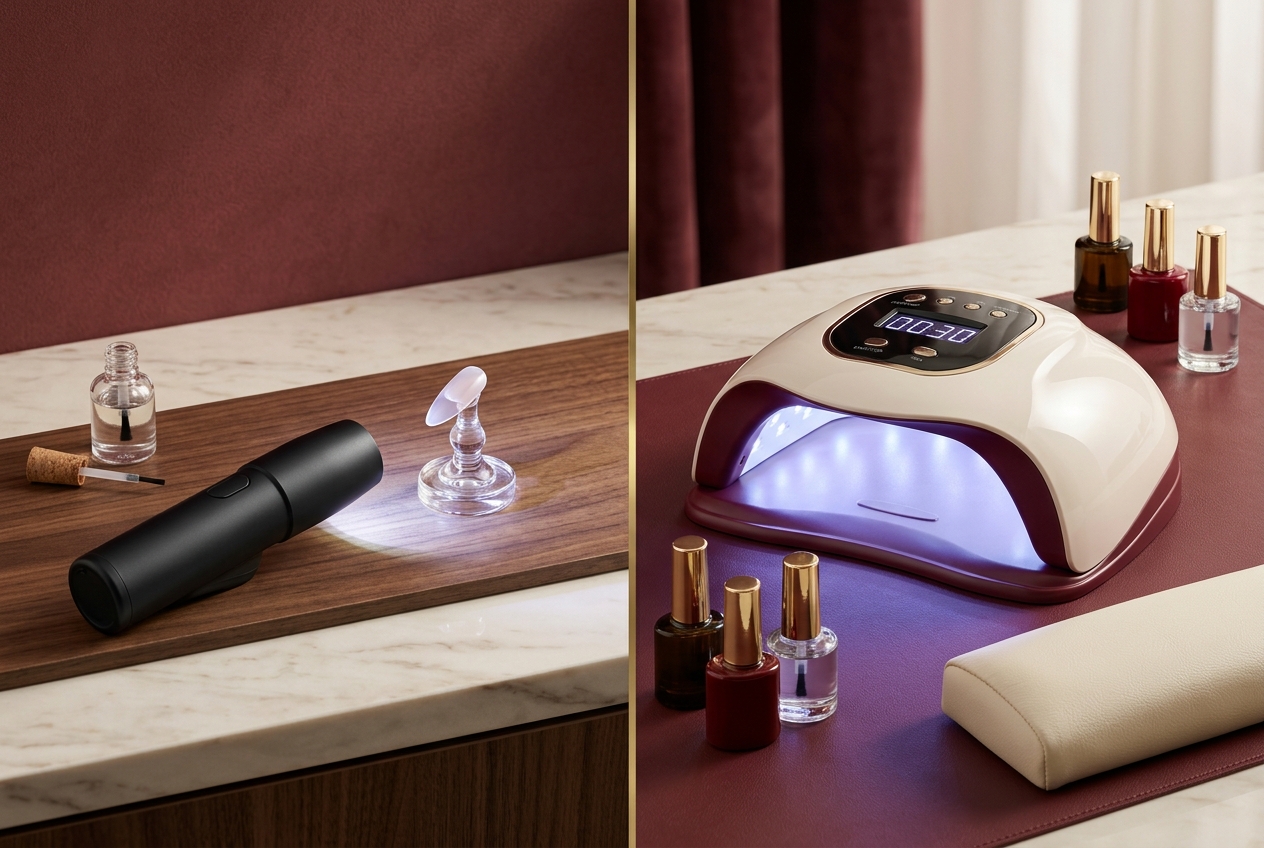
Imagine two manicure desks divided by a narrow strip of daylight. At the first, a single finger advances toward a movable light. At the second, an entire hand waits at the mouth of a fixed lamp. Nothing important happens because a checklist says it should. The decision develops from the finger's movement: first a tip is held, then a decoration is steadied, then the hand changes position for a broader cycle.
The listed GAOY and MelodySusie lamps emphasize focused work on an individual nail. The LKE and Lavinda listings describe timer-based hand-in features. That distinction affects placement, stabilization, timing, coverage, and the questions that remain unanswered about gel compatibility. A fast initial set is not automatically a complete cure, and broad UV/LED wording does not prove that every gel will cure safely or fully beneath a particular lamp.
At the left desk, one finger refuses to wait
The flash-cure station begins before the lamp is switched on. An extension tip, builder material, rhinestone glue, or raised design has been positioned, but the finger still needs to remain steady. The worker may need access from above, from the side, or close to the free edge. Rather than moving a whole hand into a tunnel, the light moves toward the nail.
That change in direction is the defining feature. A conventional full-size lamp asks the hand to travel to the unit. A flash lamp brings illumination to one finger. Depending on its form, it can sit at the edge of the desk, be held over a nail, or be aimed at a specific point. The benefit is not simply a smaller footprint. It is the ability to preserve a placement while the material is still mobile.
The index finger sets the pace
Start with the index finger. The product is applied according to its maker's directions, and the finger is held in the desired position. A targeted lamp is brought to the nail for the initial exposure specified by the gel maker or, where relevant, the product-copy timer. The immediate goal is stabilization: the nail should not be bumped, tilted, or pressed into an enclosed lamp while the material is still moving.
The MelodySusie P-ART01R Handheld Nail Lamp illustrates this arrangement. Its listing describes a cordless 3W UV LED handheld format, a transparent protective cover, a 450mAh built-in battery, and 20- and 60-second timer settings. MelodySusie also describes applications such as Gel-X nails, 3D gel designs, decorations, rhinestone glue, solid nail glue gel, extension gel, and liner gel polish. These are product-copy claims, not a universal curing schedule.
The seller's statement that some applications can flash-cure in 3-5 seconds should be read as an initial-set claim for the named contexts. It does not prove a complete cure for every layer, formula, opacity, or design. The distinction matters at this first desk: the lamp may help hold a detail in place, but the complete process remains tied to the material maker's directions.
The GAOY Handheld UV Gel Nail Lamp with Stand creates a related bench with a different physical arrangement. Its listing describes a cordless lamp with a stand, LCD display, 400mAh battery, and a stated focus on one-nail curing and detail nail art. GAOY's product copy separately claims 8 seconds for gel nail polish and 12 seconds for gel top coat. Those times are specific listing claims; the listing does not establish that they apply across brands, shades, thicknesses, or gel systems.
Here, the stand is part of the movement story. It can reduce the need to hold the light during a delicate placement step, while the LCD is intended to keep curing time and battery information visible. Neither feature tells the worker that a particular gel has received its required complete exposure. The finger has become steadier; the material question is still open.
A clamp changes the desk, not the chemistry
The Geisofu UV Nail Lamp is listed as a USB-powered clamp-on lamp with one 3W LED, four adjustable brightness levels, a flexible 360-degree gooseneck, and options to clip, hang, or place it flat. Its role is especially clear when the workstation itself is constrained. The user can position the lamp around the desk rather than repeatedly repositioning the hand.
The central question is whether the clamp can attach securely to the actual surface and whether the gooseneck can direct light without forcing the finger into an awkward pose. Those are placement questions. The listing does not state a wavelength range, irradiance, beam area, tested gel list, or formula-specific cure times. Its four brightness levels are controls, not four verified gel-curing programs.
If a gel brand provides a lamp recommendation or cure schedule, that instruction governs the process. A movable lamp should not be assumed compatible simply because it emits UV light or because a listing calls it a flash-cure lamp. The clamp can solve where the light is located. It cannot by itself answer whether the material received the exposure its maker specifies.
Firm enough to release is not the same decision as fully cured
Flash curing can stabilize a placement problem. It does not remove the need to complete the system's prescribed curing process. Use the exact gel maker's directions, including guidance that varies by product or application. The relevant question is not only whether the surface feels firm; it is whether the exact material has received the exposure its maker specifies.
Follow the gel maker's handling and cure instructions. Use labeled exposure times rather than inventing an arbitrary extra period. Product and lamp compatibility have more context in UV versus LED nail lamps. The meaning of a wattage label is discussed in nail lamp wattage explained; wattage alone is not a cure-performance measurement.
At the right desk, the hand takes over
Now the index finger has finished its placement-sensitive step. It joins the other nails. The hand enters a lamp with a defined interior, and the user selects a timer corresponding to the gel maker's instructions. The attraction of the full-size station is not a promise that every product will cure in every lamp. For the listed LKE and Lavinda formats, timers and hand-in designs support a multi-nail workflow.
A larger unit reduces the number of times a person must hold a light over an individual nail. The hand can be placed in one position, a timer can run, and the manicure can proceed in cycles. Sensor activation and displays may make that routine more convenient, but they do not identify the formula, determine the correct cure time, or verify the result. They are workflow features rather than compatibility evidence.
The LKE cycle: a fixed destination for the hand
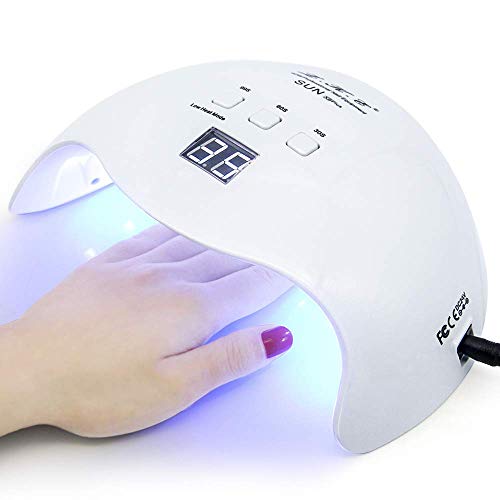
The LKE 40W UV LED Nail Lamp with 3 Timers is listed with 21 LED lights, 30-, 60-, and 99-second timer settings, an LCD screen, and sensor wording that says the LEDs automatically light when a hand is inserted. Its listed exterior dimensions are 8.54 x 5.24 x 2.95 inches. The listing names UV gel, UV top coat, UV builder gel, and LED nail gel, and LKE explicitly says it cannot dry regular polish or gel without UV content.
The hand-in rhythm is straightforward: prepare the hand, select the maker-appropriate timer, place the hand inside, and keep it in position for the cycle. The 40W label still needs context. The listing does not explain how that figure was measured or whether it represents input or output. It also does not publish interior dimensions, irradiance, wavelength information, or independent results for particular gel formulas.
The three timer choices are concrete operating controls. They are not a substitute for the cure instructions on the gel bottle or within the product system. A visible countdown can make repeated work easier to organize without proving that the selected cycle is correct for a specific material.
The Lavinda cycle: more controls, still a listing
The Lavinda 48W UV LED Nail Lamp represents a more feature-heavy full-size route. Its listing describes 33 LED beads, advertised dual 365nm and 405nm light sources, 10-, 30-, 60-, and 90-second settings, infrared hand detection, a low-heat mode activated by long-pressing the 90-second button, and a detachable magnetic base.
The seller says the interior is intended for five fingernails or toenails. That stated capacity can be convenient for a manicure or pedicure routine, but it does not establish clearance for every hand or foot because interior measurements are not stated. The product-copy description gives the desk a clearer hand-in shape; it does not supply measured comfort data or formula-by-formula cure behavior.
At this station, the worker is less concerned with aiming at one gem and more concerned with consistent hand placement. A fixed housing and timer can support that routine. They do not verify cure completeness or replace the gel maker's instructions. The listing also does not provide interior measurements, detailed cleaning instructions, or measured comfort data.
The table is a map of jobs, not a winner's podium
| Format or product | Best-defined role | Placement and stabilization | Published timing or controls | Important missing information |
|---|---|---|---|---|
| MelodySusie P-ART01R | One-finger flash curing and detail work, per listing | Cordless handheld format; transparent cover listed | 20- and 60-second timers; seller also describes some 3-5-second flash cures | Wavelength, intensity, dimensions, weight, charging method, formula-specific schedules |
| Geisofu UV Nail Lamp | Movable, clamp-on light for a constrained workstation | 360-degree gooseneck; clip, hang, or flat placement listed | One 3W LED and four brightness levels | Wavelength range, irradiance, beam area, cure time, working distance, clamp capacity |
| GAOY Handheld UV Gel Nail Lamp | One-nail curing and detail nail art, per listing | Cordless format with a listed stand | LCD display; listing claims 8 seconds for gel polish and 12 seconds for gel top coat | Wavelength, wattage, LED details, charging method, dimensions, coverage |
| LKE 40W UV LED Nail Lamp | Timer-based hand curing for named UV/LED gel categories | Fixed lamp with sensor wording for hand insertion | 30-, 60-, and 99-second timers; LCD; 21 LEDs listed | Interior dimensions, irradiance, wavelength, measurement meaning of 40W |
| Lavinda 48W UV LED Nail Lamp | Convenience-focused hand or foot cycles, per listing | Fixed lamp with detachable magnetic base; five-nail or five-toenail claim | 10-, 30-, 60-, and 90-second timers; sensor; low-heat mode; advertised 365nm and 405nm sources | Interior dimensions, irradiance, wavelength tolerance, electrical details, measured cure behavior |
A timer follows the movement of the work
At the flash-cure station, a timer answers a narrow question: how long does this one placement need to remain steady before it can be released? MelodySusie's 20- and 60-second options, or the GAOY display and its separate listing time claims, are relevant because the work happens nail by nail. Short bursts can help stop a tip or decoration from moving. Where the system requires more, they are followed by the product maker's complete-cure process.
At the full-size station, a timer answers a broader workflow question: how can the prepared hand receive a consistent exposure cycle? LKE's 30-, 60-, and 99-second choices and Lavinda's 10-, 30-, 60-, and 90-second choices make repeated cycles easier to select. Neither set of presets makes the lamp universal.
A 60-second button is an interface choice, not evidence that every gel needs, receives, or safely completes a 60-second cure in that lamp. The same caution applies to technical labels. A 3W single LED, a 40W lamp label, a 48W lamp label, 21 LEDs, or 33 LED beads describe elements of the listings. They do not independently state the exposure delivered to a particular nail surface.
The material makes the compatibility call
Compatibility and complete-cure instructions are product-specific. Consult the gel maker's stated lamp and exposure guidance. A light described as UV, LED, dual-light, or UV LED should not be treated as automatically appropriate for any gel in the drawer. Begin with the maker-specified product and lamp cure instruction. If the instructions name a particular lamp, wavelength range, or time, use that information. If the directions are unclear, ask the product maker for clarification before using the product.
The listings show why broad language needs boundaries. LKE names specific UV and LED gel categories and excludes regular polish and gel without UV content. Lavinda lists several gel categories and advertises dual 365nm and 405nm sources, but its listing does not provide measured output or formula-by-formula results. MelodySusie and GAOY frame their compact products around focused work, while their timing language does not establish a universal complete cure. Geisofu emphasizes position and USB-powered flexibility rather than a defined nail-gel testing program.
None of this makes one format inherently wrong. It assigns the formats different questions. Use flash curing for placement control when the product directions allow it. Use a full-size lamp for the complete-cure stage when its specifications and the gel maker's instructions align. If those pieces do not align, changing the timer at random is not a dependable correction.
Care belongs beside the workstation
The U.S. Food and Drug Administration describes UV nail curing lamps as low risk when used as directed and advises users to follow labeled exposure times. The FDA notes that people concerned about exposure can consider broad-spectrum sunscreen or UV-absorbing gloves, and that medications or cosmetics can contribute to photosensitivity. The American Academy of Dermatology advises broad-spectrum, water-resistant SPF 30+ on the hands or dark, opaque fingerless gloves before gel manicures.
These sources provide general care information and do not endorse any lamp in this comparison. The AAD also advises avoiding cuticle trimming, not picking gel polish, and taking nail-polish breaks when appropriate. Lavinda's listing-derived safety note advises stopping use and reassessing if unusual heat, irritation, or discomfort occurs. A protective-cover claim, low-heat feature, or sensor is not a medical guarantee.
Two lamps, one continuous gesture
A combined setup can give each format one defined job. The flash-cure lamp handles the moment when an individual tip, rhinestone, sculpted detail, or decoration must not move. The compatible full-size lamp then handles the maker-specified cure cycle once placement is stable. This division avoids asking a small targeted light to perform as a documented hand lamp, while also avoiding the awkwardness of forcing every delicate placement into a full-size chamber.
If mobility is the main concern, compare the battery and power arrangement. MelodySusie lists a 450mAh battery and up to 90 minutes of continuous use. GAOY lists a 400mAh battery and up to 60 minutes of continuous use. Geisofu is described as USB powered. The broader power decision appears in cordless versus plug-in nail lamps.
Choose a handheld flash-cure lamp when the bottleneck is precise placement on one finger. Choose a full-size lamp when the bottleneck is completing consistent, maker-directed curing cycles across a hand. If both stages genuinely appear in the routine, the desk has a clear choreography: one finger steadies beneath the movable light, then the whole hand disappears into the lamp. The unresolved buyer question is simple: which part of the next manicure is actually making you stop—the detail that will not stay put, or the hand that still needs a compatible complete cycle?
Frequently asked questions
Can I use a flash-cure lamp as my only nail lamp?
Only if the exact gel maker says the lamp and its exposure process are appropriate for complete curing. A flash-cure format is commonly organized around one nail and initial placement control, so it should not be assumed to replace a hand-sized lamp.
Do more watts automatically mean a faster or better cure?
No. The LKE and Lavinda listings use 40W and 48W labels, but wattage alone does not state irradiance at the nail, formula compatibility, or the correct time for a specific gel.
Is the GAOY stand the same as a full-size lamp housing?
No. GAOY lists a stand for its cordless handheld lamp, while a full-size housing is designed around placing the hand inside a broader curing area. The listing does not state GAOY's full-hand coverage.
Can the Geisofu brightness settings be used as gel-cure presets?
No. The listing calls them four brightness levels. It does not connect each level to a tested gel type, thickness, wavelength output, or curing duration.
What should I do if gel feels hot or my skin becomes irritated?
For exposure questions, use labeled instructions and consider the FDA-noted photosensitivity considerations. For under-cure concerns, use the gel maker's instructions.
Sources
U.S. Food and Drug Administration: UV-emitting nail dryer lamps. General exposure guidance, including labeled exposure times, low-risk-as-directed framing, optional sunscreen or UV-absorbing gloves, and photosensitivity considerations.
American Academy of Dermatology: Gel manicures. General manicure-care guidance, including SPF 30+ or dark opaque fingerless gloves, cuticle care, avoiding picking, and breaks when appropriate.
Amazon product facts, prices, availability, specifications, controls, and feature descriptions were captured from current listing/API data supplied for this article. They are attributed to product listings and have not been independently hands-on tested. Neither the FDA nor the AAD endorses the referenced products.