Tabletop nail dust collectors are often presented as a simple station upgrade: turn on a fan, file over a grille, and the workspace is handled. A product page cannot support that conclusion by itself. This guide looks at the category rather than a specific machine, explains what local collection may do, and identifies the details needed before treating an airflow, filter, or quiet-operation claim as meaningful.
The dust-path audit: what a tabletop collector may do
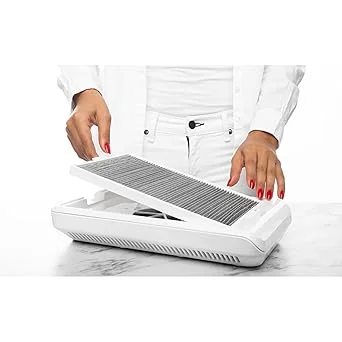
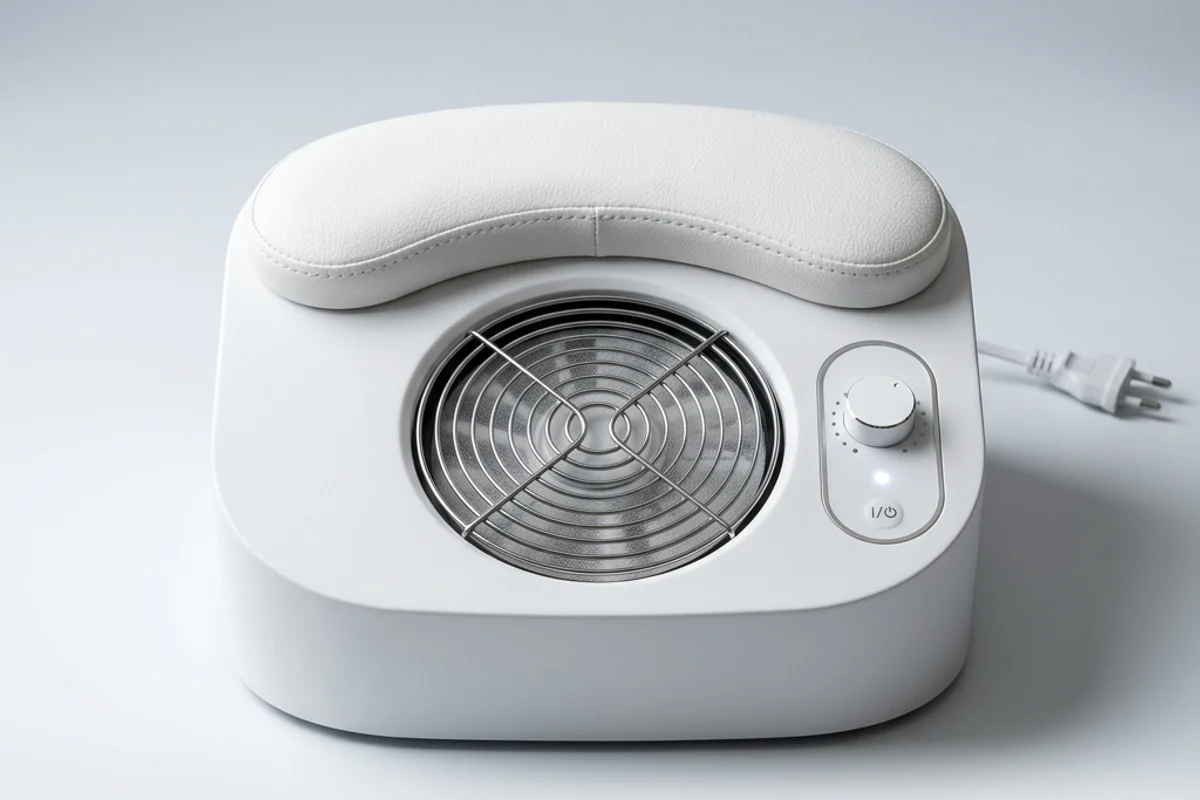
A tabletop collector is best understood as a local collection point placed near dry filing work. When filing happens directly over an intake, some loose debris may be drawn toward the grille and retained in the machine’s designated collection area. That is the narrow, plausible job of the category: to provide an opportunity to collect material near where it is generated.
Whether that opportunity becomes useful in a particular setup depends on more than a motor label. Nail position, hand movement, filing direction, the shape and size of the intake, fan design, filter condition, room air movement, and the condition of the unit can all affect where debris goes. Material that does not enter the intake may settle on nearby surfaces or remain elsewhere in the work area. A listing cannot establish total capture simply by showing a hand positioned over a vent.
- Generation: Dry filing creates debris at the nail and tool contact point.
- Position: The intake has an opportunity to collect only when the work stays close to its designed intake area.
- Entry: Material must move into the grille rather than past it, behind it, or onto the surrounding table.
- Retention: The specified pad, bag, cartridge, or other filter arrangement must be installed and maintained as directed.
- Cleanup: Debris that lands on hands, tools, products, and surfaces still needs normal housekeeping.
That is why a tabletop unit should not be treated as a room-air cleaner, respiratory protection, a clean-air guarantee, or proof that all dust has been captured. It is one possible source-control measure at the work surface. It does not replace appropriate housekeeping, workplace procedures, or protective measures that may apply to a particular setting.
Filter language needs a closer look
Filter terminology can sound more definite than it is. A listing may use words such as reusable, washable, fine filter, HEPA-style, or high-density filter. Those labels do not automatically tell a buyer the filter’s construction, its fit within the housing, the system’s sealing, how often it should be serviced, or whether replacement media will remain available.
A reusable pad may be convenient only if the manufacturer provides clear cleaning instructions and a replacement part number. Do not assume that every fabric or foam-looking pad can be rinsed, brushed, vacuumed, or reused indefinitely. Follow the exact manual for cleaning and replacement. If a listing does not identify the replacement filter, ask the seller for the part number, dimensions, material description, and instructions before purchasing.
A HEPA or HEPA-style reference also needs context. The wording alone does not prove the filter is certified to a stated standard, that it is installed in a sealed system, or that the complete collector achieves a defined capture result during nail filing. It is reasonable to ask what the term means for that exact model. It is not reasonable to turn the word into a health, air-quality, or total-capture promise.
How to translate airflow claims
Marketing language often combines electrical specifications with performance language. They are not interchangeable. Wattage describes an electrical power specification, not a direct measurement of collection at the nail. Motor speed, fan speed, or a variable-speed control may describe part of a design, but none proves how much debris reaches the intake or stays in the filter.
Likewise, phrases such as “strong suction,” “professional airflow,” and “high power” do not use a universal threshold. Even an airflow figure needs context: where it was measured, whether a filter was installed, the speed setting, the intake opening, and the test method. Without that context, it cannot support a meaningful comparison between models. It also cannot prove collection across a stated distance, full-table coverage, or control of what escapes the work area.
Noise claims deserve the same caution. “Quiet” is a preference-based marketing term unless an exact listing explains how sound was measured and under what operating condition. A buyer can evaluate controls, placement, return terms, and documented specifications, but should not infer a noise outcome from product photos, family resemblance, or an unverified review.
| Listing feature or format | Useful details to verify in the exact listing or manual | What the detail does not prove |
|---|---|---|
| Portable tabletop collector | Overall dimensions, intake location, cord placement, power requirements, included filter, and stable placement instructions. | Dust capture throughout a room, compatibility with every station, or better results than another format. |
| Built-in collector | Cutout dimensions, clearance needs, installation instructions, service access, and whether the table is included. | Superior collection, easier maintenance, or suitability for an existing table without confirmed measurements. |
| Reusable pad or bag system | Exact replacement part number, service instructions, disposal guidance, and whether replacements are currently sold. | Unlimited reuse, interchangeability with another brand, or a particular filtration standard. |
| “HEPA” or “HEPA-style” wording | The manufacturer’s stated standard, filter identity, installation method, and supporting documentation. | Whole-system sealing, respiratory protection, clean air, or total dust capture. |
| High-wattage or high-airflow claim | The exact measurement, test conditions, installed filter condition, control settings, and stated limitations. | Capture at the nail, performance over distance, or a direct comparison to another collector. |
Who the category may fit—and who should skip it
It may fit people who need a defined work-surface collection point
A tabletop collector may suit a person who does dry filing at a fixed or portable station, can keep the work near the intake, and is willing to follow the manufacturer’s maintenance directions. It may also appeal to someone who wants a removable device instead of modifying furniture. Before buying, that person should be able to confirm the unit’s size, power setup, replacement-filter path, return policy, and cleaning instructions for the exact model.
Skip the purchase if the basic evidence is missing
Skip a model when the seller cannot identify the exact machine, the replacement media is unclear, the manual is unavailable, or the product page relies on broad claims without documentation. A collector is also a poor fit for anyone expecting an air-quality guarantee, a substitute for housekeeping or appropriate protection, or proof that dust will not settle beyond the intake. Built-in units should be skipped unless the table measurements, installation requirements, and service access are confirmed in advance.
Current disclosure gaps
Because no current catalog record is available, several buyer-relevant facts remain unverified: whether any collector is currently stocked, which accessories are included, what filter media is specified, whether replacement filters are sold, how the unit is maintained, whether it is portable or installed, and what warranty or return terms apply. There is also no verified basis for claims about airflow, dust capture, noise, durability, compatibility, safety, or value.
Those gaps matter because a nearby model can look nearly identical while using a different intake, filter shape, power connection, or replacement system. Do not use an old product image, an old model name, or a seller’s generic description as confirmation that a current item is the same machine.
Purchase checklist: questions worth asking before checkout
- What is the manufacturer’s exact model number, and does it match the manual and product-page photos?
- Is the unit tabletop, built-in, or part of a table system? What is included in the box?
- Where is the intake, and what are the complete exterior and installation dimensions?
- What power source, plug type, voltage requirements, and control arrangement does the manual specify?
- What filter, bag, or cartridge comes with the unit, and what is its exact replacement part number?
- Does the manufacturer state how to remove, clean, replace, and dispose of the collection media?
- Does the airflow claim include a test method, operating setting, and limitations, or is it only promotional wording?
- Can the seller provide warranty, return, and replacement-part information in writing?
- For a built-in system, do the required cutout, clearance, and access measurements match the actual table?
Use and upkeep: keep expectations grounded
Once an exact model is documented, use it according to its manual. Keep the intended intake area unobstructed, position the filing work where the design calls for it, and service the collection media on the manufacturer’s schedule. Avoid improvising replacement materials or cleaning methods when the documentation does not permit them. Clean settled residue from the station, tools, and surrounding surfaces as part of the normal work routine rather than assuming the collector has handled every trace of debris.
A dust collector also does not change gel-product instructions. Wattage and diode counts do not prove cure adequacy. Follow the gel maker’s named lamp and cure instructions; there is no universal cure time. Keep uncured gel off skin, and if curing causes painful burning, stop rather than resuming.
Related guides
- Nail Lamp Wattage Explained explains why one specification rarely answers a broader compatibility question.
- Gel Polish Curing Problems covers separate gel-system questions that a dust collector cannot answer.
- How to Apply Thin Gel Polish Coats offers application guidance for gel services; it is not a dust-collector performance guide.
Frequently asked questions
Can a tabletop nail dust collector guarantee cleaner air?
No. A tabletop collector may collect some debris near its intake, but it is not a clean-air guarantee and does not establish what remains elsewhere in the room. Product claims should be evaluated as local collection claims unless the manufacturer provides specific, relevant documentation.
Does higher wattage mean better dust collection?
No. Wattage is not a direct collection measurement. Intake design, fan design, filter condition, placement, and the manufacturer’s test method all affect what an airflow statement can mean. Compare documented information from exact models rather than treating wattage as a performance ranking.
Does a HEPA-style filter make a collector respiratory protection?
No. Filter wording does not turn a tabletop collector into respiratory protection or prove whole-system sealing. A local collector does not replace appropriate housekeeping or protective measures for the setting.
Can replacement pads from another brand be used?
Do not assume so. Similar-looking pads can differ in dimensions, thickness, material, support structure, and fit. Use the exact replacement media named in the manufacturer’s documentation unless that manufacturer expressly approves an alternative.
Is a built-in collector automatically better than a tabletop model?
No. Built-in and tabletop designs solve different setup problems. A built-in unit may require furniture modification and planned service access, while a tabletop unit may be easier to move. Neither format proves airflow, capture, safety, or compatibility without exact documentation.
Concise verdict
Nail dust collectors are best evaluated as local work-surface collection tools, not as proof of dust-free work or clean air. With no exact current catalog listing available, there is no basis for recommending a specific model or repeating legacy performance claims. Buy only when the seller can document the exact unit, filter system, maintenance process, installation needs, and support terms—and treat broad airflow and filter language as questions to verify, not conclusions.