
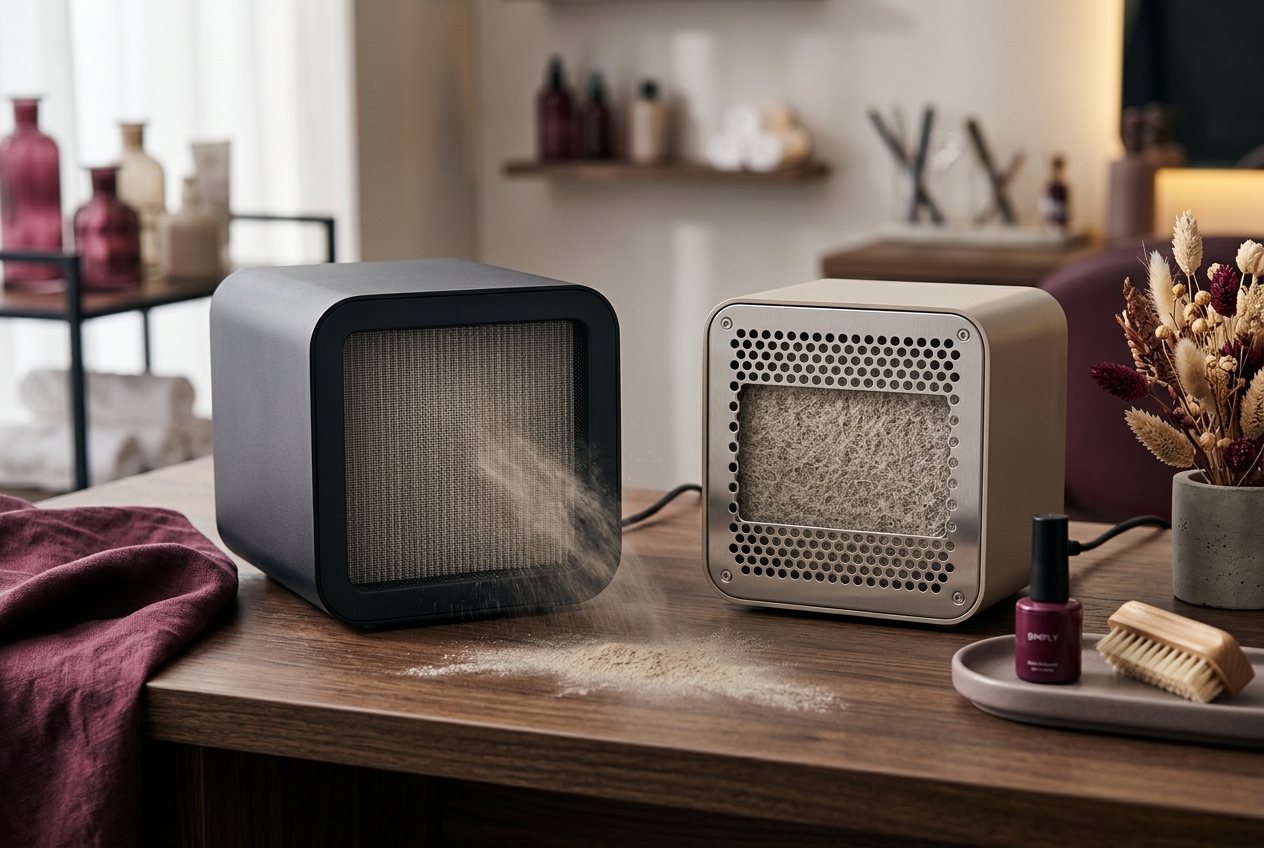
The filing station is ready: the collector sits beside the hands, the abrasive tool is prepared, and the next question is not which product has the largest number in its title. It is where the dust will go during the few seconds between filing and cleanup. A particle begins at the nail when a file, e-file bit, or buffer breaks product into fine debris. Moving air may carry it toward an intake, onto the table, or elsewhere in the room.
A collector placed close to the filing point has an opportunity to intercept dust before it disperses, but the supplied product listings do not establish comparative capture performance. The two listing-defined options have different stated controls and filter descriptions: NXJ INFILILA offers stepless control and a claimed HEPA filter, while MelodySusie HPro offers three stated suction levels and a magnetic-cover reusable filter. Neither listing supplies measured airflow.
The short answer: compare the capture point, not the headline number
A nail dust collector is a tabletop source-capture device intended to pull filing debris toward a filtered intake near the hands. It can reduce visible dust at that work point, but it is not automatically equivalent to a designed local-exhaust ventilation system. Compare intake placement, usable capture area, filter access, cleaning instructions, replacement support, and independently stated performance. RPM, “turbo,” and particle-capture language do not by themselves prove whole-workspace protection.
Setup: put the intake where filing happens
Before the tool starts, identify the active filing zone. A technician refining enhancement product near the free edge creates particles with a range of sizes. Some heavier fragments fall quickly. Finer particles can be disturbed by hand movements, the e-file, a client shifting position, or an adjacent fan. The collector has its strongest opportunity when its intake draws the debris in while it remains close to the work surface.
That is the central distinction between source capture and later cleanup. Once dust crosses the intake area and spreads over the table, a small portable collector has a harder job. Wiping the settled surface remains important, but it occurs after release rather than at the point where the material was generated.
The National Institute for Occupational Safety and Health describes local exhaust or source-capture control for artificial-nail chemical hazards: contaminants should be controlled as near as possible to where they are generated. Its guidance concerns both dust and vapors in nail work. This principle does not turn every tabletop product into engineered local exhaust. It does explain why collector location, the direction of the work, and an unobstructed intake can matter more than an attractive retail specification.
For a home setup, the intended arrangement may place the collector directly below or immediately beside the filing zone before the drill is turned on. For a salon, the surrounding room also matters: adjacent stations, general ventilation, products in use, cleaning practices, and the time workers spend exposed throughout a day. A collector is one layer in a broader exposure-control plan, not the whole plan.
Table space is part of the setup decision. A unit that cannot stay near the hands because it is awkward, unstable, too tall, or poorly positioned may have less opportunity to collect dust than its fan language suggests. The listings do not provide comparative capture-distance testing, so placement remains a practical variable rather than a measured product advantage.
Active capture: read fan language in context
Retail listings often lead with fan speed because it is easy to display. The NXJ INFILILA listing states a 4,500 RPM, 13 cm brushless turbo fan and claims 80% more suction than standard models. The listing extract does not define the comparison model, test method, airflow, static pressure, intake geometry, or collection distance. A rotational-speed figure describes the stated fan speed, not the amount of dust captured during a specific filing session.
The MelodySusie HPro product copy describes a turbo brushless fan, powerful collection, low noise, rear ventilation, and heat-dissipation behavior. It also identifies LOW, MEDIUM, and HIGH suction settings. These are operating descriptions, but the available extract does not give numerical airflow, pressure, decibel, wattage, or continuous-use figures for any setting. “High” has meaning relative to the same device unless the manufacturer provides a measurement and test context.
Fan speed is not irrelevant. It can describe the hardware the seller says is inside the unit. Capture, however, depends on more than the motor’s rotational speed: intake size and openness, filter resistance, leaks around a filter or cover, distance from the dust source, and whether filing occurs within the collection zone can all affect the result. The supplied listings provide no measured airflow or capture data for clean versus loaded filters.
This is also why a portable collector should not be described as room air cleaning on the basis of a fan claim. The unit’s intended work is close to the hands. Room-scale ventilation and a tabletop intake address different parts of the environment.
For a broader buying discussion, see this nail dust collector vacuum review. The tool generating the debris has a separate role. An e-file creates or mobilizes dust through filing; a collector attempts to intercept it. The differences among bits and their uses are covered in this nail drill bits guide. Bit cleaning is a separate task, explained in how to clean nail drill bits.
Filter loading: the claim belongs to the listing
A filter claim answers one question about media under a stated condition. It does not automatically establish how much material the complete appliance captures at the source. The supplied listings do not provide whole-device capture testing. That distinction matters whenever a product page uses HEPA terminology, a percentage, or broad “vacuum effect” wording.
The NXJ INFILILA listing says its reusable HEPA filter traps 99% of particles as small as 0.3 microns. That is a product-copy filtration claim, not independent verification of collector performance across a manicure table. The same copy says the filter can be rinsed or tapped clean when suction drops, describes a 3-to-6-month service interval depending on use, and estimates annual filter cost at $40 to $60. The supplied extract does not provide a drying procedure after rinsing, a filter part number, or a test report.
The MelodySusie HPro listing calls its media a reusable fine filter. Its magnetic cover is described as allowing removal, and seller guidance says to clean the filter with a hairdryer or dust brush and replace it every 3 to 4 months for optimal performance. The extract provides no filtration standard, particle-capture percentage, replacement-filter price, or filter dimensions. That absence does not establish that the arrangement is ineffective; it limits how far the listing can support a filtration conclusion.
“Reusable” should not be read as indefinite service life. The supplied listings do not state how cleaning or filter condition changes airflow or capture performance. Use the applicable maker instructions where they are complete, and seek clarification where they are not. If a seller says a filter may be rinsed, the supplied NXJ extract still does not explain how it should be dried before reinstallation.
Filter access affects the filing session indirectly. A filter that is difficult to reach may be cleaned less consistently, while an accessible cover can make routine maintenance easier. Ease of access is a design characteristic, not evidence that the collector keeps the same performance over time. The table below keeps those two ideas separate.
Teardown: cleaning instructions are model-specific
When the filing session ends, dust remains in more than one place. It may be on the collector body, around the cover, on the work surface, and in or on the filter. Opening, removing, cleaning, and reinstalling the filter should follow the applicable manufacturer instructions.
The two listings give different directions. NXJ INFILILA product copy permits rinsing or tapping. MelodySusie HPro product copy names a hairdryer or dust brush. These instructions should not be merged into a universal procedure: they are seller-specific claims, and the supplied information does not establish that one model’s method is suitable for the other. No independent validation here supports wet-cleaning either product’s filter, and the NXJ extract does not say how to dry it.
The listed intervals are also not interchangeable. NXJ states a 3-to-6-month service interval depending on usage. MelodySusie suggests replacement every 3 to 4 months for optimal performance. Those statements are not a guarantee that every filter will last for the same period, nor do they describe a measured performance threshold. Use, visible condition, seating, and changes in operation may all prompt a support question, but the listings do not define a universal replacement test.
Clean the collector body and table as well. A removable cover, low-profile body, or easy-access filter may make routine care more likely, but convenient maintenance design does not prove that the device remains sealed or performs consistently. If performance changes, the unit is damaged, or the filter no longer seats correctly, consult the applicable manufacturer support instructions.
Dust collection should remain distinct from disinfection and sanitation. A collector does not disinfect bits, hands, implements, or work surfaces. The bit-care article linked above provides context for cleaning nail drill bits, while product residue, dust removal, and any required sanitation process should not be treated as the same activity.
Two listing-defined choices, side by side
The following is a constrained comparison of captured listing facts rather than test results or a ranking. Price and availability are captured listing details and can change. Neither product is described here as proven full-room air cleaning or as a substitute for a complete local-exhaust installation.
| Criterion | NXJ INFILILA Nail Dust Collector, 4500 RPM | MelodySusie HPro Portable Nail Dust Collector |
|---|---|---|
| Captured price and availability | $35.99; In Stock | $38.49; In Stock |
| Stated control arrangement | Stepless speed knob and LED speed display | LOW, MEDIUM, and HIGH button controls |
| Stated fan information | 4,500 RPM, 13 cm brushless turbo fan | Turbo brushless fan; motor speed Not stated |
| Stated filter description | Reusable HEPA filter; listing claims 99% capture of particles as small as 0.3 microns | Reusable fine filter under a magnetic cover; filtration standard Not stated |
| Listing cleaning and replacement guidance | Rinse or tap clean; stated 3-6 month interval depending on usage | Clean with hairdryer or dust brush; suggested replacement every 3-4 months |
| Published airflow, suction pressure, and noise level | Not stated | Not stated |
| Stated dimensions | 2.3-inch thickness; other dimensions Not stated | 7.67 x 2.34 inches |
| Power details | USB power port stated; output and power consumption Not stated | Not stated |
NXJ INFILILA: adjustable control, incomplete measurement picture
The NXJ listing states stepless control, an LED display, a USB power port, a 2.3-inch profile, and a 2-year warranty. It also states the 4,500 RPM, 13 cm brushless turbo fan and claims 80% more suction than standard models. For a user who wants to vary the collector response instead of selecting among three fixed positions, stepless control is the direct differentiator. The captured $35.99 price is below the captured HPro price.
The unanswered questions are equally important. The supplied material does not state airflow, pressure, sound level, the complete dimensions, USB output, or an accessory list. The 4,500 RPM and 13 cm fan diameter do not substitute for those values. “Standard models” is not identified, so the 80% suction statement remains a listing comparison rather than a measured basis for choosing between these two units.
The filter description is also bounded by the wording of the product copy. The listing calls it reusable HEPA media and gives the 99% claim for particles as small as 0.3 microns. It does not provide independent testing or whole-appliance capture results. A buyer who values the stated filter claim and adjustable control can treat those as the product’s advertised distinctions without converting them into broader performance conclusions.
MelodySusie HPro: simple settings and magnetic-cover access
The HPro listing states three settings, a magnetic cover, a reusable fine filter, and 7.67 x 2.34-inch dimensions. Its product copy describes a turbo brushless fan, powerful collection, low noise, rear ventilation, and heat-dissipation behavior. The three button-controlled levels offer a straightforward operating arrangement: LOW, MEDIUM, or HIGH.
At the captured $38.49 price, the HPro listing does not establish that it outperforms the NXJ. It provides no airflow or pressure measurements, decibel rating, power-source description, cord length, runtime, filtration standard, package-content list, or replacement-filter cost in the extract. “Portable” describes the intended format; it does not prove cordless operation because power details are not stated.
The magnetic cover is a stated access feature, not a performance test. The seller’s cleaning direction names a hairdryer or dust brush, and the suggested replacement interval is every 3 to 4 months for optimal performance. Those details can inform a maintenance comparison, but they do not demonstrate how the collector behaves under a particular dust load.
Room context: where a tabletop collector stops
OSHA notes that nail-salon workers can encounter exposures through vapors, dust, skin contact, and accidental ingestion. Its nail-salon guidance emphasizes ventilation, hazard communication, safety data sheets, appropriate work practices, and PPE selected for the hazard. That wider framing matters because a collector does not address every route or every material used during a service.
Ventilation designed for the room and work process is a separate consideration. Where applicable, workplace requirements and the relevant safety data sheet should inform the broader control plan. PPE is an additional hazard-specific layer, not a reason to ignore source capture, filter maintenance, or ventilation.
A portable tabletop collector can be useful because it is positioned close to the work and can intercept debris before it settles. It should not be presented as complete local exhaust ventilation without evidence about its capture effectiveness, airflow path, and installation. Complete local-exhaust ventilation is distinct from a portable tabletop collector.
This distinction becomes more consequential in a busy salon. One tabletop intake does not describe the air movement at adjacent stations, the room’s general ventilation, or exposures that occur while products are opened, applied, removed, or cleaned. The listings do not provide evidence that either device manages those broader conditions.
Make the choice from the stated record
Start with the physical filing position. If the collector cannot remain near the work because its shape interferes with the client’s hands or the technician’s movements, the product’s fan language is not enough to resolve the setup problem. Then look at use frequency. More frequent operation makes accessible filters, replacement sourcing, and a clear maintenance routine more consequential.
For NXJ INFILILA, the known listing features include continuous adjustment, a display, a claimed HEPA filter, a 2.3-inch profile, a stated USB port, and a 2-year warranty. For HPro, the known listing features include three settings, stated dimensions, a magnetic cover, and reusable-filter access. For both products, airflow, suction pressure, and noise are not stated. Neither can be selected on verified extraction capacity from these listing facts alone.
Price is also limited to the captured moment: NXJ INFILILA is listed at $35.99 and In Stock, while MelodySusie HPro is listed at $38.49 and In Stock. Those details may change and should not be treated as a lasting price ranking.
The final setup question is broader than either product page. Is a portable collector enough for the room, work pattern, and exposure-control needs involved? For frequent professional use or persistent dust concerns, a workplace-specific ventilation assessment may be more relevant than another fan claim.
Close the session with the unresolved choice in view
Choose NXJ INFILILA when its stated stepless control, LED display, low-profile 2.3-inch design, and claimed HEPA-filter arrangement are the features that matter most, while recognizing that its headline RPM and suction comparison do not supply measured collection performance. Choose MelodySusie HPro when its compact stated footprint, three simple settings, and magnetic-cover filter routine better suit the table, while recognizing the same absence of airflow, noise, and power data.
Either way, the collector belongs at the dust source, its filter belongs in a maintained state, and the device remains a portable tabletop collector rather than full local-exhaust ventilation. The filing light goes off, the last pale crescent of dust is wiped from the table, and the buyer is left with one concrete question: will this intake stay close enough to the hands, service after service, to be the layer the room actually needs?
Frequently asked questions
Does a higher fan RPM mean a better nail dust collector?
No. RPM identifies the stated rotational speed of a fan, but it does not by itself show airflow, pressure, collection distance, filter resistance, leakage, or how effectively dust is captured during actual filing.
Which of these two collectors has a published noise rating?
Neither captured listing provides a decibel figure. The MelodySusie listing uses low-noise language, but that is product-copy language without a stated measurement in the supplied extract.
Can I use the NXJ INFILILA USB port to power any nail device?
The listing says the unit includes a USB power port and describes powering nail lamps or drills, but the supplied extract does not provide the port output specification. Confirm voltage, current, and device requirements before relying on it.
Should a reusable collector filter be replaced even when it looks clean?
Use the applicable maker interval and replace it earlier if performance declines, it is damaged, or it will not seat properly. The NXJ listing states 3-6 months depending on use, while MelodySusie suggests 3-4 months for optimal performance.
Does a nail dust collector replace room ventilation?
No. A tabletop collector addresses dust near its intake, while room ventilation addresses the broader environment. OSHA and NIOSH guidance supports a layered approach rather than treating one portable device as a complete control solution.
Sources
NIOSH: Controlling Chemical Hazards During the Application of Artificial Fingernails. Source-capture discussion and distinction between near-source control and complete local-exhaust systems.
OSHA: Health Hazards in Nail Salons. Exposure routes, ventilation, hazard communication, safety data sheets, work practices, and hazard-appropriate PPE.
Amazon product facts were captured from current listing/API data for NXJ INFILILA Nail Dust Collector, 4500 RPM (ASIN B0FW4Q9YPN) and MelodySusie HPro Portable Nail Dust Collector (ASIN B0D83LNMC2). No hands-on testing was performed. Suction, filtration, noise, cooling, heat behavior, lifespan, and safety statements remain attributed to product copy rather than independently measured outcomes.

