
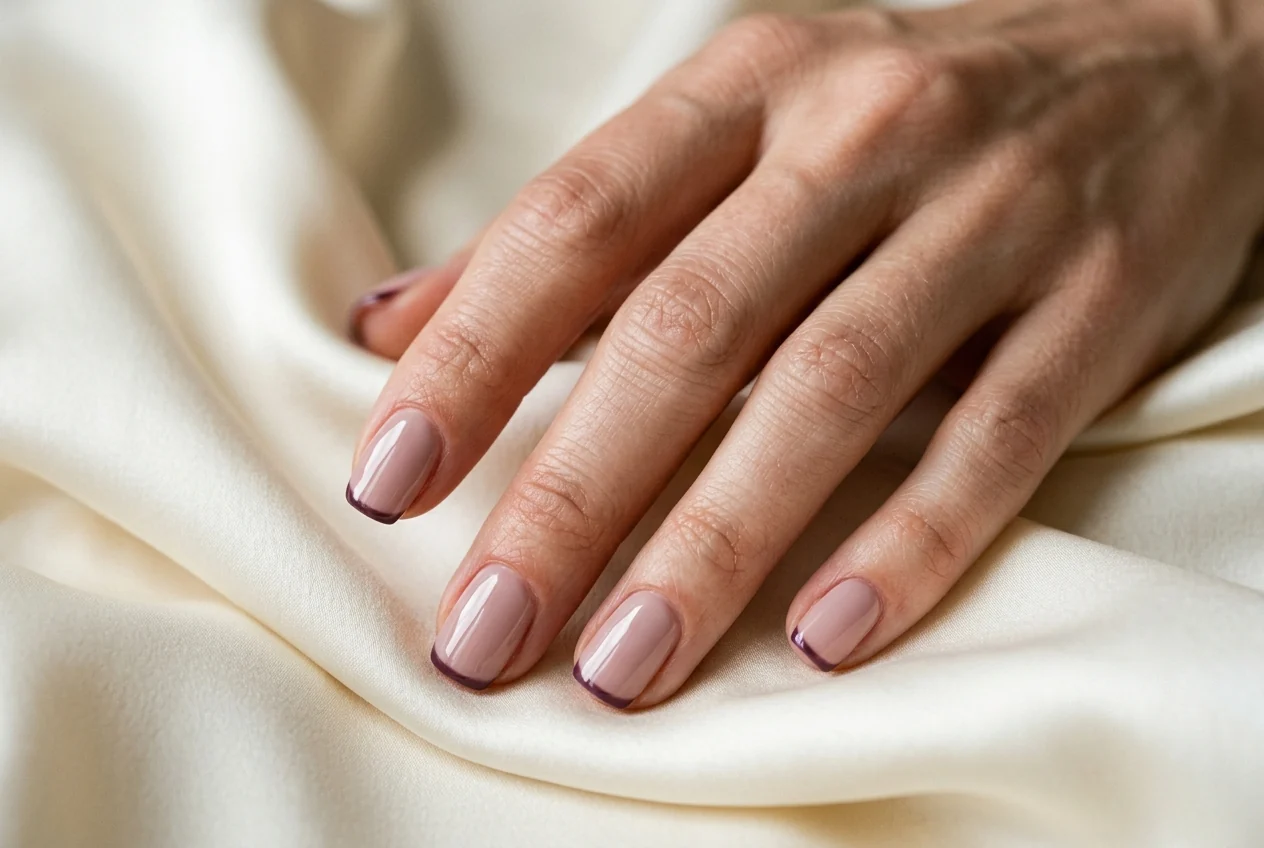
A short square nail is a tiny tailored cuff at the fingertip: a clean horizontal edge, upright-looking sides, and corners softened only as much as the mood requires.
Here, "short square" means a short length with a comparatively straight free edge and straighter-looking side boundaries. It describes appearance, not a nail-care method, durability claim, or popularity ranking. On this compact canvas, perimeter, finish, and line placement carry the whole composition.
Edge character comes first
The short-square silhouette begins with proportion. The visible length stays concise; the free edge reads comparatively horizontal rather than pointed or strongly rounded; the side boundaries appear straighter than those of a fully oval outline. Together, those cues create a compact, rectangle-like impression.
Square need not mean severe. A crisp edge can feel architectural, graphic, or tailored. Ease the corners slightly and the same outline becomes quieter, less rigid, almost polished by hand rather than drawn with a ruler. The essential cue remains the same: the free edge is primarily straight and the sides retain a comparatively upright direction.
At short lengths, small decisions show. A narrow dark border can make the perimeter appear more defined; a translucent finish can let it recede; a reflective top layer can draw attention back to the edge. Lighting, color contrast, photography, nail beds, and camera angle all change how those choices appear.
| Outline | Free edge and corners | Overall visual read |
|---|---|---|
| Short square | Comparatively straight free edge, straighter-looking sides, and crisp or gently softened corners | Compact, clean, and geometric |
| Squoval | A softer, more rounded perimeter with visibly curved corner transitions | Compact, with a gentler outline |
Neither outline is better or more practical. They simply give a color, finish, or detail a different frame. If the perimeter becomes continuously curved, it moves toward the squoval description rather than short square.
Five moods for the compact square
1. Almost bare
Choose a translucent beige, soft rose, milk white, or muted taupe and keep the free edge calm. A faint pearly veil, a barely darker tip, or a close-toned accent adds depth without breaking the hush. This is restraint with a clear outline beneath it.
2. Dark tailoring
Black, espresso, navy, charcoal, oxblood, deep berry, moss, cobalt, and near-black make the short square feel especially contained. Let a single opaque shade do the work in gloss or matte, or add one fine contrasting tip when the composition needs a second note. No art is required.
3. The defined micro French
A narrow band at the free edge turns the horizontal boundary into the motif. White, black, metallic, primary, pastel, or a related shade from the base color family all change the temperature of the idea. Keep the band narrow for a clean edge focus; widen it for a firmer color-block effect. Double lines, offset lines, and alternating tip colors take it somewhere more graphic.
4. The precise accent map
Use the nail as a miniature layout: a centered dot, a slim off-center vertical stripe, a small star-like symbol near one corner, or two parallel marks near the edge. Repeat the mark across every nail for rhythm, or leave it on one or two accent nails for interruption. A simple color field keeps the detail legible.
5. Light on the surface
Here, color plays supporting role to finish. Try a muted base beneath a pearly sheen, a dark shade with a velvet-like directional glow, or gloss and matte in the same tone. Fine shimmer, reflective glaze, and translucent layering bring variation without illustrated detail; changing light becomes part of the look.
Make the choices speak to one another
Short square gives design placement a small, useful grid: a vertical centerline, two side boundaries, and the free edge. A thin line near the tip echoes the silhouette. A side panel tests the width of the canvas. A centered symbol creates a still point. The question is simply where the eye lands first, not whether a placement promises a particular effect.
Build around one primary contrast: light and dark, matte and gloss, sheer and opaque, or flat color and reflected color. A narrow palette can make a set feel continuous; a deliberately mixed palette can be equally intentional when line width, color temperature, finish, or one recurring accent color holds it together.
For a separate color-placement idea, the Italian manicure styling guide for short nails offers another visual option. For different silhouette labels, see the coffin versus almond guide. Neither link defines short square or serves as evidence for the descriptions here.
No external sources are included. This is editorial styling rather than a trend ranking, search-volume study, hands-on test, nail-care protocol, or claim about physical outcomes. Color, finish, line placement, and design suggestions are creative editorial options rather than verified effects.
Frequently asked questions
What is a short square nail shape?
A short square nail shape has a short visible length, a comparatively straight free edge, and straighter-looking side boundaries. Its corners may be crisp or gently softened while the overall perimeter still reads primarily straight.
How does short square differ from squoval?
Short square retains a straighter free edge and a more upright visual direction along the sides. Squoval has a softer, more rounded perimeter and more visibly curved corner transitions.
How can the corners of short square nails be softened?
Softening the corners changes the edge character while keeping the free edge comparatively straight.
What nail art suits a short square canvas?
These are compositional options: narrow French tips, fine lines, centered dots, small symbols, offset blocks, side panels, and restrained metallic accents. Keeping the color field simple gives those small details room to read clearly. No placement is claimed to produce a physical or guaranteed aesthetic outcome.
Is this a report on 2026 nail trends?
No. This is an editorial guide to short-square styling in 2026, not a trend ranking, popularity claim, search-volume study, or hands-on test.
Salon brief
Short length, comparatively straight free edge, softly eased corners, and one clear idea: a warm sheer neutral with a fine metallic tip; espresso in full gloss; or a muted base with one precise off-center mark.