Are UV nail lamps safe?
The U.S. Food and Drug Administration describes UV nail curing lamps as low risk when used as directed. That conclusion does not make every lamp, gel formula, timer, or exposure session identical. The relevant safeguards are modest and specific: use the gel product’s labeled cure directions, avoid unnecessary extra cycles, protect hand skin if you choose, and take photosensitivity seriously.
A wattage number is not a dose measurement at the nail. A listing can identify electrical power, light-source count, or claimed wavelengths without stating irradiance, uniformity, wavelength tolerance, or a test method. Public-health guidance describes a cautious way to use these devices; product listings describe features and seller claims.
A nail lamp is part of a gel-polish system. It is not simply a general dryer, and its timer is not an all-purpose prescription. The formula maker’s instructions identify the product being cured and the schedule intended for that product. That instruction has greater relevance than a generic listing statement that a lamp works with many gels.
The four questions below separate the issues that are often compressed into one reassuring product-page sentence: how exposure is limited, how curing is decided, when personal sensitivity changes the picture, and which listed features can actually guide a choice.
Question one: how should UV exposure be limited?
The FDA’s central direction is to follow the labeled exposure time. In practice, that means using the schedule supplied for the actual gel product and lamp combination whenever one is provided. Do not add cycles because a lamp has a high wattage label, a large LED count, or a claim about speed. Do not assume a shorter setting is sufficient merely because the polish looks set. More time is not automatically a better cure, and a quick-looking result is not proof of adequate curing.
Skin coverage is a separate decision. The FDA identifies broad-spectrum sunscreen and UV-absorbing gloves as optional choices for people who want an additional layer of hand protection. The American Academy of Dermatology advises applying broad-spectrum, water-resistant SPF 30+ sunscreen to the hands or wearing dark, opaque fingerless gloves before a gel manicure. Neither option changes the product’s labeled cure schedule.
Fingerless gloves leave the nails available to the lamp, so their coverage must be read literally. The wrist, finger sides, skin around each nail, and openings created by the glove’s shape can remain exposed. Fit matters: a glove that bunches, shifts backward, or leaves broad openings does not cover the same area as one that stays close to the hand. Sunscreen depends on an even topical application; gloves can reduce reliance on that application. Some people choose one approach, and some use both.
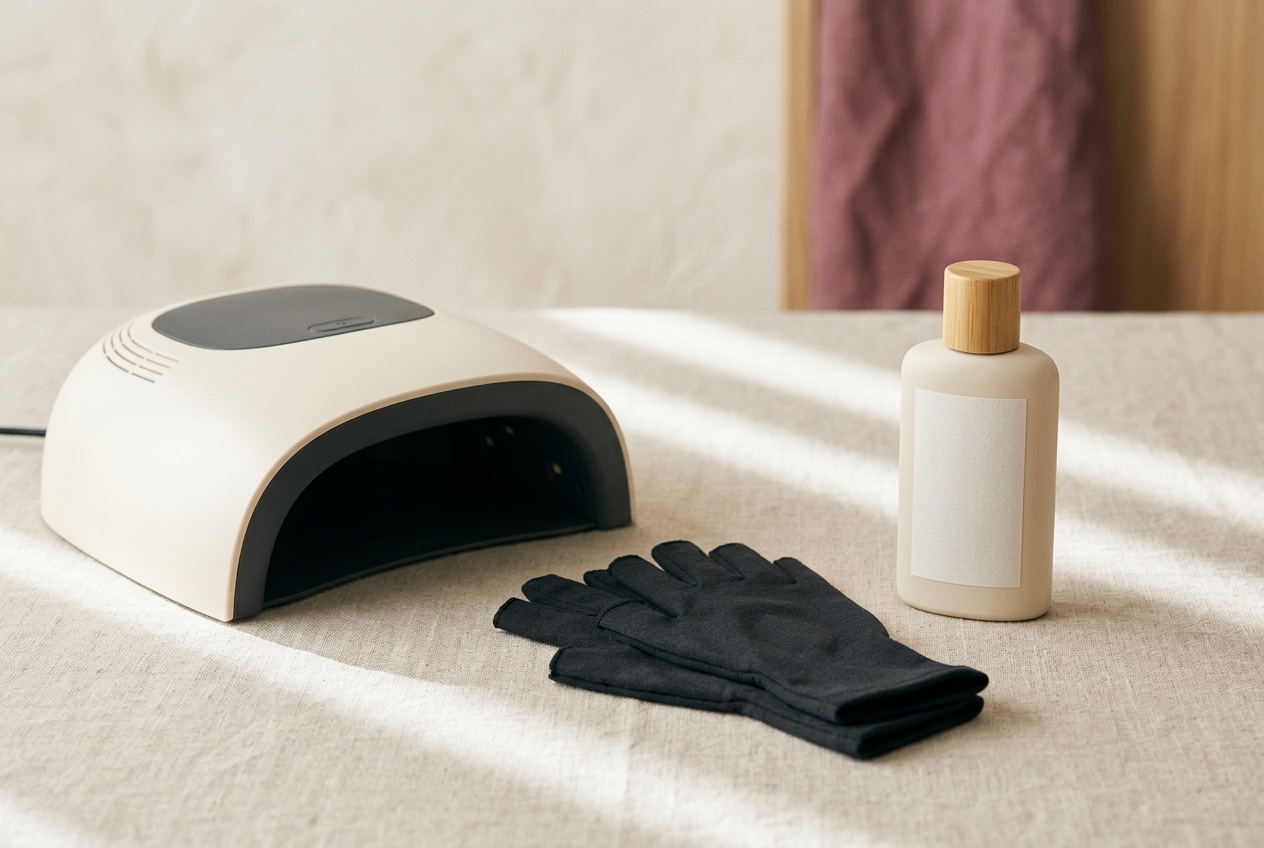
The Modelones 48W UV Nail Lamp with Gloves and 3 Timers is listed as a lamp-and-fingerless-glove kit. Its listing says the kit includes a 48 W lamp and UV gloves, and its product copy claims UPF 99+ and 99% UV blocking. Those are seller claims. The supplied listing does not independently confirm glove performance, fit, coverage, or protection at the nail opening. Anyone assessing the accessory still needs to look at sizing, seam placement, wrist length, and exposed areas.
A label is not a dose reading
The difference between a 40 W title label and a 48 W title label cannot, by itself, establish the ultraviolet dose reaching the nail or skin. Listings may use wattage to mean rated electrical power, a maximum value, an input figure, a combined component rating, or another convention. A listing may also provide bead counts or named wavelengths while omitting irradiance at the nail, distribution across the hand, wavelength tolerance, and test conditions.
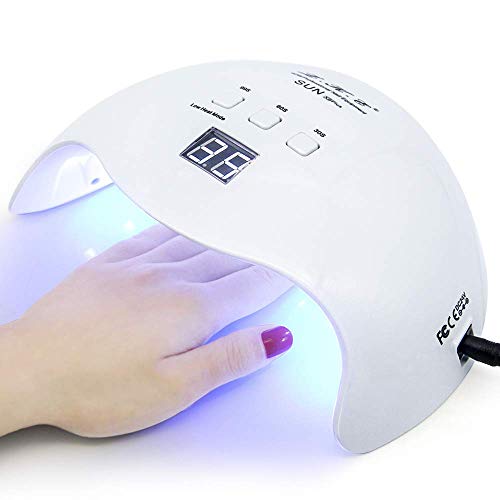
The Modelones listing uses a 48 W label and says there are 21 UV and LED light sources. The LKE listing uses a 40 W label and says there are 21 LED lights. Lavinda’s listing identifies 48 W, 33 LED beads, and advertised 365 nm and 405 nm sources. These are different listing details, not a controlled safety or speed comparison. For a narrow explanation of the numbers, see our guide to nail lamp wattage.
The same caution applies to marketing language. A phrase such as “two times faster,” “soft light,” “eye protection,” or “skin-browning prevention” does not become a measured outcome because it appears beside a wattage figure. LKE’s feature copy attributes eye-protection and skin-related effects to its housing design. Lavinda’s listing uses eye, skin, comfort, and speed language. The source and status of each statement should remain visible.
Question two: who decides the cure time?
The gel manufacturer decides the relevant cure instructions for its formula. One gel may respond differently from another because formulas, pigments, layer thickness, base coats, top coats, and accessory gels can differ. A lamp or polish package that broadly says “UV/LED” may offer useful compatibility language, but that wording does not prove a complete, safe cure for every product in the category.
Read the formula maker’s application and cure directions for each layer. Look for any named lamp requirement, wavelength or lamp-family guidance, exact times for base, color, top, or builder products, and removal instructions. Then check whether the lamp offers the schedule the gel maker specifies. A timer button is a control; it is not independent evidence that a particular gel has cured correctly.
The LKE 40W UV LED Nail Lamp with 3 Timers illustrates the point. Its listing names 30-, 60-, and 99-second timers and says it is for UV gel, UV top coat, UV builder gel, and LED nail gel. It also explicitly says it cannot dry regular polish or gel without UV content. Thus it is not a general-purpose nail dryer merely because it has a timer. For the gel categories named in the listing, the formula maker’s directions remain controlling.
Lavinda’s listing presents four timer settings: 10, 30, 60, and 90 seconds. It claims dual 365 nm and 405 nm lighting and names multiple gel categories. Those details describe the listed controls and configuration. A 90-second button is not a universal guarantee for builder gel, color gel, top coat, or a thicker application. The appropriate time still comes from the product instructions.
What heat can and cannot tell you
A low-heat label may describe a convenience feature, but it is not proof that every application will be comfortable or correctly cured. Lavinda’s listing says low-heat mode is activated by long-pressing the 90-second setting. That is a control claim, not independently tested thermal performance.
For discomfort or questions about application, follow the gel maker's instructions and seek individualized advice when photosensitivity is a concern. Do not answer discomfort by applying thicker coats, extending exposure at random, or keeping a painful hand under the lamp. Comfort and cure quality depend on the whole product system, not on one button.
A sticky layer also needs context. The Modelones listing says a sticky layer after 60 seconds can be normal. That statement should not be generalized to every product: some systems intentionally retain an inhibition layer, while others provide different finishing instructions. The appearance of a surface is not a substitute for the gel maker’s directions.
Question three: when does personal photosensitivity change the decision?
The FDA notes that medication and cosmetic photosensitivity can matter for people using UV nail lamps. This is especially relevant after starting a new medicine, using a new topical cosmetic product, or noticing an unusual skin response. It is a personal factor, not something a lamp description can settle for everyone.
Do not self-diagnose a reaction from a product page or an internet checklist. If you have known light sensitivity, a history of concerning reactions, or uncertainty about a medication or topical product, obtain individualized guidance from the clinician or pharmacist who knows your situation before continuing UV exposure. The point is not to label every lamp session dangerous; it is to avoid treating a personal risk factor as irrelevant because a listing sounds reassuring.
Protection choices do not turn a session into a risk-free event. Fingerless gloves leave the nail area accessible by design, and sunscreen depends on application and the skin it covers. Neither measure replaces labeled cure times. Neither validates a lamp’s speed, output, comfort, or seller claims.
The AAD’s advice also places the lamp inside a larger manicure routine. It advises avoiding cuticle trimming, not picking gel polish, and taking nail-polish breaks when appropriate. The relevant sequence includes preparation, application, curing, wear, and removal. A cautious decision therefore cannot be made from the lamp’s light-source count alone.
Public guidance and product copy are different kinds of evidence
FDA and AAD guidance does not endorse the Modelones, LKE, or Lavinda lamps. It can inform behavior around UV exposure and gel manicures, but it does not validate a seller’s stated cure speed, eye-protection language, skin-comfort statement, or durability claim. Keep the source attached to the claim: public-health guidance addresses general use, while the listing describes product features and marketing language.
Question four: which listed details can guide a choice?
Once the gel instructions are in hand, the useful comparison becomes narrower. Can the lamp deliver the required timer? Does its listed configuration match the formula maker’s stated requirements, if any? Are the accessories clearly sized and shaped? Are the physical dimensions, power details, and controls sufficient for the intended cosmetic routine? Missing information should remain missing rather than being filled with assumptions.
The Modelones listing gives 30-, 60-, and 90-second timer settings and says an automatic sensor turns the lamp on when a hand is inserted and off when it is removed. That may reduce a button press, but it does not override the selected product schedule. The listing expressly includes fingerless gloves, whose UPF 99+ and 99% UV-blocking statements remain product-copy claims requiring scrutiny of fit and coverage.
LKE’s listing gives 30-, 60-, and 99-second choices, an LCD screen, automatic-sensor wording, and exterior dimensions of 8.54 x 5.24 x 2.95 inches. It states 110-240V input and refers to using the original adapter. It does not state interior opening dimensions. Exterior measurements therefore cannot establish clearance for broad hands, long nails, or a particular pedicure position.
Lavinda’s listing describes infrared hand detection, 10-, 30-, 60-, and 90-second settings, and a detachable magnetic base. It says the space is intended for five fingernails or toenails. Those statements concern the listed design and cosmetic use. They do not establish treatment benefits for foot pain, circulation concerns, fungal conditions, injuries, or other medical needs.
| Product | Listed timers | Listed configuration | Exposure-related listing detail | Not stated in supplied listing data |
|---|---|---|---|---|
| Modelones 48W UV Nail Lamp with Gloves and 3 Timers | 30, 60, 90 seconds | 48 W title label; 21 UV and LED light sources | Included fingerless UV gloves; product-copy UPF 99+ and 99% UV-blocking claims | Glove sizing, coverage measurements, lamp dimensions, irradiance, electrical-input format |
| LKE 40W UV LED Nail Lamp with 3 Timers | 30, 60, 99 seconds | 40 W title label; 21 LED lights; 110-240V input listed | Automatic sensor wording when a hand enters | Interior dimensions, irradiance, wattage measurement basis, complete hardware inventory |
| Lavinda 48W UV LED Nail Lamp | 10, 30, 60, 90 seconds | 48 W listing label; 33 LED beads; advertised 365 nm and 405 nm sources | Infrared hand detection; low-heat mode control claim | Dimensions, weight, voltage, plug type, cord length, irradiance, wavelength tolerance |
For a formula-focused comparison, read our UV versus LED nail lamp compatibility guide. For visible finish problems rather than exposure questions, use the gel-polish curing problems guide. The decision point is concrete: place the gel bottle beside the lamp, match its stated cycle to an available control, and leave any unresolved photosensitivity question with a qualified clinician or pharmacist rather than with the wattage printed in a title.
Frequently asked questions
Should I use sunscreen or UV gloves for gel nails?
They are optional exposure-reduction measures. The FDA mentions broad-spectrum sunscreen or UV-absorbing gloves for concerned users. The AAD advises broad-spectrum, water-resistant SPF 30+ on the hands or dark, opaque fingerless gloves before a gel manicure. Check glove fit and openings rather than assuming all hand skin is covered.
Does a higher-wattage nail lamp mean less UV exposure?
No. A wattage label does not reveal dose at the skin, cure completeness, or the correct cycle for a gel. Use the gel maker’s stated lamp and time instructions instead of treating 40 W or 48 W as an exposure calculator.
Can I cure regular nail polish in an LKE UV LED lamp?
No. LKE’s listing specifically says the lamp cannot dry regular polish or gel without UV content. Conventional polish needs its own drying process rather than a UV-gel curing cycle.
What does Lavinda’s detachable base change?
The listing describes a removable magnetic base intended to make cleaning and hand-or-foot access more flexible. It does not establish interior clearance, medical foot benefits, or suitability for every pedicure position.
Are Modelones’ included gloves enough to make lamp exposure risk-free?
No. The listing’s UV-protection and UPF statements are product-copy claims, and fingerless construction leaves the nail area accessible. Gloves can be one part of a cautious routine alongside labeled exposure times and personal photosensitivity considerations.
Sources
U.S. Food and Drug Administration: UV-emitting nail dryer lamps. Used for low-risk-when-directed framing, labeled exposure-time guidance, optional sunscreen or UV-absorbing gloves, and medication or cosmetic photosensitivity considerations.
American Academy of Dermatology: Gel manicures. Used for SPF 30+ or dark opaque fingerless glove guidance, avoiding cuticle trimming and picking, and taking nail-polish breaks when appropriate.
Amazon product facts, offer snapshots, feature wording, and product-copy claims for Modelones, LKE, and Lavinda were captured from current listing/API data. They were not independently hands-on tested, medically reviewed as product endorsements, or verified for irradiance, cure speed, durability, fit, electrical performance, or seller safety claims. Prices and availability can change.