The short answer
A lamp turning on confirms that it has power and that at least some LEDs illuminate. It does not confirm that your particular gel received the wavelengths, usable exposure, cure time, or nail coverage specified by the product maker. If the result remains soft, wrinkles, dents, or lifts soon after curing, keep it away from skin and use the product maker's directions. Start with the bottle label and the gel maker's specified lamp and exposure instructions. General “UV/LED” wording is not proof that a particular formula will cure safely in a particular device.
The useful diagnostic question is not “Is the lamp bright?” It is “What changed on the nail, and does that change match the gel maker's expected result?” A lamp can illuminate while the product-and-lamp combination remains unverified. A coat can also fail because it is too thick, because a thumb sits outside the strongest light path, or because the wrong product is being treated as though it shares another formula's instructions.
Read the surface before replacing equipment. Soft, wrinkled, shrinking, sticky, and uneven results are not identical failures. Keep uncured gel off skin while checking the cause. FDA identifies nail products as cosmetics and notes that artificial-nail methacrylates can cause sensitization; labels, warnings, and careful avoidance of skin contact therefore belong at the beginning of the investigation, not as an afterthought.
When every nail looks wet or gummy
If the entire manicure remains wet, smears readily, or can be wiped away, begin with the bottle. Confirm that it is a light-cured gel product and locate the brand's cure schedule. LKE says its lamp cannot dry regular polish or gel without UV content. That is a product-category limitation, not a promise that every UV-containing gel will cure in that lamp.
Look for a named lamp requirement, a different time for base, color, or top coat, and instructions that change with the shade or layer. A lamp advertised for “UV/LED gels” may still lack a demonstrated match for the formula in your hand. Do not turn a broad category label into a compatibility verdict.
Then examine one layer rather than the manicure as a whole. A slight tack can be intentional in some gel systems, but a color layer that moves under light pressure, transfers heavily, or wipes down to bare nail is a failure signal. Do not cover that material with another layer. Remove the failed product using the method intended for the formula.
For a controlled check, choose one nail and apply a fresh, deliberately thin coat. Use the maker's specified time, place the nail fully inside the chamber, and inspect the result without pressing wet product with a bare fingertip. If the same test fails, stop treating longer cycles as the answer. Review the formula, lamp pairing, product condition, and instructions instead.
When the top hardens but the color wrinkles
Wrinkling often tells you to inspect the layer beneath the surface. A set-looking surface does not by itself resolve whether the layer cured as the maker intended. If the gel maker specifies thin coats, use that instruction as the first comparison point and remove material that has failed.
Apply thin, even coats and cure each one separately for its stated time. Keep the application method consistent while testing. If opacity seems to require a heavy deposit, do not solve that uncertainty by guessing at a substantially longer exposure. The problem may lie in the amount applied or in the formula's behavior. Our guide to applying thin gel polish coats covers the application variable in more detail.
Repeat the same shade on one nail with a deliberately thin layer. If that test behaves as the maker describes, thickness was the most useful lead. If it remains soft or wrinkles despite thin application, correct timing, and correct placement, move to the lamp-and-formula pairing rather than thinning the product without limit.
When some nails cure and others do not
Inconsistent curing points toward geometry as well as equipment. Check whether the maker's instructions call for a particular hand position or separate thumb cycles. Keep the nail flat and fully inside the chamber. A tilted finger, overlapping fingers, or a sidewall turned away from the light can change what reaches the product.
Thumbs deserve their own check. Their angle can place part of the nail outside the most direct light path, especially when the hand is inserted as a group. If the gel maker's directions allow separate-thumb curing, test that arrangement without changing the product, layer thickness, or stated time at the same time.
Inspect the lamp's LED windows, removable surfaces, and reflective areas for residue or obstruction. Clean them according to the lamp instructions. A sensor can activate a cycle, but activation does not verify even exposure across every nail surface.
Move the same thin test coat from one position to another. A repeated positional pattern is a reason to recheck the lamp instructions, hand placement, and product-maker guidance. If every location fails, return to the product instructions and pairing question. Do not wear an under-cured result while waiting to see whether it hardens later.
When the manicure shrinks, dents, or pulls away
Shrinking and lifting require a distinction between adhesion and cure. Review the gel maker's preparation sequence and the specified layer thickness. Product on the cuticle or sidewall can lift and can also increase contact with uncured material. Use the complete preparation method supplied for that formula rather than adding unrelated steps during the test.
A manicure that feels firm at first is not automatically cured correctly. A hard surface, a sealed top coat, or several days of attachment cannot establish what happened inside the layer. Conversely, lifting can expose a soft section that was already under-cured. The appearance of the failure should guide the next check, but durability alone is not a cure test.
AAD advises avoiding cuticle trimming and not picking gel polish; picking can damage the nail plate and make the original failure harder to interpret. Remove failed gel with the method intended for the product instead of peeling it away. Keep the work focused on identifying the failed variable, not preserving a manicure that may contain uncured material.
When only the surface stays sticky
A sticky surface is not always the same as a wet layer. Some product instructions describe a tacky surface after curing and specify whether to leave it, wipe it, or apply the next layer. The relevant question is what the product maker says should happen after the stated exposure.
Check whether the instructions say to leave the surface alone, wipe it, or cover it with top coat. Use the specified finish as the reference. If the instructions are unavailable or unclear, treat the result as uncertain rather than assuming that every sticky surface is normal.
Do not seal suspected under-cured gel beneath another coat. Remove it, avoid skin exposure, and review the formula, layer, lamp pairing, time, and nail position. Repeatedly touching the surface with a bare finger is also a poor test because it can transfer uncured product to skin.
Compatibility comes before wattage
Wattage is an easy number to compare and an incomplete diagnosis. A wattage label does not, by itself, state irradiance at the nail, spectral output, interior coverage, or how a particular gel responds. More LEDs and more timer options may be useful controls, but they do not establish a safe cure for every bottle. Our guide to UV versus LED nail-lamp compatibility examines that distinction.
Work through the match in order: identify the formula, read its curing directions, check whether the maker names a lamp category or device, use the stated exposure for the specific product and shade, and keep the nail correctly positioned. Treat base, color, builder gel, and top coat as separate products when their instructions differ. One timer setting is not automatically transferable across a whole manicure system.
Be especially cautious with old, decanted, unlabeled, or mixed products. Color and texture are not enough to reconstruct a cure schedule. A lamp that worked with one brand, shade, or top coat has not thereby been shown to cure another. When a controlled thin-coat test fails, changing the product-and-lamp pairing is more informative than stacking on more product or repeating cycles without a stated basis.
What the listings can and cannot tell you
The comparison below is a diagnostic reference, not a lamp ranking. The details are listing-attributed. They may help you identify timer, placement, or cleaning controls, but none of them establishes curing performance with your gel.
| Product | Listed light or power detail | Listed timing or control detail | Stated limitation |
|---|---|---|---|
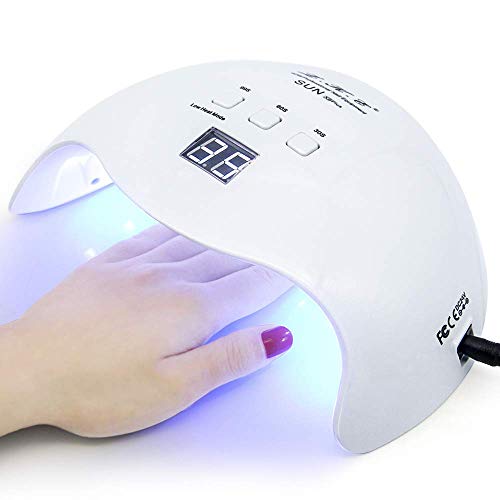
| LKE 40W UV LED Nail Lamp with 3 Timers | 40W; 21 LED lights | 30-, 60-, and 99-second timers; LCD; automatic sensor wording | The listing does not explain how the 40W figure was measured or publish interior dimensions. |
| Lavinda 48W UV LED Nail Lamp | 48W; 33 LED beads; advertised 365nm and 405nm sources | 10-, 30-, 60-, and 90-second timers; infrared hand detection; low-heat mode described through the 90-second control | Measured irradiance, dimensions, electrical details, and formula-specific cure evidence are Not stated. |
| beetles 55-Piece 32-Color Gel Nail Polish Kit | LED lamp included | Seller directs at least 60 seconds per base, color, and top layer under a UV&LED lamp | Lamp wattage, dimensions, output, and color-specific cure data are Not stated; adapter is not included and the listing calls for a certified 5V/2A adapter. |
The LKE listing identifies 30-, 60-, and 99-second timers, 21 LEDs, and automatic sensor activation wording. Its 40W label has no measurement context in the stated details. Those controls can be compared as features; they cannot show how a given bottle will cure.
The Lavinda listing names 10-, 30-, 60-, and 90-second settings, a detachable magnetic base, hand detection, and advertised 365nm and 405nm light sources. It describes a low-heat mode activated by long-pressing the 90-second setting. These are listing details, not measured output or formula-specific evidence.
The beetles listing gives a seller-directed minimum of 60 seconds for each base, color, and top layer and includes an LED lamp. It does not state lamp output or color-specific cure data. The listing excludes an adapter and calls for a certified 5V/2A adapter, so that detail belongs to the product-copy conditions rather than being silently omitted.
Run one controlled nail
A single-nail comparison usually produces clearer information than redoing all ten nails. Use the same prepared surface and the same product. Apply a thin coat, use the exact maker-specified time, and place the nail fully inside the lamp. Keep formula, timing, thickness, and position stable until the result is assessed.
If the test behaves as expected, add back one variable at a time: the ordinary shade, the usual amount of product, all fingers together, or your regular thumb angle. The first change that recreates the failure identifies the next place to look. If the initial test fails, review product condition, lamp condition, instructions, and compatibility rather than assuming that the user or the timer alone is responsible.
Do not treat discomfort as confirmation of cure. Stop if discomfort occurs and follow the product and lamp instructions. Remove the hand, stop the service, and reassess the relevant instructions. A low-heat setting described in lamp copy is a control feature, not medical assurance or a guarantee that a product will cure correctly.
Keep skin, nails, and workspace separate
Avoid uncured gel on skin and do not continue wearing gel that you suspect is under-cured. FDA advises attention to labels and warnings and notes the sensitization potential of artificial-nail methacrylates. Broad UV/LED compatibility language does not prove a safe cure, especially where the formula maker names a particular lamp or exposure method.
AAD advises broad-spectrum, water-resistant SPF 30+ on the hands or dark, opaque fingerless gloves before gel manicures. That is general dermatology advice, not an endorsement of a particular lamp, polish, timer, or cure schedule. Stop after irritation or discomfort and obtain appropriate professional advice for persistent or significant skin or nail concerns.
Dust is a separate workspace issue. Lavinda describes a detachable magnetic base and space intended for five fingernails or toenails; those listing details do not change the need to keep the workspace clean.
When a replacement answers the question
Replacement becomes easier to justify when it addresses a documented need: a timer range required by the gel maker, a way to position thumbs correctly, a removable base for cleaning or cosmetic foot access, or a lamp specifically approved by the formula maker. Do not choose solely because another product advertises more watts, more beads, or faster curing.
Read the product copy carefully. LKE states that its lamp is for named UV gel categories and says it cannot dry regular polish or gel with no UV content. That stated limit is diagnostically more useful than an unqualified speed claim. Lavinda's controls may address positioning or cleaning needs, while the beetles listing supplies a stated timing direction but leaves lamp output and color-specific timing Not stated.
The decision point is concrete: remove the failed material, run one thin test under the formula maker's instructions, correct thickness or placement if the test passes, and stop using the pairing if it does not. A glowing chamber is only the beginning of the check. The unresolved buyer question is whether the lamp in front of you is actually the device your bottle's instructions were written around.
Frequently asked questions
Can I cure gel polish for twice as long if it is still soft?
Not as a default fix. Confirm the bottle's instructions, apply a thin test coat, and place the nail correctly. If the specified cure fails, the formula and lamp may not be a suitable pairing. Extending time without that check does not prove a safe cure.
Why does my lamp cure one brand but not another?
Different brands can provide different cure instructions. A successful result with one product does not establish compatibility with another, and broad UV/LED wording does not validate every gel in the same lamp.
Is a 99-second timer stronger than a 30-second timer?
No. A timer describes duration, not light intensity or spectral output. The LKE listing labels 30, 60, and 99 seconds as timer selections; use a longer selection only where the gel maker's directions support it.
Can I use the beetles kit lamp with a different gel brand?
The supplied listing identifies an included LED lamp but does not provide its output or establish compatibility with every outside formula. Use the other brand's lamp and cure guidance rather than assuming the kit lamp is interchangeable.
What should I do if gel burns or irritates my skin during curing?
Remove your hand from the lamp, stop the service, and avoid further contact with uncured product. Do not continue because a cycle is nearly finished. Use the product's removal directions and obtain appropriate professional advice if symptoms persist or are significant.
Continue the system check
Sources and evidence boundaries
U.S. Food and Drug Administration: Nail Care Products was used for the cosmetic-product context, label and warning considerations, sensitization risk associated with artificial-nail methacrylates, and avoiding skin contact.
American Academy of Dermatology: Gel Manicures was used for general advice on SPF 30+ or dark opaque fingerless gloves, avoiding cuticle trimming and picking, and taking breaks when appropriate.
Amazon product facts were captured from current listing/API data. Product names, prices, availability, timer labels, light-source descriptions, included-item statements, compatibility wording, and seller claims are attributed to listing or product-copy claims; they are not hands-on tests, medical guidance, or endorsements by FDA or AAD.