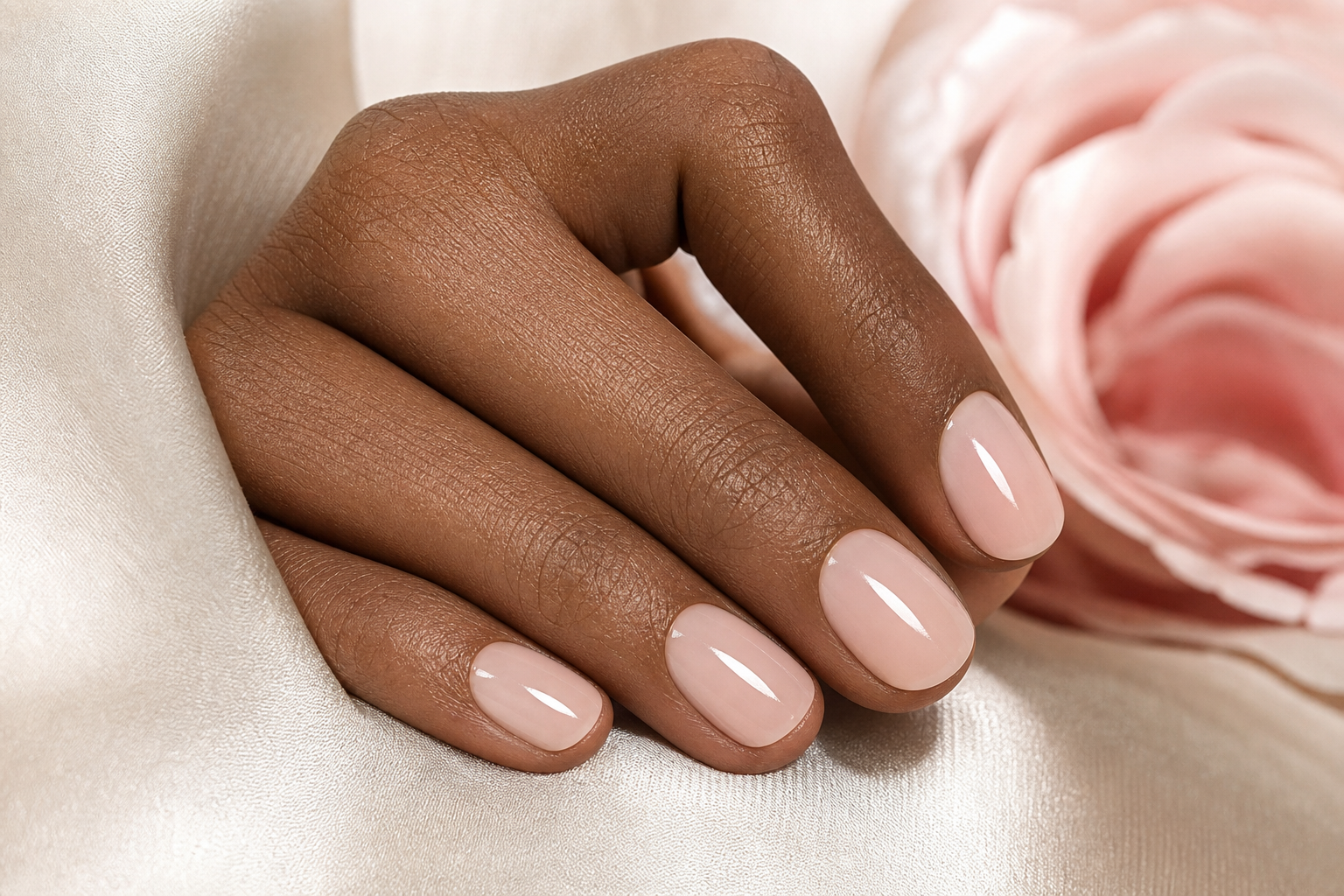
The appeal of ballet blush nails is in what they leave visible. Rather than covering the nail in a solid baby pink, this manicure lets the natural nail plate, free edge, and a little individual variation remain part of the picture. The result is a soft pink wash with enough beige to feel restrained, enough rose to read as intentional, and a clean finish that keeps it from looking unfinished.
It is a useful reference point within the softer end of current nail trend coverage, but ballet blush is best understood as a color-and-finish direction, not one bottle or a rigid recipe. A translucent cool rose, a neutral pink-beige jelly, and a milky petal pink can all belong in the same family if the overall effect remains light, dimensional, and neatly finished.
What defines a ballet blush manicure
Three details distinguish ballet blush from a standard pale-pink manicure: translucency, pink-beige balance, and precision. Translucency means the polish is not trying to erase the nail beneath it. Depending on the coverage, the free edge may remain clearly visible or soften into a hazy line. The pink should suggest blush rather than candy, while the beige note keeps the color from becoming stark or overly sweet.
The final component is the finish. A ballet blush manicure can be glossy, pearly, matte, or tipped with a tiny French edge, but the application needs to look deliberate. Even sidewalls, a tidy cuticle area, balanced lengths, and a smooth surface matter more here than they might with a dark cream polish. Because the color is quiet, uneven layers and pooled product have nowhere to hide.
It is also different from simply wearing clear gloss. Clear gloss leaves the nail color almost entirely unchanged. Ballet blush adds a visible veil of pink-beige tone. It is less opaque than a classic pastel pink and generally less fruit-toned than a strawberry or watermelon jelly. Think of it as a tint, not a blanket.
Choose the coverage before choosing the shade
Coverage determines the mood of this manicure as much as hue does. One very sheer coat reads like a transparent rosy filter. Two thin coats create a more composed blush effect while still showing nail dimension. A translucent milky base beneath a sheer pink gives a softer-focus version, useful when you want the free edge to look less distinct without moving into opaque territory.
- Transparent blush: A clearer pink-beige wash that leaves the natural nail highly visible.
- Balanced blush: Two restrained layers or a lightly pigmented jelly that gives the nail a noticeable rosy cast.
- Milky blush: A sheer, cloudy base paired with pink for a more diffused finish, not a solid cream manicure.
Natural nail color, ridges, staining, and the length of the free edge will all affect what a sheer shade does. That is not a failure of the look; it is part of working with translucency. If you want the polish to disguise every irregularity, an opaque nude or a more substantial milky manicure may be a more practical direction.
Finish matrix: ways to wear ballet blush
The base color can stay consistent while the top finish changes the character of the manicure. This matrix is a styling guide rather than a set of rules; the same soft pink can be adjusted toward minimal, bridal, tailored, or slightly more decorative.
| Version | Color approach | Surface finish | Styling impression |
|---|---|---|---|
| Clear blush glaze | One or two transparent rose-beige layers | High-shine top coat | Minimal and natural-nail focused; the free edge remains part of the design. |
| Milky ballet blush | Sheer pink over a translucent soft-milk base | Glossy and smooth | More diffused and formal, with less contrast at the free edge. |
| Pearl veil | Neutral or rosy blush base | Fine pearlescent sheen, not a mirror effect | Light-catching without changing the manicure into silver chrome. |
| Velvet matte | Slightly more pigmented pink-beige base | Soft matte top coat | Powdery and fashion-led; surface texture needs to be especially even. |
| Micro French blush | Sheer blush base with a narrow pale tip | Glossy top coat | A dressier variation that retains the softness of the base color. |
What to ask for at the salon
A useful request is: I want a sheer rose-pink manicure with a neutral beige undertone and a glossy finish. I want my natural nail to show through, but I do not want an opaque baby pink or a white-based pastel.
That language gives the nail professional a clearer brief than the name alone, which can mean different things across polish lines.
If you know how much coverage you want, add that detail. For example: One coat should look like a tint; if we do two, I still want visible dimension.
Or ask for a translucent milky base if you prefer a softened free edge. Seeing a swatch on a clear tip is helpful, but a sheer pink can read differently over your own nail plate than it does over plastic.
For a pearl version, specify a fine pearly veil, not a reflective silver chrome.
For a French variation, ask for a very narrow tip in soft white, pale pink, or a creamy off-white rather than a high-contrast line. Those small qualifiers preserve the blush effect.
Length and shape change the balance
On short nails, ballet blush can look especially clean when the shape is softly rounded, oval, or a compact rounded square. A clearer formula keeps the manicure light, while a milky base can make a short free edge look more blended. Rounded-square nails make the look feel crisp; short ovals make it feel gentler.
Medium-length soft almond nails give the pink more room to show its gradient from cuticle to tip. This is a natural place to try a balanced two-layer blush or a subtle pearl treatment. Keep the almond soft rather than sharply tapered if you want the color to remain the focus.
Long nails and extensions can wear ballet blush as well, but the free edge may become visually prominent through a very transparent formula. A more neutral pink-beige, a milky underlayer, or a micro French can create a more controlled result. If nail lengths are uneven or you are growing out damage, consider slightly more coverage instead of insisting on the clearest possible wash.
At-home layering: lacquer and gel options
For regular lacquer, start with nails that are shaped and free of visible residue, then use the base coat recommended for your color system. Apply the first pink layer with a light touch and enough polish on the brush to cover the nail without flooding the cuticle. Let it set according to the product directions before deciding whether the color needs a second layer. Finish with a clear top coat for the glassy version, or a matte top coat if you are deliberately pursuing the velvet variation.
Streak control is mostly about restraint. Sheer pinks can look uneven when the brush is pressed hard against the nail, when a second pass is made after the polish has started to set, or when a thick correcting layer is added over a patchy first coat. Use thin, confident strokes from cuticle to tip. If the first layer looks a little irregular, do not overwork it; a second thin layer often evens the color more gracefully than a heavy one.
Gel gives you the option to build a sheer veil in precise layers, but it is not simply regular polish with a lamp added. Choose a compatible base, color, top coat, and lamp system, and read the product directions before beginning. Our guide to applying thin gel polish coats is useful if your sheer layers become bulky or uneven, while the overview of gel polish starter kits can help clarify what a coordinated home setup includes.
For gel or chrome details, keep uncured gel off skin. Clean accidental contact before cure using the maker directions, then follow the matched product and lamp cure instructions rather than assuming lamps are interchangeable. Stop for irritation or painful heat. A pearl powder may require a specific fully cured layer and sealing sequence, so follow that product system rather than improvising. If layers remain wrinkled, dull, tacky in an unexpected way, or otherwise inconsistent, consult this guide to gel polish curing problems before adding more product.
At home, the limitation is that a bottle color cannot account for your particular nail plate. Test the sheer pink on one nail before committing to all ten. If you are evaluating gel ingredient labels as part of your selection process, the HEMA-free gel polish guide explains how to approach the terminology and product listings.
Undertone experiments worth trying
Ballet blush is not one pink that suits every preference under every light. Daylight, indoor lighting, natural nail color, and the surrounding skin tone can all shift the result. The most productive approach is to decide whether you want the manicure to look more rosy, beige, peach-leaning, or slightly mauved, then test that direction on your hand.
A blue-rose or muted mauve blush can give a cooler, more shadowed read. A peach-rose can feel softer against skin with golden or olive notes. A neutral beige-pink is often the easiest place to start when you do not want the polish to announce a strong undertone. On deeper skin tones, a richer transparent rose, raspberry-pink, or warmer beige-pink may show more clearly than a very pale formula that appears gray or chalky. These are options to compare, not rules to follow; the preferred result is the amount of contrast and color you want to see.
Wedding, office, and everyday interpretations
For a wedding, ballet blush can be made more formal with a translucent milky base, a high-shine finish, and perhaps a narrow pearl sheen. A micro French is another option when the outfit calls for a little definition at the tip. The key is to decide whether the nails should blend into the overall palette or offer a small point of polish against it; a clearer rose tint does the first, while a pearly or French version does slightly more.
For an office setting, a straightforward glossy blush is often the most flexible expression. One sheer pink-beige layer, or two very thin layers, looks considered with tailoring, knits, denim, and sharper accessories without introducing a competing nail-art motif. If your workplace is conservative, skip pearl dust and keep the free edge natural rather than adding a tip.
For everyday wear, there is room to play with finish. A translucent blush with a pearl veil catches light in a more noticeable way, while matte turns the same color into something quieter and more tactile. A small bow, tiny crystal, or floral accent can work for an occasion, but it shifts the manicure away from the spare appeal that makes ballet blush distinct. Let the pink wash remain the primary visual.
Common mistakes and practical fixes
- It looks chalky instead of sheer. The formula may have too much white pigment for the effect you want. Move toward a clearer rose jelly or reduce the number of layers.
- It looks streaky. Use thinner coats, lighter brush pressure, and fewer correction strokes. A thick coat can make a sheer color look cloudier rather than smoother.
- It turns too peach, purple, or gray outside. Check the manicure in daylight before repeating it. Shift one step warmer, cooler, or more neutral rather than trying to correct the cast with multiple extra layers.
- The cuticle line looks messy. This is especially noticeable with soft pink. Keep the application slightly away from the skin and remove any accidental gel contact before curing according to maker directions.
- Gel is peeling or lifting. Review your prep, product compatibility, layer thickness, and lamp instructions. The guide to why gel polish peels off can help you identify variables before redoing the manicure.
One final editing note: a ballet blush manicure does not need to be perfectly opaque to look intentional. Trying to force every nail into identical coverage can remove the translucent character that defines it. Aim for a consistent color family and clean finish, then allow the natural nail to contribute some variation.
FAQ
What are ballet blush nails?
They are soft rose-pink nails with a beige or neutral balance, visible translucency, and a neat glossy, pearly, matte, or micro-French finish.
How many coats should ballet blush nails have?
One coat creates a clearer tint. Two thin coats create more visible blush. The right number depends on the formula and how much of your natural nail you want to see.
Can ballet blush work on short nails?
Yes. Short oval and rounded-square shapes suit a sheer blush well. A milky underlayer is an option if you prefer less free-edge contrast.
Can I add pearl chrome or a French tip?
Yes, provided the additions remain restrained. Choose a fine pearl sheen rather than mirror chrome, or a narrow soft-white or pale-pink French line.
Will a sheer blush hide nail staining or ridges?
Not reliably. Sheer finishes reveal the nail beneath them. A translucent milky base can soften what shows through, but an opaque color offers more coverage.
Ballet blush works best when it is treated as a proportion exercise: enough pink to be seen, enough beige to stay grounded, and enough transparency to keep the manicure personal to the nail underneath. Once those elements are in place, the choice between gloss, pearl, matte, or a tiny French tip is simply a matter of where you want the softness to land.