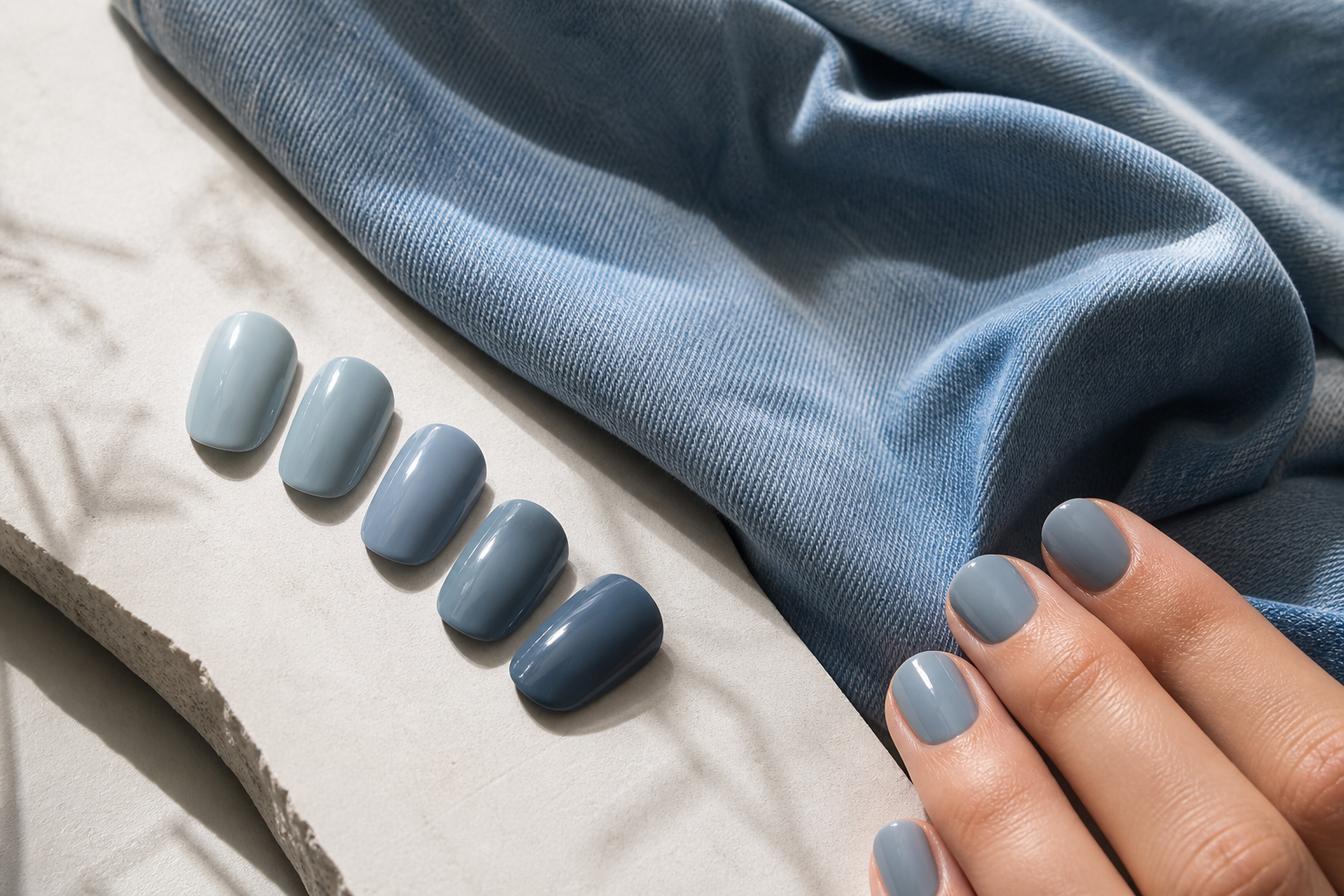
The most convincing blue manicure is not always the bluest one. Washed denim blue has the softened, lived-in character of a pair of jeans that has been through enough laundry cycles to lose its original intensity. On nails, that translates to blue interrupted by gray, white, haze, or a slightly muted undertone—not a single exact polish color.
It is a useful direction for anyone who likes the clarity of blue but finds cobalt too assertive, navy too severe, or baby blue too sugary. The right version can read as cool and minimal, a little nostalgic, or deliberately graphic depending on its depth, finish, and shape. The key is restraint: washed denim should look diluted or faded, never merely pale.
What makes a blue look “washed denim”?
Washed denim sits in the broad space between pastel blue, slate, and softened indigo. It has enough blue pigment to remain recognizably blue, but some saturation has been removed with gray, white, taupe, or a misty milky base. Think faded chambray, old blue workwear, a weathered painted door, or the lighter portions of a dark-rinse jean—not primary-school royal blue.
That distinction matters because blue is particularly sensitive to context. A clear, saturated blue can look sporty or graphic. A true baby blue can look confectionary. A washed blue gets its character from complexity: it may lean smoky, chalky, silvery, periwinkle, or softly greened depending on the formula and the light.
There is no need to search for a bottle literally named “denim.” Some denim-named polishes are deep indigo; some are bright medium blue. Evaluate the color itself. If it appears softened by a veil of gray or milk rather than diluted into a weak pastel, it is in the washed-denim family.
Choose the depth before choosing the design
Depth changes the mood more than people often expect. A light washed blue gives a manicure an airy, slightly powdery look. A middle denim feels closest to actual faded jeans and has more visual definition on short nails. A deep washed indigo has a moodier effect, especially when it carries charcoal or slate instead of black.
| Blue depth | Visual character | Undertone to try | Strong manicure formats | Watch for |
|---|---|---|---|---|
| Light washed blue | Cloudy, powdered, and close to a milky pastel without becoming sweet. | A touch of gray for softness; a hint of periwinkle for a cooler cast. | Sheer jelly layers, a faded French tip, or a compact solid manicure. | Too much white can turn the result chalky or correction-fluid opaque. |
| Mid washed denim | The most literal faded-jean read: clear enough to register as blue, muted enough to feel relaxed. | Slate, steel, or a muted blue-green note. | Full-color solids, reverse French details, and soft vertical ombré. | A bright cyan pull can move it away from denim and toward pool blue. |
| Deep washed indigo | Inky and quieter than navy, with a worn charcoal cast rather than a crisp dark edge. | Smoky gray, muted violet, or softened teal. | Short squovals, narrow French tips, and a matte-and-gloss contrast. | Too much black can make the shade read as standard navy instead of washed blue. |
Undertone experimentation is part of the appeal. A gray-blue tends to feel spare and architectural. A blue with a trace of violet can make silver jewelry feel especially intentional. A blue-green denim shade has more of a vintage workwear quality. None is inherently better on a particular person; the more practical question is whether you want the manicure to echo the coolness of your jewelry and wardrobe or create a little contrast against warmer colors.
Three ways to wear washed denim blue
Solid color
A solid manicure is the clearest way to show the shade’s nuance. It works best when the application is smooth and the color is opaque enough to look deliberate. On a short rounded square or squoval, a medium washed blue looks clean without asking for additional nail art. On a longer almond, a deep smoky denim feels more editorial than a standard navy while staying restrained.
Faded French tips
Instead of a sharp white edge, use a desaturated blue at the free edge. The French line can be narrow and crisp, or softened with a slight fade into a sheer neutral base. Keep the base close to the natural nail rather than using an opaque pink; the contrast should feel light. A deep washed-indigo tip is particularly effective when the line is fine, while a light dusty blue can handle a slightly broader tip.
Soft ombré
A washed-denim ombré should look foggy, not striped. Pair the blue with a sheer milky neutral, pale gray, or a related lighter blue rather than fading it into stark white. The smoothest version usually has the densest pigment concentrated at the tip or cuticle and a wide, diffused transition. This is one of the designs where a salon’s brushwork and controlled product application can make a meaningful difference.
Finish changes the entire read
Gloss is the most direct choice because it gives muted pigment dimension. A glossy top coat makes the gray or milky influence look suspended beneath the surface rather than dusty on top of it. If you are uncertain, glossy is the easier starting point for pale and mid-tone washed blues.
Matte can be striking, particularly on a deep slate-denim color, but it exposes texture and can exaggerate a powdery formula. Consider a selective matte finish instead: leave most nails glossy and make one accent nail matte, or add a glossy French edge over a matte blue base. The contrast makes the design intentional without requiring glitter or elaborate art.
Fine pearl or a low-key magnetic shift can also work, provided the underlying blue remains muted. A heavy chrome layer can erase the faded quality and turn the set mirror-like. For a metallic detail, a thin silver line, a tiny chrome dot, or a restrained pearl top coat is usually more in keeping with the denim idea than a full reflective finish.
How nail length and shape affect the color
Washed denim is unusually adaptable, but proportions matter. Short nails make even a medium blue feel contained. A short squoval, softly rounded square, or natural round shape is a strong match for solid color, especially if your goal is a practical manicure with one clear color decision. Keep French tips narrow on short nails so they do not visually crowd the nail plate.
Medium almond and oval nails give ombré more room to breathe. A light milky denim can become more translucent toward the cuticle, while a deeper blue can sit at the tip for a gradual gradient. On long almonds or coffins, choosing a deeper washed indigo prevents the color from disappearing at a distance. Long nails also suit a slender French line, a vertical fade, or a single silver detail better than a broad block of pale blue.
Square shapes make blue look more graphic. If that is the goal, select a medium slate-blue and keep the corners tidy. If you want the color to feel softer, an oval or squoval shape helps reinforce the faded effect.
What to say at the salon
Specific wording helps more than a broad request for “denim nails.” Try: “I’d like a desaturated medium blue with a gray or milky cast—more faded denim than cobalt, navy, or baby blue. Can we compare it against a light dusty blue and a smoky indigo before we start?”
For a solid manicure, ask to see the shade painted on a swatch or one nail if the salon offers that option. Bottle color can be misleading, and sheer formulas may look cooler, lighter, or less gray once layered. For an ombré, describe the placement: “I want the blue concentrated at the tip and diffused into a sheer milky base, with no hard line.” For a French manicure, ask for a narrow muted-blue tip on a sheer neutral base, then adjust the width based on your nail length.
If a shade seems a little too bright, request a dustier alternative rather than assuming a white top coat will solve it. Adding white can make blue look chalky; adding gray can make it lifeless. The most polished answer is often choosing a better-built muted blue from the available range, not improvising the color at the last minute.
At-home options—and where they get tricky
Regular polish is the simplest at-home route for a solid washed-denim manicure. Use a base coat, then apply the blue in thin, even coats rather than trying to cover the nail with one heavy pass. Muted blues, especially pale creams, can show brush marks if the polish floods the cuticle or if each stroke is worked repeatedly after it begins to set. A glossy top coat can help visually unify a slightly sheer finish.
A sheer blue jelly over a milky neutral is another approachable option, but it requires a light hand. Build the blue gradually and pause to inspect all nails in natural-looking light before adding another layer. The desired effect is haze, not a blue that collects at the sidewalls or near the cuticle. A makeup sponge may create a soft ombré with regular polish, though it can also leave a textured surface that needs careful smoothing with top coat.
Color mixing deserves caution. Mixing random regular-polish bottles can produce an unpredictable level of opacity, separation, or finish, even when the starting colors look promising. Mixing gel colors is a bigger question because products and curing systems are not automatically interchangeable. Rather than decanting and blending gels to chase a custom denim shade, choose a pre-made muted blue, layer only as directed by the maker, or test a compatible system on a swatch before committing to a full set.
If you are working with gel, detailed application matters more than the color label. Our guide to applying thin gel-polish coats explains why controlled layers help avoid ridges and pooling. If the surface stays wrinkled, shrinks away from the edge, or does not seem to set as expected, consult this overview of gel-polish curing problems before adding more product.
Keep uncured gel off the skin. If product touches the sidewalls or cuticle, clean the accidental contact before curing according to the maker’s directions. Use the matched product and lamp instructions for each cure, and stop if you experience irritation or painful heat. The same care applies when a chrome powder is being used over a gel layer: the decorative effect is not a reason to rush the underlying gel steps.
How to avoid patchiness, chalkiness, and a too-bright result
Patchiness is usually an application issue. Pale blue creams can apply unevenly if the coat is too thin in one area and too thick in another. Start with a well-prepped nail plate, use a base that suits the polish system, cap the free edge only if the product directions call for it, and apply consistent pressure from cuticle to tip. Resist the urge to keep brushing over a section once it has begun to level.
Chalkiness is a color-and-finish issue. An extremely white blue with a flat surface can resemble school paint rather than fabric fade. A translucent layer, a more gray-leaning blue, or a glossy top coat often brings back depth. If you prefer matte, choose a denim with enough underlying pigment and smoke so it does not depend on shine to look dimensional.
Too much saturation is the easiest mistake to spot. If the shade reads as electric, pool-blue, or marker-blue, it has left washed-denim territory. Do not try to fix every bright blue by layering white over it; that can create streaks and an opaque pastel effect. A muted gray-blue, blue-gray, or soft indigo is a better reset.
Lifting at the edges is not unique to blue, but dark or mid-tone pigment makes it easier to notice. Avoid applying color onto the cuticle or skin, and review our guide to why gel polish peels off if a gel manicure repeatedly separates from the nail plate. If you are shopping for gel and ingredient preferences are part of your decision, this HEMA-free gel-polish guide offers useful context for comparing options.
Styling notes for a muted blue manicure
Washed denim has an easy relationship with silver, pewter, white, charcoal, cream, black, and actual denim, but literal matching is not necessary. A deep indigo shirt with pale blue nails can feel more considered than matching the two exactly. Gold jewelry can work well too, especially with blue that has a slightly softened green or gray undertone. For nail art, stay small-scale: a silver microdot, a fine line near the cuticle, or one pearlized accent nail is usually enough.
The color also transitions across seasons more easily than a beachy turquoise or a bright pastel. Light cloudy blue suits warm-weather linen and crisp cotton; a deep smoky version works naturally with charcoal knits, dark denim, and leather once the weather shifts. Browse more color and design directions in our nail trends archive if you are deciding between washed blue and another muted manicure idea.
Washed denim blue nails: FAQ
Is washed denim blue the same as baby blue?
No. Baby blue is generally lighter, cleaner, and more pastel. Washed denim has a gray, milky, slate, or faded-indigo influence that reduces the sweetness and saturation.
Should washed denim nails be glossy or matte?
Gloss is the most dependable choice for highlighting depth in a muted blue. Matte is effective when you want a velvety, graphic finish, particularly with a deeper smoky denim, but it can emphasize texture on pale colors.
Can washed denim blue work on short nails?
Yes. A solid mid-tone denim on short squoval or round nails is one of the cleanest versions. Keep French tips fine and avoid overly large art motifs so the nail does not feel visually crowded.
What is the easiest version to do at home?
A glossy solid manicure in a pre-made gray-blue or dusty blue regular polish is the most straightforward. A softly layered jelly is also manageable, while an even ombré or sharply matched French set takes more control.
Washed denim blue succeeds when it retains a little ambiguity. It should not announce itself as navy, pastel, or cobalt from across the room. That softened middle ground is precisely what gives the manicure its point of view: blue, but with the edges worn in.