
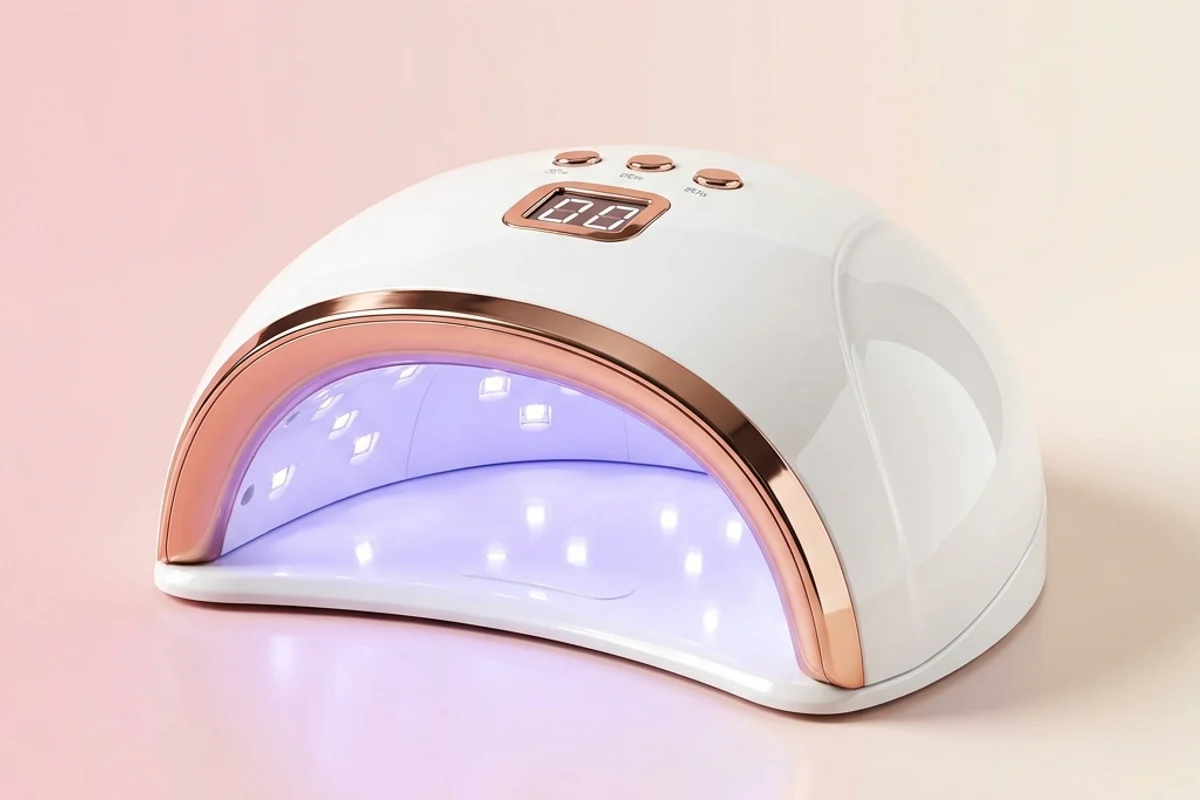
This is an identity-first buying guide, not a performance review. The supplied current catalog data contains no exact SUNUV SUN5 record. That means this article cannot verify a current SUN5 specification, included accessories, control layout, removable base, light configuration, compatibility claim, price, warranty, or seller support policy. The legacy page called the product a SUNUV SUN5 Dual-Source UV LED Lamp, but an older title, photo, review, or similar-looking lamp is not evidence of an exact current match.
Identity before features
Shared naming is common in nail lamps. A seller may use an abbreviated name, reuse an older product image, group related models under one listing, or ship a revised housing under familiar branding. Those situations can make a lamp look like the product described in an older review while leaving important details unresolved. A white shell, a SUNUV family resemblance, or the word SUN5 in a marketplace title does not establish that the controls, base, power supply, manual, or internal configuration match the legacy item.
The most useful evidence is a continuous identity chain: the seller's listing identifies the exact product; the product photos show a readable model label; the included manual uses the same model identifier; and the invoice or order record preserves the seller and item sold. If one link is missing, treat unconfirmed features as unconfirmed rather than filling the gap with older SUN5 information.
- Ask for the complete model code printed on the unit or retail box, not only the listing title.
- Ask whether the seller can identify the revision, package version, or manufacturing batch when more than one version is offered.
- Request photos of the underside label, control panel, opening, base area, power-input port, included adapter, and manual cover.
- Compare every identifier across the listing, seller response, packaging, manual, and delivered unit.
- Keep the listing screenshot and seller correspondence until the return window and any stated support period have passed.
A seller-specific SKU can help track an order, but it is not automatically the manufacturer's model number. Likewise, a product title may be edited after purchase. The label on the physical lamp and a matching model-specific manual are more useful than a generic title alone.
The evidence ladder for a claimed SUN5
Because there is no exact current record in the supplied catalog, the appropriate comparison is between types of evidence rather than between supposedly equivalent lamps. The table below shows what each source can and cannot establish.
| Evidence source | What it may establish | Limit | Best buyer action |
|---|---|---|---|
| Exact current manufacturer record | Model identifier, revision-specific photos, manual, included items, and stated support information | No exact current record was supplied for this article | Request a direct, model-matched document or listing before relying on a feature claim |
| Seller product page | The seller's offered configuration, price, fulfillment terms, and return process | A title or stock image may cover more than one version | Ask the seller to confirm the code on the actual inventory being shipped |
| Physical label and matching manual | The delivered unit's identity, electrical information, control descriptions, and intended setup | These are usually available only after delivery unless the seller provides clear photos | Compare them with saved pre-purchase documentation immediately on arrival |
| Legacy review or old image | Historical wording or an older product reference | It does not verify current construction, functions, or included accessories | Do not transfer specifications or results from it to a current offer |
| Nearby SUNUV model or similar lamp | Only a broad category comparison | Family resemblance is not an exact match | Exclude it from model-specific purchasing decisions |
Controls and base: verify the physical workflow
A lamp's controls and base affect how it fits a nail routine, but neither should be inferred from an older review. Before ordering, look for a current, readable photo of every button and display. The manual should explain what each control does, how it starts or stops a session, whether a hand sensor is present, whether settings can be changed during use, and what any mode labels mean. If a seller advertises a special setting, request the manual page that describes it rather than assuming it matches a prior revision.
Also confirm whether the lamp uses a display, indicator lights, touch controls, mechanical buttons, or some other interface. A photo taken at an angle can hide labels, while a reused image can show a control arrangement that is not on the shipped unit. Buyers who need a particular workflow should not treat a generic claim such as “easy controls” as enough information. The meaningful question is whether the exact controls shown and documented work for the intended use.
The base deserves the same scrutiny. Ask whether a floor plate or tray is included; whether it is fixed, removable, or detachable; how it is secured; and whether the manual gives cleaning or reassembly instructions. Do not assume a base is magnetic, removable, washable, included in the box, or suitable for a particular setup unless the exact listing or manual says so. A listing should also clarify whether the lamp is intended to be used with the base attached and whether any configuration limits are stated.
Power details belong in this verification step as well. Confirm the supplied adapter, plug type, input information, cable connection, and any regional requirements from the exact listing and manual. A product photo that happens to show a cord is not enough to establish what adapter will arrive. If the seller cannot answer basic questions about the inventory they are shipping, that is useful purchase information in itself.
Hand placement is a documentation question, not a guess from the shell
Hand placement should follow the exact lamp instructions and the gel system's instructions, not assumptions about the opening size or an interior photo. A roomy-looking opening does not prove that every nail is positioned as intended, and an image of a hand inside a lamp does not establish how thumbs, long nails, curved extensions, or toe placement should be handled. If the manual has a placement illustration, save it with the model information.
Before purchase, check whether the listing provides dimensions or a scaled diagram, a clear view of the opening, and instructions that address how hands should be placed. On arrival, compare the physical lamp with those images before opening gel products or discarding packaging. Keep nails positioned according to the named gel maker's lamp and cure instructions. Do not invent a placement pattern or cure sequence from an older SUN5 review.
Keep uncured gel off skin. Do not use skin as a test surface, and do not cure gel applied to skin. If curing is painful, remove the hand and stop. Painful burning means stop, not resume. Do not try to solve that response by immediately restarting, extending, or repeating a cycle. Consult the relevant product instructions before continuing with the product.
Gel-system compatibility requires two matching documents
A lamp listing and a gel product label answer different questions. The lamp listing may describe the lamp being sold; the gel maker's instructions identify how that gel system is intended to be used. Compatibility is not established simply because a seller uses broad words such as UV, LED, dual light, professional, universal, builder, or all gels. Wattage and diode count do not prove cure adequacy, and a claimed light configuration does not replace the gel maker's named lamp and cure instructions.
Start with the gel you plan to use. Check its package, technical directions, or manufacturer guidance for the named lamp and stated cure directions. If the gel maker names only its own lamp, treat another lamp as unconfirmed rather than assuming a seller's broad compatibility statement overrides that guidance. There is no universal cure time for gel products. Do not choose a timer setting from a legacy review, a social post, or another brand's instructions.
This matters across gel polish, builder gel, and magnetic cat-eye products. A lamp listing cannot promise a particular result for a builder product, including strength, self-leveling, or removal behavior. It also cannot promise color opacity, wear, soak-off speed, or a cat-eye magnetic effect. Those outcomes depend on the specific product system and its directions, not on a shared lamp name. Likewise, a current catalog listing would not, by itself, prove performance, safety, or compatibility.
If you are choosing gel by a HEMA-free claim, read the formula's own documentation carefully. HEMA-free does not mean allergy-safe, and a lamp choice does not change that boundary. Do not use home skin patch tests to decide whether a gel product is suitable. For removal, use the directions for the specific product system; there is no universal solvent or one removal method that can be assumed for every gel formula.
Seller support is part of the product record
For an unverified model listing, seller support should be evaluated before checkout rather than after a problem appears. A helpful seller should be able to identify the exact inventory, provide photos or a manual, explain what is included, and state the return and warranty process in writing. Ask whether support is handled by the seller, a distributor, or the manufacturer, and keep the answer with the order documentation.
Good questions are specific: What model code is printed on the unit? Which manual is included? Is the pictured base included with this revision? Which adapter is in the box? What is the procedure if the delivered label does not match the listing? A seller's response can clarify the transaction, but it is not a substitute for a gel manufacturer's instructions or proof that an unnamed lamp is compatible with a gel system.
Who a verified listing may fit, and who should skip it
It may fit buyers who
- can obtain a model-specific label, manual, and clear photos before buying;
- are prepared to follow the named lamp and cure instructions for their chosen gel system;
- need to compare controls, base design, opening shape, adapter, and package contents before deciding;
- value a seller with clear written returns, support contacts, and revision-specific answers.
Skip or pause the purchase if you
- need confirmed specifications now and the seller offers only an old image or generic title;
- are selecting a lamp solely because of wattage, diode claims, or a broad “works with all gels” statement;
- need a confirmed removable base, specific control type, or particular hand-placement guidance that is not documented;
- intend to use a gel whose maker names a different lamp and does not provide alternate compatibility guidance.
Current disclosure gaps
Because no exact current SUN5 catalog record was supplied, this article cannot confirm the current model code, revision, exterior design, controls, timer options, sensor behavior, base construction, interior dimensions, light configuration, electrical details, package contents, instructions, price, warranty, replacement policy, or compatibility claims. It also cannot identify a current authorized seller. Those are not minor omissions: each can affect whether the lamp offered for sale is actually the lamp a buyer expects.
Purchase checklist for an exact-match order
- Save the complete seller listing, including photos, stated package contents, return terms, and seller identity.
- Obtain the model code and ask whether the listing photos show the exact revision being shipped.
- Request a photo of the underside label, controls, base connection, power-input area, and manual cover.
- Confirm the included adapter and plug arrangement from documentation, not from a general product image.
- Read the gel maker's named lamp and cure instructions before buying a lamp for that system.
- On delivery, compare the unit label, manual, controls, base, and included accessories with the saved listing before use.
- Keep uncured product off skin and follow the product system's preparation, application, curing, and removal directions.
- Use the seller's return process if the delivered item does not match the documented offer.
FAQ
Is the legacy SUN5 review enough to identify a current listing?
No. It is historical material, not a current product record. It cannot verify that a seller's lamp has the same revision, controls, base, power supply, or manual.
What counts as an exact model match?
Look for a matching manufacturer model code on the listing, physical label, packaging, and manual. A shared product name, similar shell, old image, or nearby model is not enough.
Can wattage or diode claims tell me whether my gel will cure correctly?
No. Wattage and diode count do not prove cure adequacy. Follow the gel maker's named lamp and cure instructions; no universal cure time applies across gel systems.
Can a seller's “all gel” claim confirm builder or cat-eye compatibility?
No. Broad compatibility language does not prove that a specific builder, gel polish, or cat-eye product is appropriate for that lamp. Use the gel maker's own instructions as the controlling reference.
How should I handle a HEMA-free gel claim?
HEMA-free does not mean allergy-safe. Do not rely on a home skin patch test, and keep uncured gel off skin. Review the product's own documentation before use.
What if the delivered lamp differs from the listing photos?
Pause use, compare the label and included manual with your saved documentation, and use the seller's stated return or support process. Do not assume a similar replacement is the same model.
Verdict
There is not enough current, exact evidence to endorse or characterize a SUNUV SUN5 listing as the product described in the legacy review. The sensible decision is verification, not substitution: match the model code, revision, controls, base, manual, adapter, and seller support record before purchase. Then match the lamp decision to the gel maker's named lamp and cure instructions. Until those records align, treat every product-specific claim as unverified.